

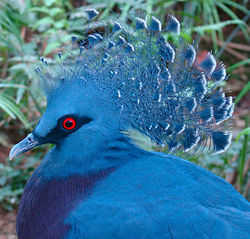
The Victoria crowned pigeon is a large, bluish-grey pigeon with elegant blue lace-like crests, maroon breast and red irises. It is part of a genus (Goura) of four unique, very large, ground-dwelling pigeons native to the New Guinea region, with the Victoria crowned pigeon measuring as the largest extant species of pigeon. The bird may be easily recognized by the unique white tips on its crests and by its deep 'whooping' sounds made while calling. Its name commemorates the British monarch, Queen Victoria.
Region
New Guinea and nearby islands
Typical Environment
Found in the northern lowlands of New Guinea, including adjacent islands, primarily in undisturbed and lightly disturbed lowland rainforest. It favors swamp and riverine forests, sago palm groves, and seasonally flooded areas where fruit is abundant. The species spends much of its time walking on the forest floor, retreating to low branches when disturbed. It also utilizes secondary forest and forest edges near villages where hunting pressure is low.
Altitude Range
Sea level to 600 m
Climate Zone
Tropical
Ease of Keeping
Beginner friendly: 3/5
This spectacular ground-dwelling pigeon is among the largest living pigeons and is instantly recognizable by its lacy, white-tipped blue crest and deep maroon breast. It lives on the forest floor but roosts and nests in trees, usually laying a single egg. Its deep, resonant whooping calls carry far through lowland rainforest. Though often calm and confiding, it is threatened by habitat loss and hunting in parts of its range.


Skeleton

Male pigeon displaying his wings


Temperament
calm and confiding
Flight Pattern
short, heavy wingbeats with limited sustained flight
Social Behavior
Usually seen in pairs or small family groups. Monogamous pairs build platform nests in low trees or palms and typically raise a single chick per clutch. Both parents share incubation and chick-rearing duties. They spend most of the day walking and foraging on the forest floor.
Migratory Pattern
Resident
Song Description
Deep, resonant whooping calls that carry through the forest, often given in series. Also produces low booms and loud wing claps when alarmed.
Plumage
Smooth bluish-grey plumage with a silky, lace-like crest tipped in white and a rich maroon breast; pale grey panel on the wings.
Diet
Primarily eats fallen fruits and seeds gleaned from the forest floor, including figs and other soft fruits. Supplements its diet with buds, small invertebrates, and occasionally nuts it can swallow whole. Foraging is deliberate and methodical, often in shaded leaf litter. It may follow fruiting trees and feed beneath them when fruit is abundant.
Preferred Environment
Forages on the forest floor in lowland and swamp forests, along riverbanks, and in sago stands. It also uses lightly disturbed edges and secondary growth where fruit crops are accessible.


