

Verreaux's eagle is a large, mostly African, bird of prey. It is also called the black eagle, especially in southern Africa, not to be confused with the black eagle of south and southeast Asia. The Verreaux's eagle lives in hilly and mountainous regions of southern and eastern Africa, and very locally in the Middle East.
Region
Eastern and Southern Africa and southwest Arabia
Typical Environment
Most common in hilly and mountainous regions with extensive cliffs, rocky slopes, and escarpments. It frequents arid and semi-arid landscapes, including Karoo and savanna mosaics where rock hyraxes are abundant. Nests are placed on cliff ledges or in caves, occasionally on large rocky outcrops. It avoids dense forests and open plains without relief but may range over adjacent valleys while foraging. In Arabia it occurs locally in rugged highlands and wadis.
Altitude Range
0–3500 m
Climate Zone
Highland
Ease of Keeping
Beginner friendly: 1/5
Also known as the black eagle, Verreaux's eagle is a powerful raptor specialized in hunting rock hyraxes. Pairs occupy rugged cliffs and escarpments and are highly territorial, often remaining on the same territories for years. It is easily recognized by a striking white 'V' on the back and rump against otherwise black plumage. Despite its size, it soars with effortless grace along mountainous ridges using thermals.


![Illustration from the species description by Lesson published in 1830[4]](https://upload.wikimedia.org/wikipedia/commons/thumb/9/93/VerreauxsEagle.jpg/1280px-VerreauxsEagle.jpg)
Illustration from the species description by Lesson published in 1830[4]

Portrait of Aquila verreauxii

Adult Verreaux's eagle in flight in South Africa.

Juvenile Verreaux's eagle

Subadult Verreaux's eagle flying

A captive Verreaux's eagle in South Africa.


Few accipitrids are as specialized as the Verreaux's eagle. One of their two favored prey species: Cape hyrax.
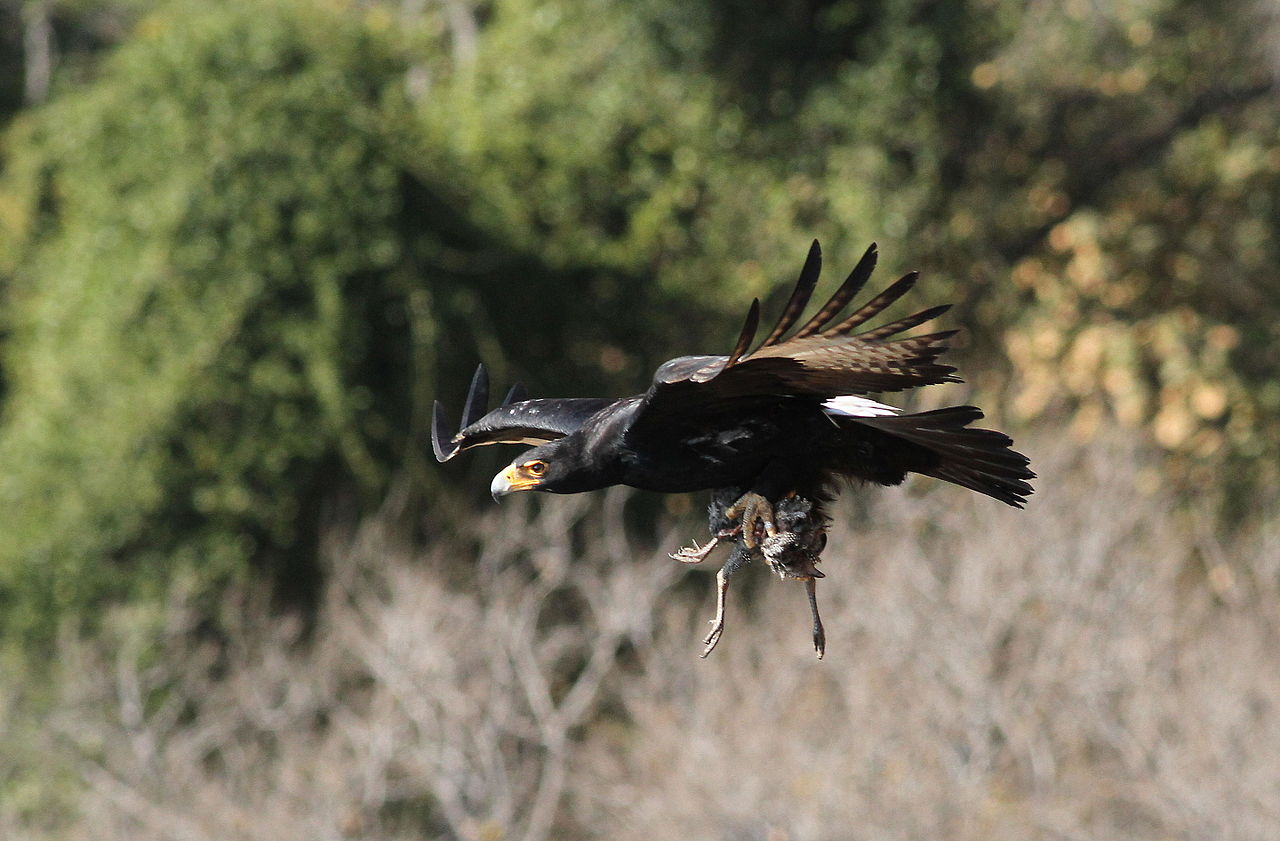
An adult Verreaux's eagle carrying avian prey.

A Verreaux's eagle finds itself attacked by a lanner falcon when it enters the latter's home range, but the falcon quickly veers off when the eagle presents its talons.

A breeding pair of Verreaux's eagles.

A Verreaux's eagle at Giant's Castle.
Temperament
solitary and territorial
Flight Pattern
soaring glider with slow, deep wingbeats and extended ridge-soaring
Social Behavior
Typically seen in pairs that maintain large, long-held territories centered on cliff nesting sites. Monogamous, with elaborate aerial displays over territory. Lays 1–2 eggs; siblicide is common so usually only one chick fledges. Nest is a large stick platform reused and refurbished over multiple seasons.
Migratory Pattern
Resident
Song Description
Generally silent, but gives high-pitched, whistled calls during displays and near the nest. Calls are piercing and carry across valleys, often heard during territorial interactions.
Plumage
Mostly glossy black with a conspicuous white lower back and uppertail coverts forming a 'V' on the mantle; flight feathers are black with some contrast on underwing coverts.
Diet
Highly specialized on rock hyraxes, which form the bulk of its prey. Also takes rabbits and hares, medium-sized birds, young ungulates on rare occasions, and reptiles. Hunts by soaring along slopes and ridgelines, then stooping or quartering to seize prey on rocky ground. Will hunt cooperatively as a pair, with one bird flushing while the other strikes.
Preferred Environment
Favors rugged rocky landscapes with cliffs and boulder-strewn slopes where hyrax colonies are present. Often forages along escarpments, kopjes, and mountainous foothills, occasionally over adjacent open savanna.


