

The varied thrush is a member of the thrush family, Turdidae. It is the only species in the monotypic genus Ixoreus.
Region
Pacific Coast and western North America
Typical Environment
Breeds from coastal and inland Alaska through British Columbia and south along the Cascades and Sierra Nevada into the northwestern United States. Prefers mature and mixed coniferous forests with dense understory, including hemlock, spruce, fir, and redwood habitats. In winter it descends to lower elevations and moves south into coastal and foothill regions, reaching as far as California and occasionally farther inland. Vagrants sometimes appear well east of the Rockies, especially in winter.
Altitude Range
Sea level to 2500 m
Climate Zone
Temperate
Ease of Keeping
Beginner friendly: 1/5
The varied thrush is the only species in the monotypic genus Ixoreus and is closely related to other thrushes in the family Turdidae. Its haunting, single-pitched whistles carry far through misty conifer forests. In winter it often visits gardens and feeders in the Pacific states, especially during cold snaps.


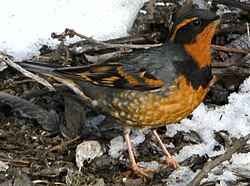
Female

Temperament
shy and secretive
Flight Pattern
short rapid wingbeats with direct, low forest flights
Social Behavior
Generally solitary or in loose associations, becoming territorial during the breeding season. The female builds a cup nest on a horizontal branch or in dense shrubs, and typically incubates while the male helps feed fledglings. They forage quietly on the ground or low branches, often flicking leaves aside with their bill.
Migratory Pattern
Partial migrant
Song Description
A series of pure, ethereal, single-pitched whistles, each note held for a few seconds and separated by pauses; different notes may be delivered at varying pitches. Calls include dry, metallic chips and harsher notes when alarmed.
Plumage
Striking, with bold contrast; males show a dark slate-blue upper body with a vivid orange supercilium and underparts separated by a black breast band. Females are browner and more muted with a thinner, duller breast band. Both sexes show orange wing bars and bright orange underwings.
Diet
Insects and other arthropods dominate in the breeding season, including beetles, ants, caterpillars, and spiders. In fall and winter it shifts to berries and fruits such as elderberry, huckleberry, and madrone, and will also take seeds. It occasionally visits feeders for suet and fallen seed, especially during harsh weather.
Preferred Environment
Feeds on the forest floor and in dense understory, probing leaf litter and mossy ground. In winter it forages in berry-laden shrubs, forest edges, and suburban gardens with mature trees and cover.


