

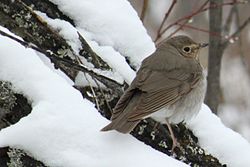
Swainson's thrush, also called olive-backed thrush, russet-backed thrush, and salmonberry bird is a medium-sized thrush. It is a member of genus Catharus and is typical of it in terms of its subdued coloration and beautiful, ascending flute-like voice. Swainson's thrush was named after William Swainson, an English ornithologist.
Region
North America (breeding) and northern South America (wintering)
Typical Environment
Breeds across boreal and montane forests from Alaska and Canada south through the northern United States and along the Pacific Coast. Prefers dense, moist coniferous or mixed woodlands with a well-developed shrub layer and riparian thickets. During migration it uses forest edges, parks, and hedgerows, and winters in humid and gallery forests of Central America and the Andes' foothills. Often keeps to shaded understory and midstory strata.
Altitude Range
Sea level to 3000 m
Climate Zone
Temperate
Ease of Keeping
Beginner friendly: 1/5
Also called the olive-backed or russet-backed thrush, it is famed for its ethereal, ascending flute-like song. It is a primarily nocturnal migrant and often detected at night by its soft, rising "whit" call notes. Two main plumage groups (olive-backed inland and russet-backed coastal) are recognized across its range. Named after the English ornithologist William Swainson.


Temperament
shy and secretive
Flight Pattern
short rapid wingbeats; strong long-distance flier during migration
Social Behavior
Typically solitary or in pairs during the breeding season. Builds a cup nest in shrubs or low trees; the female incubates while the male helps feed nestlings. Outside breeding, it may join mixed-species foraging flocks in wintering areas.
Migratory Pattern
Seasonal migrant
Song Description
Song is an ethereal, upward-spiraling series of fluted phrases that seem to rise and fade into the canopy. Calls include a soft, rising "whit" frequently heard during nocturnal migration. Phrases are clear and mellow, carrying well in dense forests.
Plumage
Olive-brown to russet-brown upperparts with a buffy face and clean white underparts marked by dusky, triangular breast spots. Feathers are smooth and sleek, giving a soft, matte appearance.
Diet
Eats a variety of insects and other arthropods including beetles, caterpillars, ants, and spiders. In breeding season it focuses on invertebrates gleaned from foliage and the forest floor. During migration and winter it adds significant fruit and berries such as elderberry and other small drupes.
Preferred Environment
Forages in dense understory, along streamside thickets, and in shaded edges within forests. Will also use second-growth and disturbed habitats with ample shrub cover during migration.


