

The swallow-tailed gull is an equatorial seabird in the gull family, Laridae. It is the only species in the genus Creagrus, which derives from the Latin Creagra and the Greek kreourgos which means butcher, also from kreas, meat; according to Jobling it would mean "hook for meat" referring to the hooked bill of this species. It was first described by French naturalist and surgeon Adolphe-Simon Neboux in 1846. Its scientific name is originally derived from the Greek word for gull, "Glaros" and via Latin Larus, "gull" and furca "two-tined fork". It spends most of its life flying and hunting over the open ocean. The main breeding location is in the Galápagos Islands, particularly the rocky shores and cliffs of Hood, Tower and Wolf Islands, with lower numbers on most of the other islands. It is more common on the eastern islands where the water is warmer.
Region
Eastern Pacific Ocean
Typical Environment
Breeds on the Galápagos Islands and ranges widely over the adjacent eastern tropical Pacific. It spends most of its life offshore, often far from land, patrolling pelagic waters. Non-breeding birds may follow productive upwelling zones off Ecuador and Peru. Nesting occurs on rocky shores and cliff ledges, where adults have easy access to open ocean foraging grounds.
Altitude Range
Sea level to 100 m
Climate Zone
Tropical
Ease of Keeping
Beginner friendly: 1/5
The swallow-tailed gull is the only fully nocturnal gull, hunting squid and small fish that rise to the surface at night. It breeds almost exclusively on the rocky cliffs of the Galapagos, nesting on ledges close to the sea. Adults have a striking red eye ring and a deeply forked tail that gives the species its name. Pairs are strongly territorial at nest sites and often raise a single chick.


Dorsal view
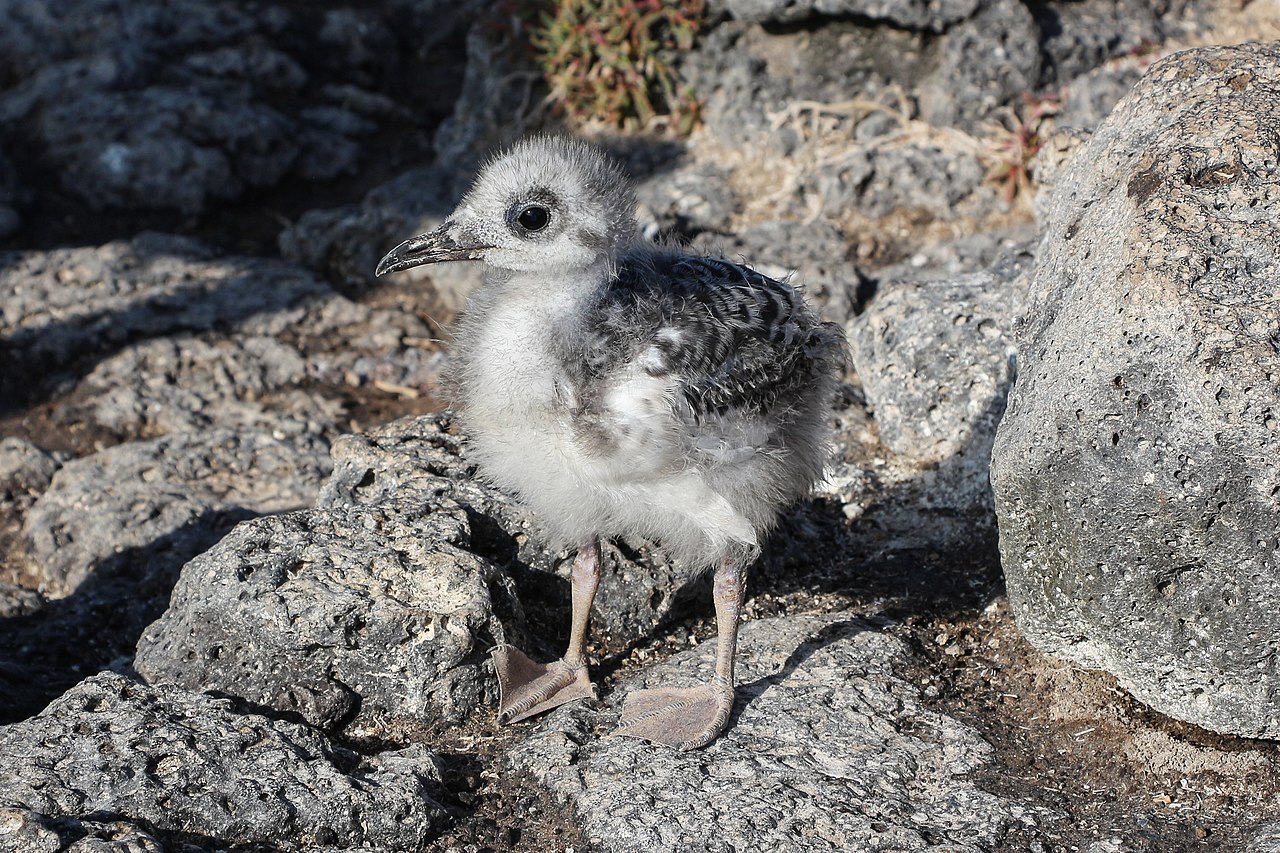
Juvenile swallow-tailed gull in Galápagos Islands

Close-up of head and neck of an adult on the Galapagos Islands. Its plumage and the red ring around its eye shows that it is in breeding condition.
Temperament
social and colonial
Flight Pattern
strong flier with buoyant, agile flight over open water
Social Behavior
Nests in dense colonies on cliff ledges, typically laying a single egg. Pairs are monogamous during a breeding cycle and both parents incubate and feed the chick. Breeding can occur at different times of the year across islands, likely tracking prey availability.
Migratory Pattern
Resident
Song Description
Vocalizations include harsh squawks, clucks, and chattering calls, especially at colonies. At sea, it uses softer contact calls during nocturnal foraging. Alarm calls are sharp and repeated when predators approach the nest.
Plumage
Breeding adults show a clean white body with pale grey mantle and a sooty-black hood; nonbreeding birds have a mottled grey and white head. Upperwings are grey with darker tips and narrow white crescents. The tail is white and deeply forked.
Diet
Primarily feeds on squid and small pelagic fishes that come near the surface at night due to diel vertical migration. It captures prey on the wing, skimming and dipping rather than scavenging. Scavenging is uncommon compared with many other gulls. Feeding success is often linked to lunar cycles and upwelling productivity.
Preferred Environment
Forages over open pelagic waters near upwelling zones and current fronts. Near colonies it works the coastal shelf and drop-offs, but quickly ranges offshore when conditions are favorable.


