
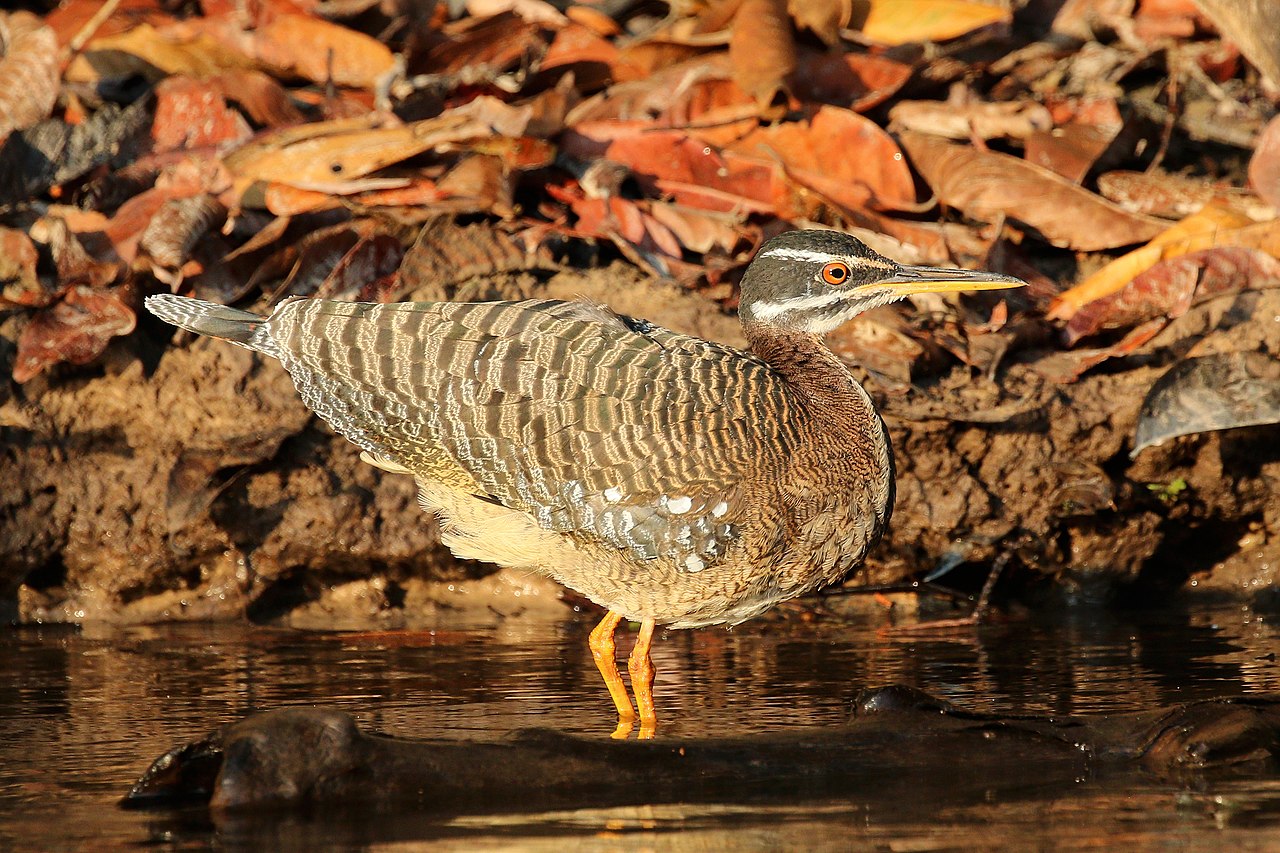
The sunbittern is a bittern-like bird of tropical regions of the Americas, and the sole member of the family Eurypygidae and genus Eurypyga. It is found in Central and South America, and has three subspecies. The sunbittern shows both morphological and molecular similarities with the kagu of New Caledonia, indicating a Gondwanan origin, both species being placed in the clade Eurypygiformes.
Region
Central and South America (Neotropics)
Typical Environment
Found from southern Mexico and Central America through the Andes foothills and Amazon Basin to Bolivia, Brazil, and the Guianas. It favors lowland and foothill tropical forests near clear streams, rivers, oxbow lakes, and wetlands with ample overhanging vegetation. Often seen along shaded creek banks, sandbars, and forested river margins. Tolerates secondary forest and gallery forest as long as shallow, slow-moving water is present.
Altitude Range
Sea level to 1500 m
Climate Zone
Tropical
Ease of Keeping
Beginner friendly: 1/5
The sunbittern unfurls spectacular wing fans with bold eye-like patterns to startle predators and in courtship displays. It is the sole member of its family and is closely related to the kagu of New Caledonia. A master of camouflage, it blends into dappled streamside habitats. Pairs often maintain territories along shaded forest creeks and nest above water.


Head
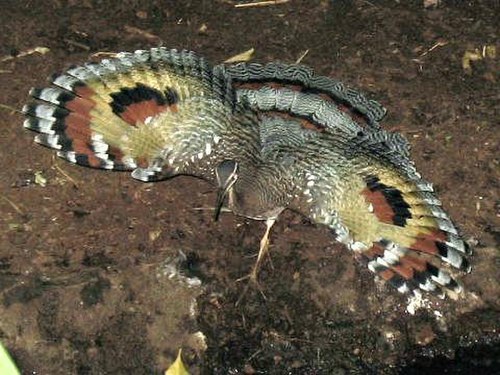
The sunbittern will open its wings to display two large eye spots when threatened

A sunbittern on display in the Natural History Museum, London.

Breeding
Temperament
solitary and territorial
Flight Pattern
short rapid wingbeats with brief glides; reluctant flier
Social Behavior
Usually encountered alone or in pairs that defend linear territories along waterways. Pairs are monogamous and build platform nests above water, where they lay two eggs. Both parents incubate and care for the young, which are well camouflaged and precocial.
Migratory Pattern
Resident
Song Description
Vocalizations are clear, whistled notes and piping calls that carry along rivers, often given at dawn. Also produces soft clucks and whistles during pair interactions and display.
Plumage
Finely vermiculated brown, grey, and black plumage with cryptic, bark-like patterning; when wings are spread they reveal large, vividly patterned fans.
Diet
Primarily takes aquatic and terrestrial invertebrates such as insects, spiders, and crustaceans. Also captures small fish, tadpoles, and occasionally small amphibians or reptiles. Forages by slow stalking, peering, and quick darting strikes at the water’s edge. May flick wings or shadow the water surface to flush prey.
Preferred Environment
Shallow, clear streams, riverbanks, and muddy or sandy margins within forest. Often hunts from exposed stones, logs, and sandbars under dappled light.


