

The striated yuhina is a bird species in the white-eye family Zosteropidae.
Region
Eastern Himalayas and Indochina
Typical Environment
Occurs from the eastern Himalayas (northeast India, Bhutan) through northern Myanmar and southern China (notably Yunnan and Guangxi) to northern Thailand, Laos, and Vietnam. It favors montane broadleaf and mixed evergreen forests, as well as forest edges and secondary woodlands. Birds frequently range along ridgelines and in gullies rich in flowering shrubs and fruiting trees. It is a regular participant in mixed feeding flocks with other small passerines.
Altitude Range
800–3000 m
Climate Zone
Subtropical
Ease of Keeping
Beginner friendly: 2/5
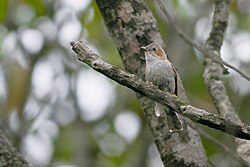
The striated yuhina is a small, crested songbird in the white-eye family (Zosteropidae) that often joins mixed-species flocks. It is active and gregarious, foraging from the midstory to canopy. The species shows fine streaking on the throat that gives it its common name, along with a distinctive chestnut crown. It adapts well to forest edges and secondary growth, which helps keep it common across much of its range.


Temperament
social and active
Flight Pattern
short rapid wingbeats with brief glides
Social Behavior
Commonly travels in small groups and frequently joins mixed-species flocks in the canopy. Pairs nest in dense vegetation, constructing cup-shaped nests well hidden in shrubs or small trees. Both parents likely assist with feeding the young.
Migratory Pattern
Partial migrant
Song Description
Song is a series of thin, high-pitched whistles and trills delivered in quick phrases. Calls include sharp chips and soft chatter used to keep contact within flocks.
Plumage
Compact, crested yuhina with finely streaked throat and upper breast, olive-brown upperparts, and buffy underparts. Crown is rich chestnut, contrasting with paler face and throat. Feathers are smooth with subtle gloss on the crown; wings and tail are dusky with pale edging.
Diet
Takes small insects, spiders, and other arthropods gleaned from leaves and twigs. Also consumes berries and small fruits when available, and may sip nectar from flowering shrubs and trees. Diet shifts seasonally with resource availability.
Preferred Environment
Forages in the midstory to upper canopy of montane forests, along edges, and in secondary growth. Often feeds while moving with mixed flocks, making rapid, acrobatic sallies among foliage.


