The striated caracara, also known as Forster's caracara, is a Near Threatened bird of prey of the family Falconidae, the falcons and caracaras. It is found in Tierra del Fuego and the Falkland Islands. In the Falklands it is known as the Johnny rook, probably named after the Johnny penguin.
Region
Southern South America
Typical Environment
Occurs on the Falkland Islands and in the far south of Chile and Argentina, including Tierra del Fuego and islands around Cape Horn. It favors coastal and subantarctic island environments with abundant seabird colonies. Typical habitats include tussock grasslands, rocky shores, kelp-lined beaches, and coastal heath. It also frequents human settlements, sheep farms, and refuse sites where food is available.
Altitude Range
Sea level to 1000 m
Climate Zone
Temperate
Ease of Keeping
Beginner friendly: 1/5
Also called the Johnny rook in the Falklands, the striated caracara is famed for its bold, inquisitive nature and remarkable problem-solving skills. It often investigates human camps and boats and will cache food. Historically persecuted, it now benefits from protections in much of its range. It is one of the southernmost birds of prey on Earth.


Watercolour made by Georg Forster in 1775 on James Cook's second voyage to the Pacific Ocean.




Temperament
bold, curious, and opportunistic
Flight Pattern
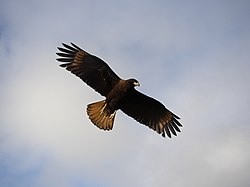
buoyant flier with strong glides and short rapid wingbeats; often low over shores
Social Behavior
Often gathers in small groups at food sources and around seabird colonies. Pairs are typically monogamous and defend nest sites on cliffs, rocky ledges, or dense tussock. Nests are bulky platforms; clutches usually contain 2–3 eggs. Juveniles linger around rich foraging sites and may form loose flocks.
Migratory Pattern
Resident
Song Description
Vocalizations include harsh, carrion-crow-like calls, raspy cackles, and chatter. Near nests or feeding sites it gives loud, repeated screams and rattling notes. Calls carry well over coastal winds.
Plumage
Sooty-brown to blackish overall with fine pale buff streaking (striations) on the head, neck, and breast; flight feathers darker with a contrasting whitish rump seen in flight.
Diet
Highly opportunistic, taking carrion, seabird eggs and chicks, invertebrates, and small vertebrates. It scavenges from beached marine mammals and fish and steals food from other birds. Around farms it consumes afterbirth and carcass remains, and it will probe kelp wrack for invertebrates. Occasional plant matter may be taken, but animal prey dominates.
Preferred Environment
Forages along rocky and sandy shores, kelp lines, and around seabird and penguin colonies. Frequently searches refuse sites and human activity areas where discarded food is accessible. Uses elevated perches or patrols on foot to locate food.