

Stephanie's astrapia, also known as Princess Stephanie's astrapia, is a species of bird-of-paradise of the family Paradisaeidae, native to the Bird's Tail Peninsula. This species was first described by Carl Hunstein in 1884.
Region
Southeast New Guinea (Papuan Peninsula)
Typical Environment
Occupies mid- to upper-montane forests, including mossy cloud forest, forest edges, and mature secondary growth. It favors ridgelines and fruiting trees within closed-canopy habitats but also visits clearings and edges when figs and other fruits are abundant. The species is typically localized to mountain ranges of the Papuan Peninsula. It is largely arboreal, spending most time in the subcanopy and canopy.
Altitude Range
1,500–3,000 m
Climate Zone
Highland
Ease of Keeping
Beginner friendly: 1/5
Stephanie's astrapia, or Princess Stephanie's astrapia, is a bird-of-paradise native to the Bird's Tail (Papuan) Peninsula of southeastern New Guinea. Males perform elaborate courtship displays, showing off shimmering iridescent plumage and a long graduated tail. Females alone build the nest and rear the young. The species was first described by Carl Hunstein in 1884 and is named after Crown Princess Stéphanie of Austria-Hungary.


Male Stephanie's astrapia specimen at the Naturalis Biodiversity Center
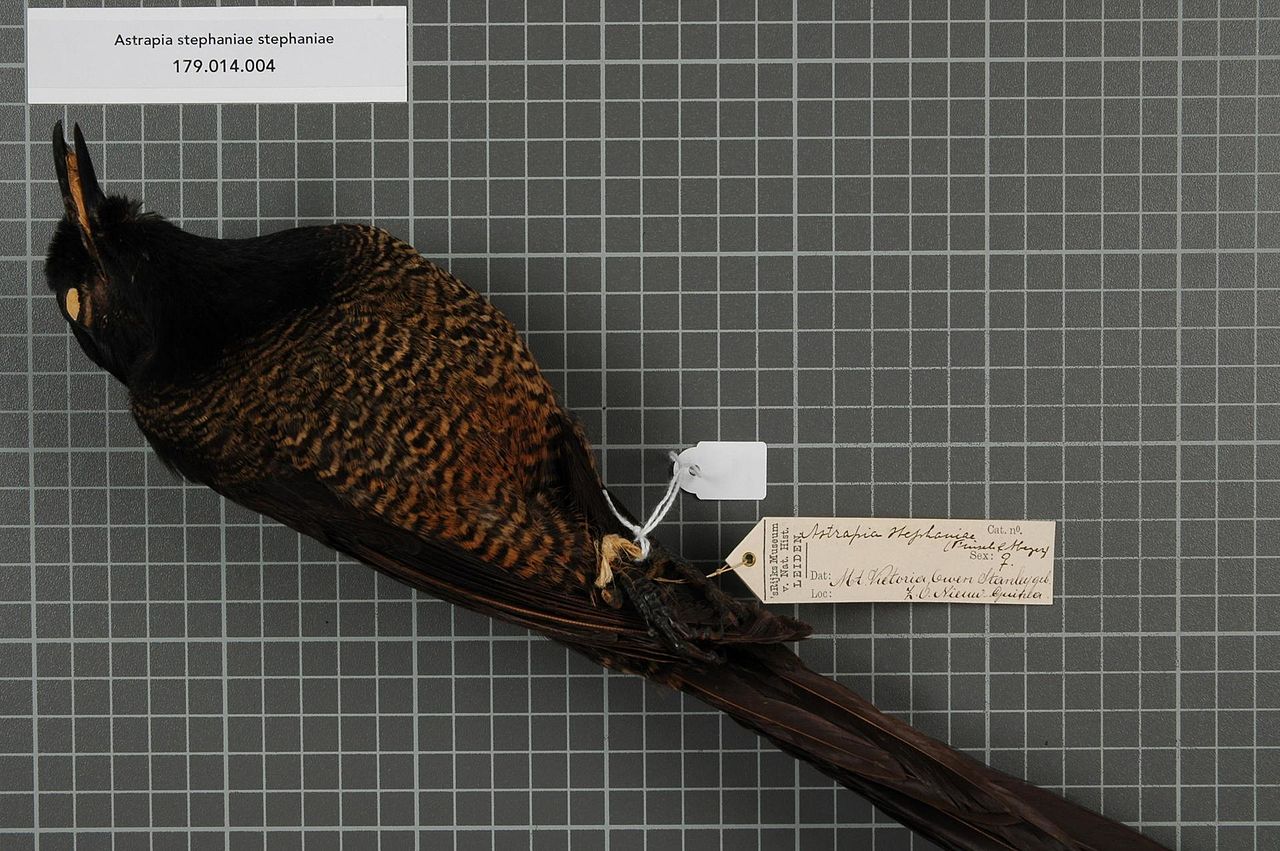
Female Stephanie's astrapia specimen

Male (left) and female
Temperament
solitary and secretive
Flight Pattern
short rapid wingbeats between perches
Social Behavior
Males display at traditional sites, often in loose leks or individually, where they perform postures and reveal iridescent plumage to attract females. Pair bonds are brief; the species is polygynous. Females build a cup nest and incubate alone, raising the chick without male assistance.
Migratory Pattern
Resident
Song Description
Vocalizations include sharp, metallic notes and rasping calls given from elevated perches. Display sequences may be accompanied by clicks and harsh, buzzy phrases. Calls carry through montane forest but are given intermittently.
Plumage
Male is velvety black with strong iridescent green to teal sheen on the breast and head, and a bronzy to coppery gloss on the nape and mantle; tail long and graduated. Female is brown with buff and darker barring, especially on underparts, with a shorter tail and less gloss. Both sexes have sleek contour feathers typical of birds-of-paradise.
Diet
Primarily frugivorous, taking a variety of soft fruits and drupes, especially figs and laurels. Supplements diet with arthropods gleaned from foliage and epiphytes, particularly when fruit is scarce. Forages methodically among branches and occasionally sally-gleans for insects.
Preferred Environment
Feeds mainly in the subcanopy and canopy at fruiting trees along ridges, forest edges, and mature secondary forest. Will descend to mid-story to exploit epiphyte-laden branches and mossy trunks.


