
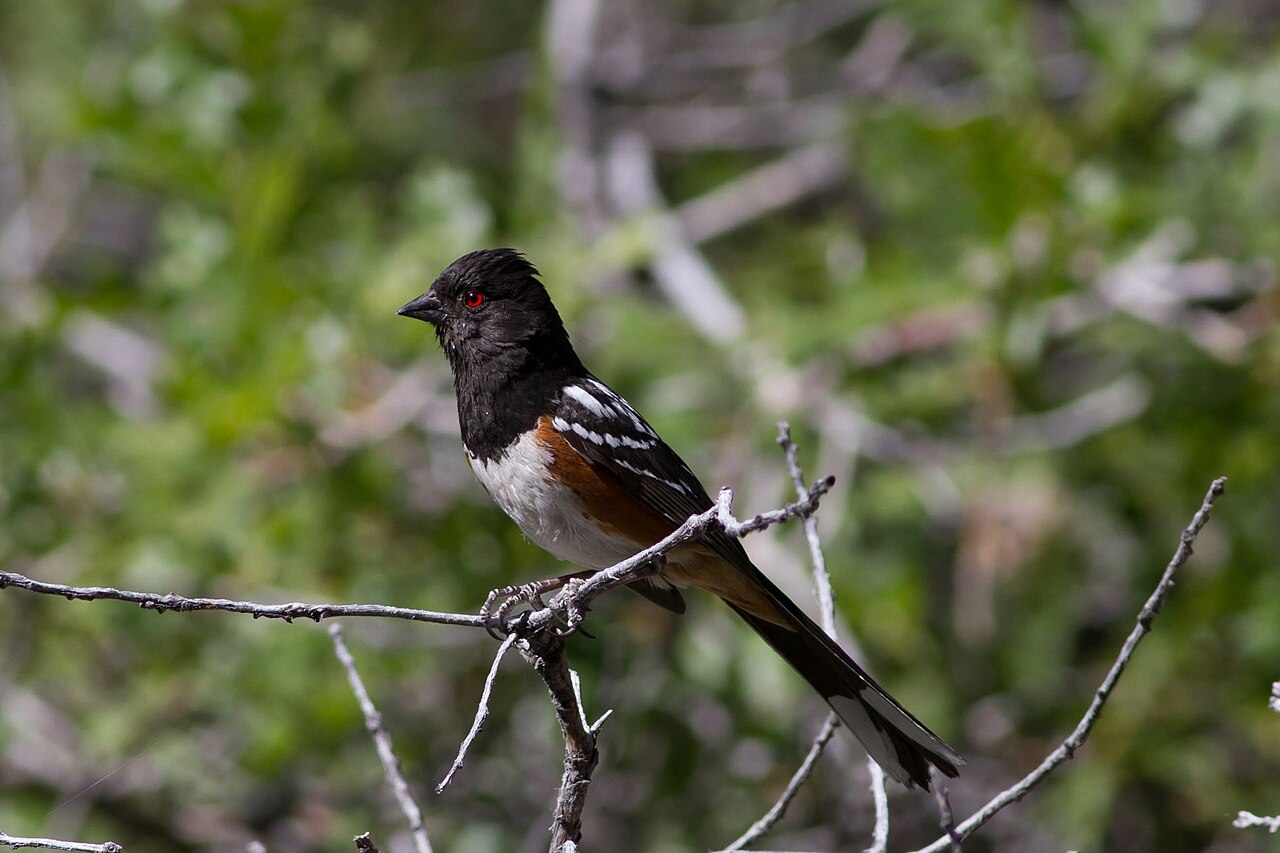
The spotted towhee is a large New World sparrow. The taxonomy of the towhees has been debated in recent decades, and until 1995 this bird and the eastern towhee were considered a single species, then named rufous-sided towhee. Another outdated name for the spotted towhee is the Oregon towhee. The call may be harsher and more varied than for the eastern towhee.
Region
Western North America
Typical Environment
Found from southern Canada through the western United States into Mexico, favoring brushy habitats. It thrives in chaparral, forest edges, overgrown fields, riparian thickets, and suburban hedgerows. Dense undergrowth is essential for nesting and foraging. Northern populations migrate southward in winter, while many in the Southwest and along the Pacific Coast are resident.
Altitude Range
Sea level to 3000 m
Climate Zone
Temperate
Ease of Keeping
Beginner friendly: 1/5
The spotted towhee is a large New World sparrow of western North America, once lumped with the eastern towhee as the rufous-sided towhee until 1995. It is famous for its two-footed scratching in leaf litter to uncover food. Males deliver a bright, trilled song from exposed perches, while nests are typically on or near the ground in dense cover.


Female in Sacramento, California.

Spotted towhee at Vasona Park


Spotted towhees forage on the ground or in low vegetation.

Temperament
solitary and territorial
Flight Pattern
short rapid wingbeats
Social Behavior
Typically forages alone or in pairs, scratching vigorously in leaf litter with a double-footed hop. Nests are cup-shaped and placed on or near the ground under dense cover; clutches usually contain 3–5 eggs. Males sing from exposed perches during the breeding season, while both sexes remain secretive within thick brush.
Migratory Pattern
Partial migrant
Song Description
Song is a bright introductory note followed by a long, buzzy trill, often rendered as a dry, rapid series. Calls include sharp, harsh mews and chewink-like notes, harsher and more varied than those of the eastern towhee.
Plumage
Boldly patterned with a dark hood and back heavily spotted with white, rufous flanks, and a clean white belly.
Diet
Eats insects such as beetles, caterpillars, ants, and grasshoppers, along with spiders and other invertebrates. Supplements with seeds, acorns, and a variety of berries, especially in fall and winter. Uses vigorous two-footed scratching to uncover hidden prey and fallen seeds in leaf litter.
Preferred Environment
Feeds on the ground under dense shrubs, in chaparral, hedgerows, and woodland edges. Also forages along riparian thickets and suburban brush piles where cover is close at hand.


