

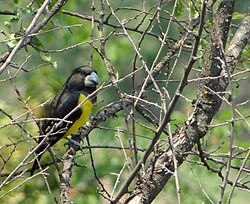
The spot-winged grosbeak is a species of finch in the family Fringillidae, found in middle to higher elevations. It is found in the Indian subcontinent and parts of Southeast Asia. Its range includes Bhutan, India, Laos, Myanmar, Nepal, Pakistan, Thailand, Tibet and Vietnam. Its natural habitats are subtropical or tropical dry forests and subtropical or tropical moist montane forests.
Region
Himalayas and Indochinese uplands
Typical Environment
Occurs from Pakistan and northern India through Nepal and Bhutan to Tibet and northern Myanmar, Thailand, Laos, and Vietnam. It favors subtropical and montane broadleaf and mixed conifer forests, often with oaks, pines, and rhododendrons. Outside breeding, it descends into forest edges, secondary growth, and wooded valleys. It is most often encountered in the canopy or along forested ridgelines and clearings.
Altitude Range
1000–3600 m
Climate Zone
Highland
Ease of Keeping
Beginner friendly: 2/5
This finch has a powerful, conical bill that lets it crack hard seeds and pits. Males are strikingly black and yellow with bold white wing spots, while females are duller and more olive-brown. It makes seasonal upslope–downslope movements following fruiting and seeding cycles. By eating berries and seeds, it helps disperse plants in mountain forests.



Temperament
wary but often confiding in small flocks
Flight Pattern
strong, direct flight with rapid wingbeats
Social Behavior
Often forages in small groups or mixed-species flocks outside the breeding season. Pairs form in spring, with cup nests placed high in trees. Both parents attend the young, and family parties may persist for weeks after fledging.
Migratory Pattern
Partial migrant
Song Description
Song is a mellow series of clear, whistled phrases with brief pauses, reminiscent of other mountain finches. Calls include sharp metallic chink and tink notes given in flight or while foraging.
Plumage
Male with glossy black head and upperparts contrasted by rich yellow underparts; wings mostly black with bold white spotting on coverts and tertials. Female is olive-brown to buff with subtle streaking and paler wing spots; overall duller than male. Both sexes show a thick-based conical bill and contrasting wing pattern.
Diet
Feeds on hard seeds, acorns, pine nuts, and various berries, supplemented with buds and shoots. During the breeding season it takes insects and other invertebrates for added protein. It will exploit seasonal mast crops and may visit orchards or fruiting shrubs. The robust bill allows it to crack thick husks efficiently.
Preferred Environment
Primarily gleans in the canopy and mid-story of montane forests and along forest edges. Also forages in clearings, along ridges with scattered trees, and occasionally on the ground beneath fruiting trees.


