

The spike-heeled lark is a species of lark in the family Alaudidae. It is found in southern Africa.
Region
Southern Africa
Typical Environment
Occurs widely across arid and semi-arid zones of southern Africa, including much of South Africa, Namibia, and Botswana, extending into the Karoo and Kalahari regions. Prefers open dwarf-shrublands, sandy plains, gravel flats, and short-grass areas with patches of bare ground. Frequently uses road verges, fallow fields, and overgrazed rangeland where cover is sparse. Avoids dense woodland and tall, continuous grass.
Altitude Range
0–2000 m
Climate Zone
Arid
Ease of Keeping
Beginner friendly: 1/5
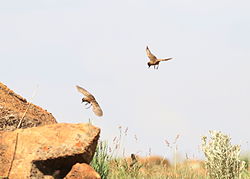
Named for its very long hind claw that looks like a tiny 'spike heel', this lark spends most of its time running rather than flying. It performs buoyant display flights while delivering a bright, tinkling song. Nests are simple cups on the ground, making them vulnerable to trampling and predation. It adapts well to open semi-arid rangelands and sparsely vegetated farmlands.



Temperament
terrestrial and wary
Flight Pattern
low, undulating flight with short rapid wingbeats
Social Behavior
Usually seen singly or in pairs, forming small loose groups outside the breeding season. Territorial during breeding, with males performing aerial song displays over territories. Nests are shallow ground cups tucked under small shrubs or grass clumps, with clutches typically of 2–3 eggs.
Migratory Pattern
Resident
Song Description
A bright, tinkling series of notes and trills, often delivered during a short display flight. Calls include sharp chips and soft contact notes while foraging on the ground.
Plumage
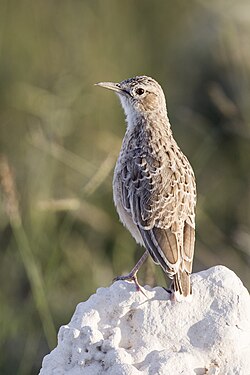
Sandy-brown to gray-brown upperparts with fine streaking and a paler, lightly streaked breast; underparts buff to whitish. Feathers are close-textured and well-camouflaged for arid substrates.
Diet
Eats grass and forb seeds complemented by small invertebrates such as ants, termites, beetles, and caterpillars. Insects form a larger share of the diet during the breeding season to feed chicks. Forages by walking briskly and picking items from the ground or low vegetation.
Preferred Environment
Feeds in open, sparsely vegetated habitats with ample bare ground, including dwarf shrublands, short-grass plains, and lightly disturbed farmlands. Often works along tracks, road verges, and around low shrubs.


