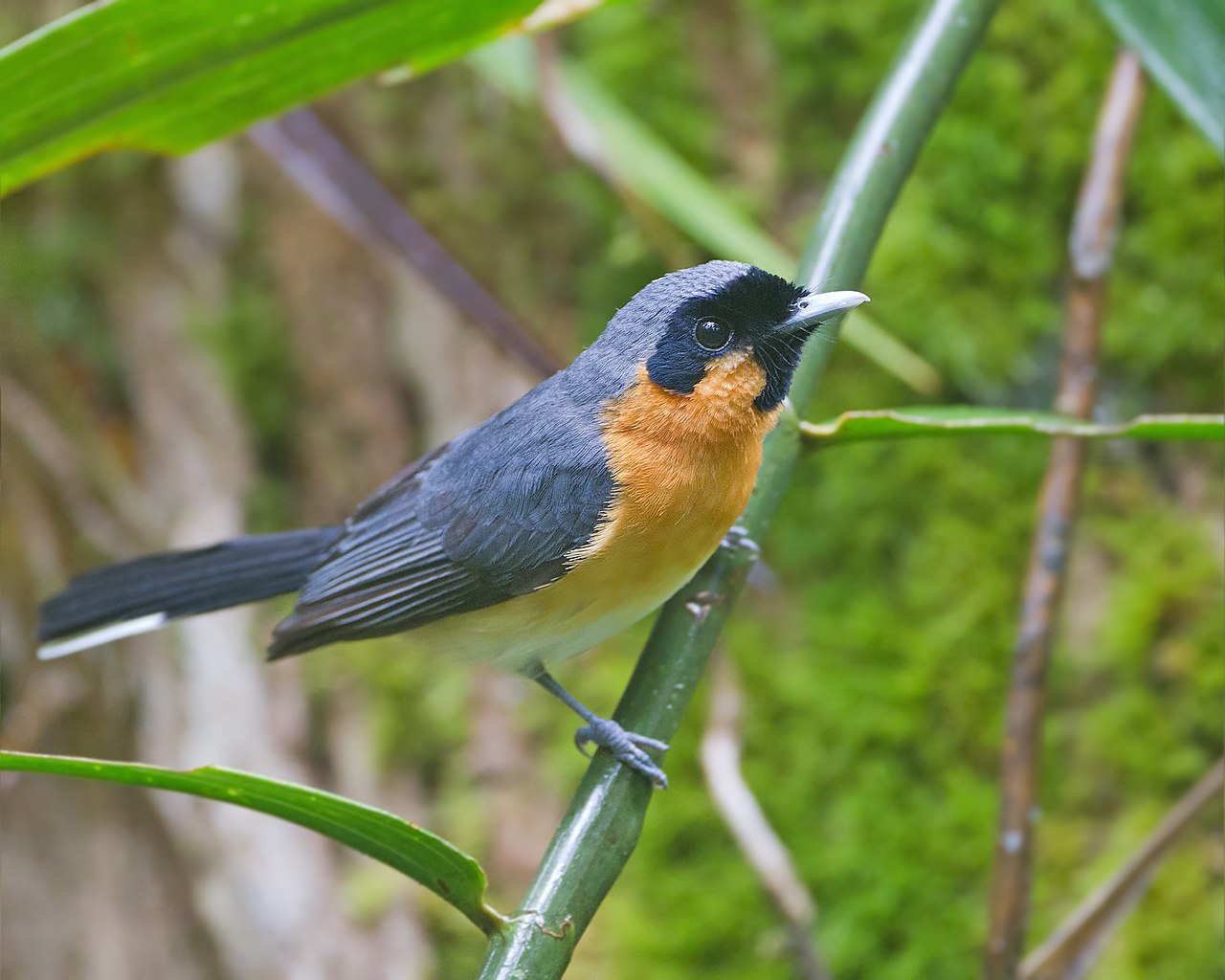
The spectacled longbill, also known as dwarf longbill, plumed longbill or dwarf honeyeater, is a species of bird in the family Melanocharitidae. It is found in New Guinea. Its natural habitats are subtropical or tropical dry forest, subtropical or tropical moist lowland forest, and subtropical or tropical moist montane forest.
Region
New Guinea
Typical Environment
Occurs widely across New Guinea in primary and secondary forests, including lowland rainforests, hill forests, and mossy montane edges. Favors dense understorey and midstory tangles, vine thickets, and forest edges where flowering shrubs are present. It also ventures into disturbed habitats and regenerating growth, especially where nectar resources are abundant. Often accompanies mixed-species flocks moving through the subcanopy.
Altitude Range
Sea level to 2200 m
Climate Zone
Tropical
Ease of Keeping
Beginner friendly: 1/5
Despite old names like 'dwarf honeyeater,' the spectacled longbill belongs to the berrypecker and longbill family (Melanocharitidae), not the honeyeaters. Its fine, slightly decurved bill lets it probe flowers for nectar and glean tiny arthropods from foliage. The pale eye-ring gives the 'spectacled' look. It often joins mixed-species foraging flocks in New Guinea forests.

Temperament
skulking but active
Flight Pattern
short rapid wingbeats between perches
Social Behavior
Usually seen singly, in pairs, or small family parties, and commonly integrates into mixed-species flocks. Nests are small cups placed in foliage; both parents are thought to share care of the young. Territoriality is modest, with foraging overlap in rich flowering areas.
Migratory Pattern
Resident
Song Description
Calls are thin, high-pitched tsee and tsit notes, often given while foraging. Song is a soft series of fine, sibilant trills and chips that can be hard to locate in dense foliage.
Plumage
Mostly olive to olive-brown above with paler, buff-olive underparts; fine, sleek feathers suited to dense foliage. A neat, pale eye-ring creates a 'spectacled' appearance. Bill is long, slender, and slightly decurved.
Diet
Takes small insects and spiders gleaned from leaves, twigs, and vine tangles. Frequently probes flowers for nectar, including mistletoes and other epiphytes. Will also sip from tubular blossoms and occasionally take small berries.
Preferred Environment
Forages in the understorey to mid-canopy of humid forest, along edges, and in secondary growth with abundant flowering plants. Often follows mixed flocks through vine-rich patches and along forest margins.