

The southern royal albatross or toroa, is a large seabird from the albatross family. At an average wingspan of above 3 m (9.8 ft), it is one of the two largest species of albatross, together with the wandering albatross. Recent studies indicate that the southern royal albatross may, on average, be somewhat larger than the wandering albatross in mass and have a similar wingspan, although other sources indicate roughly similar size for the two species and the wandering species may have a larger average wingspan in some colonies.
Region
Southern Ocean and South Pacific
Typical Environment
Breeds primarily on Campbell Island, with small numbers on the Auckland Islands, then disperses widely across the Southern Ocean. At sea it frequents subantarctic and temperate waters, often along productive frontal zones and shelf edges. It ranges thousands of kilometers during the nonbreeding season, regularly occurring off southern Australia and South America. Nests are placed on open tussock grasslands, ridges, and gentle slopes with unobstructed wind for takeoff and landing.
Altitude Range
Sea level to 600 m
Climate Zone
Temperate
Ease of Keeping
Beginner friendly: 1/5
The southern royal albatross is among the largest flying birds, with an average wingspan exceeding 3 m. It is a master of dynamic soaring, gliding vast distances over the Southern Ocean with minimal wingbeats. Pairs typically mate for life and breed biennially due to the long rearing period of a single chick.


In flight

In flight

In flight


Temperament
solitary and wide-ranging at sea; gregarious at colonies
Flight Pattern
soaring glider using dynamic soaring and slope lift, with very infrequent flapping
Social Behavior
Colonial breeder forming loose colonies on open slopes. Strongly monogamous with elaborate bill-clicking, sky-pointing, and display calls during courtship. Lays a single egg; both parents incubate and feed the chick, and most pairs skip the following year to recover.
Migratory Pattern
Seasonal migrant
Song Description
Generally quiet at sea, giving low grunts and croaks. At colonies, produces resonant calls, wails, and bill-clapping during displays and territorial interactions.
Plumage
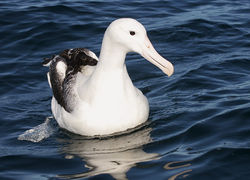
Mostly white with black on the outer upperwings and narrow black trailing edges; back and inner wings largely white. Immatures show more mottling on the upperwings and back that whitens with age.
Diet
Feeds mainly on squid, fish, and crustaceans, and will also scavenge carrion and offal from fishing vessels. Often takes prey by surface-seizing and shallow plunges, rarely pursuing deep dives. Nocturnal foraging on squid is common, especially when prey ascend toward the surface at night.
Preferred Environment
Pelagic waters over continental shelf edges, oceanic fronts, and upwelling zones where prey is concentrated. Frequently follows vessels to scavenge discards and bycatch.


