

The scaly-naped pigeon, also known as the red-necked pigeon, is a bird belonging to the family Columbidae. The species occurs throughout the Caribbean.
Region
Caribbean
Typical Environment
Occurs across many of the Greater and Lesser Antilles, including Puerto Rico and numerous smaller islands, with local absences on some islands. It inhabits evergreen and semi-deciduous forests, second-growth, forest edges, and wooded plantations. Birds often feed in the upper canopy but may visit fruiting trees in gardens and agroforestry plots. It tolerates some habitat disturbance where fruiting trees persist, though intact forests support the highest densities.
Altitude Range
Sea level to 1500 m
Climate Zone
Tropical
Ease of Keeping
Beginner friendly: 2/5
Also called the red-necked pigeon, it is a large forest pigeon native to the Caribbean. It is an important seed disperser for many native trees and often forages high in the canopy, making it easier to hear than to see. On some islands it is wary due to hunting pressure, but it remains widespread overall.


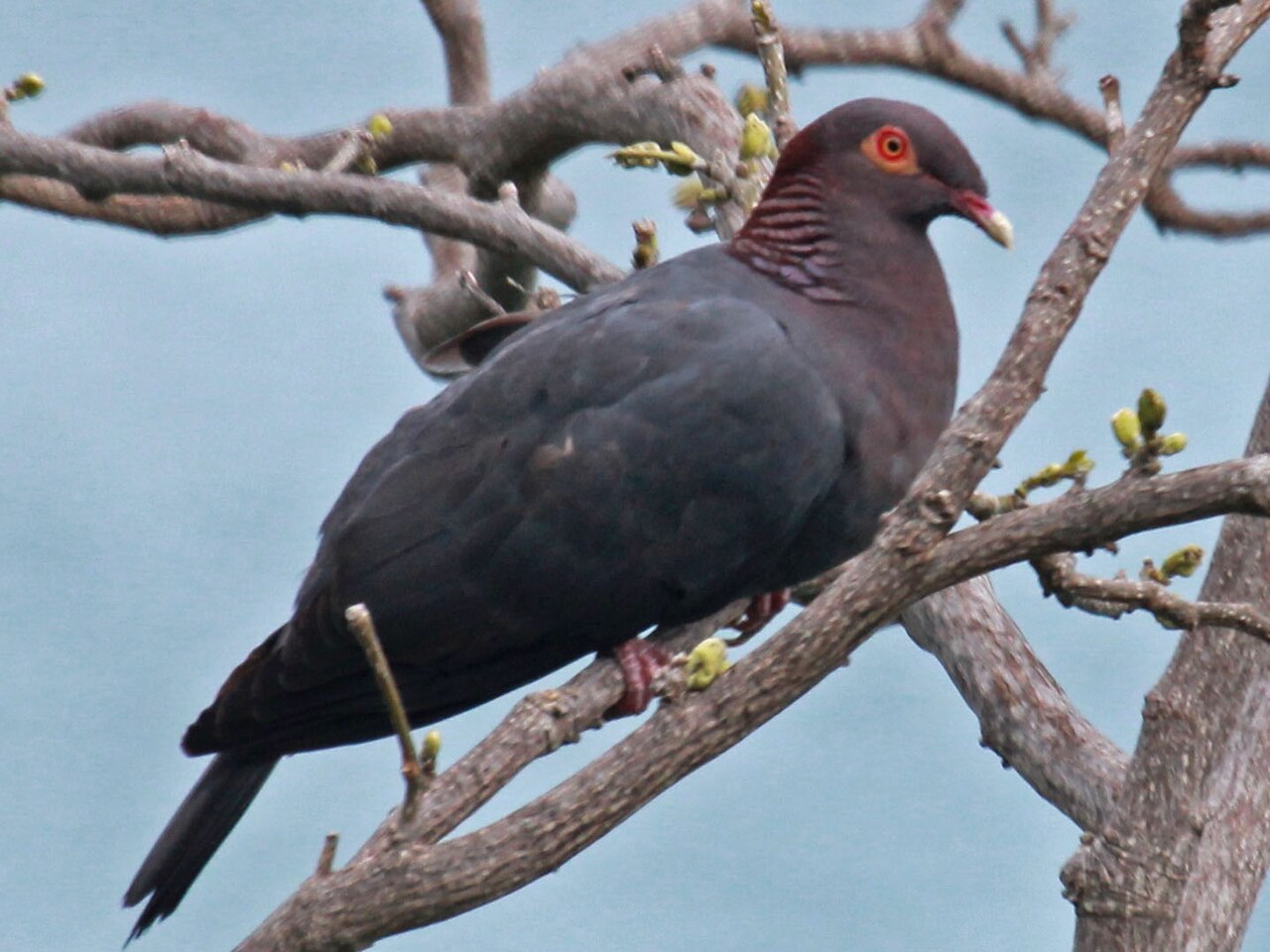
A Scaly-naped pigeon in Puerto Rico
Temperament
shy and wary
Flight Pattern
strong flier with fast, direct wingbeats
Social Behavior
Typically seen singly or in small loose groups, especially at fruiting trees. Builds a simple stick platform nest in trees and usually lays a single egg. Pairs engage in bowing displays and soft cooing during courtship, and both sexes share incubation and chick-rearing duties.
Migratory Pattern
Resident
Song Description
A deep, resonant series of coos, often delivered from a concealed perch high in the canopy. Notes are spaced and booming, carrying through forest habitats, with repetitive 'hoo-OOO' phrases.
Plumage
Large, smooth-plumaged pigeon with a glossy purplish neck showing pale-edged, scale-like feathering on the nape; body mostly dark slate-gray to dusky. Wings and tail are uniformly dark with a slight sheen, and the underparts can show a subtle vinous wash.
Diet
Primarily eats fruits and berries from native and introduced trees, including figs, palms, and other fleshy-fruited species. It may also take buds and tender leaves, especially when fruit is scarce. By swallowing fruits whole and dispersing seeds, it plays a key ecological role in forest regeneration.
Preferred Environment
Feeds mostly in the upper to mid canopy of forests and wooded edges. It also visits fruiting trees in secondary growth, gardens, and plantations.


