

The scaled pigeon is a large New World tropical dove. It is a resident breeder from southern Mexico south to western Ecuador, southern Brazil, northern Argentina, and Trinidad.
Region
Neotropics (Mesoamerica to northern South America and Trinidad)
Typical Environment
Occurs from southern Mexico through Central America to western Ecuador, southern Brazil, and north to northern Argentina, with populations on Trinidad. Prefers humid to semi-deciduous lowland forests, forest edges, and secondary growth with abundant fruiting trees. Often uses riverine corridors, plantations, and wooded savannas where tall fruiting trees are present. Typically stays in the mid to upper canopy and descends rarely to the ground.
Altitude Range
Sea level to 1500 m
Climate Zone
Tropical
Ease of Keeping
Beginner friendly: 2/5
This large New World pigeon is most often heard or glimpsed high in the forest canopy, where its soft, resonant coos carry far. The ‘scaled’ look comes from pale fringes on the neck and breast feathers. It is an important seed disperser for many tropical fruiting trees. Despite being widespread, it can be shy and is easily overlooked in dense foliage.


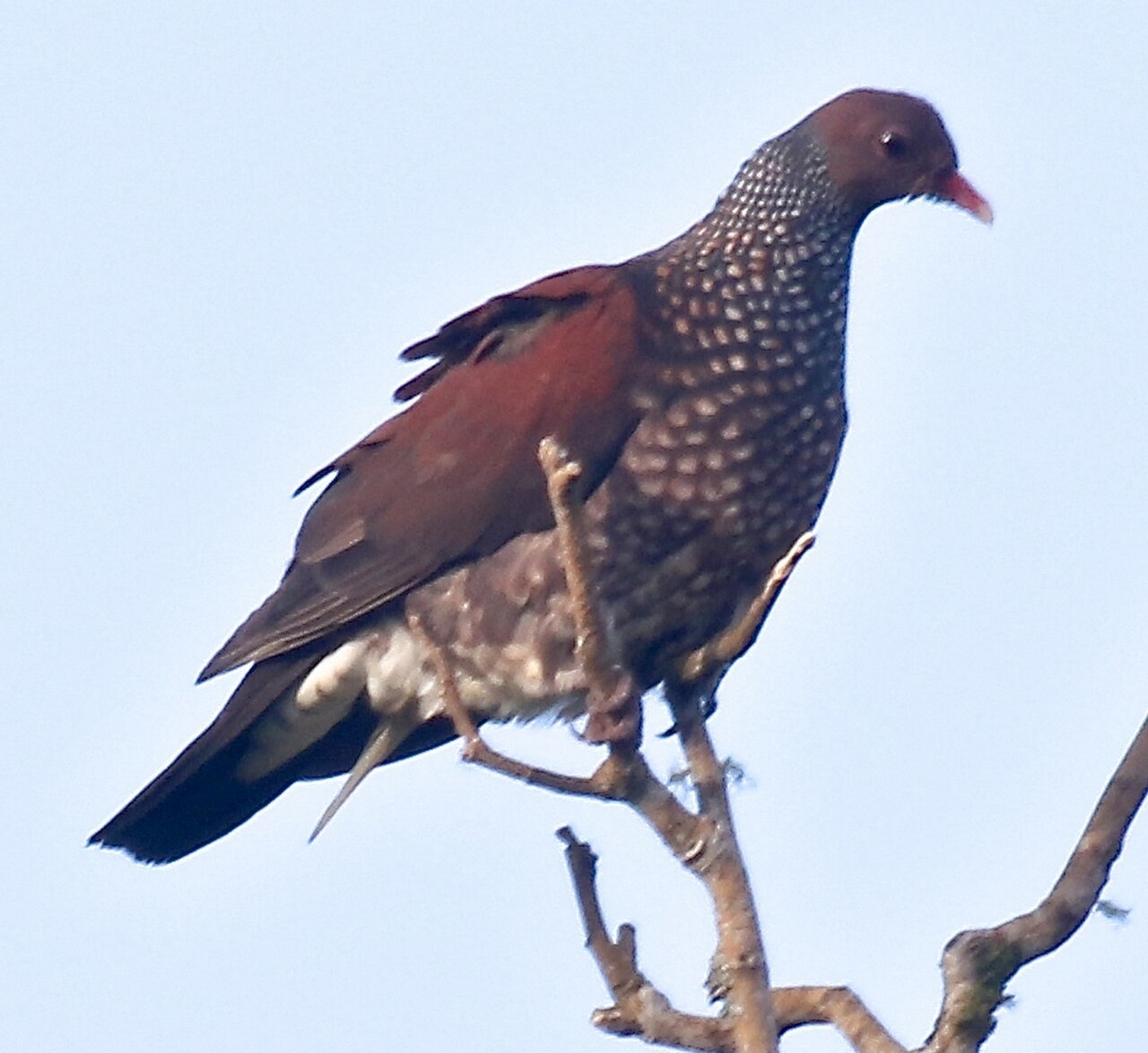
Wildsumaco Lodge - Ecuador
Temperament
shy and canopy-dwelling
Flight Pattern
strong, direct flight with rapid wingbeats
Social Behavior
Usually solitary or in pairs, occasionally small loose groups at fruiting trees. Nests high in trees on a simple stick platform. Clutch is typically one, sometimes two, eggs and both parents share incubation and chick rearing.
Migratory Pattern
Resident
Song Description
A low, resonant series of coos delivered from high perches, often in measured, repeated phrases. Calls carry well through forest, aiding contact between widely spaced birds.
Plumage
Neck and breast feathers with pale edges creating a pronounced scaled appearance; back and wings smooth and unpatterned. Overall rich brown to gray-brown body with purplish tones on the head and chest and subtle iridescence on the neck.
Diet
Primarily consumes fruits and berries, including figs and palm fruits. Swallows small fruits whole and helps disperse seeds over long distances. Will also take tender seeds when fruit is scarce. Foraging is mostly in the canopy but may descend to mid-story fruiting shrubs.
Preferred Environment
Feeds at fruiting trees along forest edges, clearings, and riparian corridors. Also visits orchards and plantations where suitable fruit is available.


