
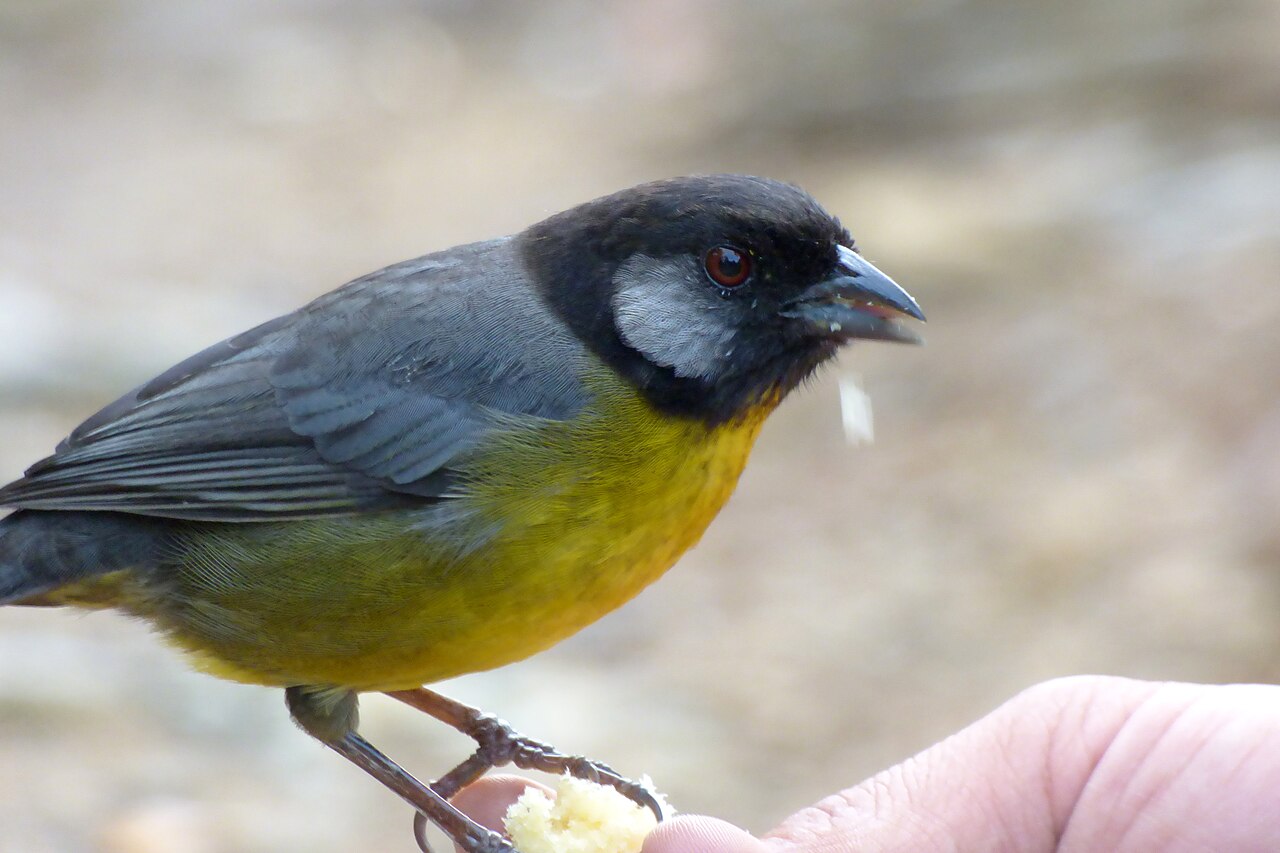
The Santa Marta brushfinch is a species of bird in the family Passerellidae. It is endemic to the Sierra Nevada de Santa Marta (Colombia).
Region
Sierra Nevada de Santa Marta, northern Colombia
Typical Environment
Occurs in humid montane forests, forest edges, and dense secondary growth, particularly in shrubby clearings and along roadsides. It tolerates some disturbance and is frequently found in coffee agroforestry with shade trees. Birds typically keep to the lower and mid understory, moving through thickets and vine tangles. It is local but can be fairly common within suitable habitat.
Altitude Range
1200–3200 m
Climate Zone
Highland
Ease of Keeping
Beginner friendly: 1/5
This brushfinch is confined to the isolated Sierra Nevada de Santa Marta of northern Colombia, where it favors dense shrubby edges and second-growth. It often forages low, flicking its tail as it moves through tangles. Pairs or small family groups are typical, and it may join mixed-species flocks in montane forest edges. Its adaptability to edges helps it persist near human-altered habitats.


Temperament
skulking but active in dense cover
Flight Pattern
short rapid wingbeats, low to the understory
Social Behavior
Usually seen in pairs or small family groups, sometimes accompanying mixed-species flocks along forest edges. Nests are typically low in dense vegetation, with both parents attending young. Territorial during breeding, but more tolerant and loosely gregarious outside the breeding season.
Migratory Pattern
Resident
Song Description
Song is a series of clear, whistled phrases delivered from within cover, often repeated with slight variations. Calls include sharp chips and thin, metallic notes used to keep contact in dense foliage.
Plumage
A hooded brushfinch with a smooth, dark head contrasting with olive upperparts and bright yellow underparts; wings and tail dusky-olive without wingbars.
Diet
Eats a mix of insects and other small arthropods, supplemented by seeds and small berries. Forages by gleaning from leaves, stems, and mossy branches, and by picking fallen items near the ground. Occasional sallying or short hops to capture disturbed prey are observed.
Preferred Environment
Feeds in the understory and lower mid-story of humid montane forest, especially along edges, gaps, and secondary growth. Also utilizes shrubby borders of shaded coffee and roadside thickets.


