

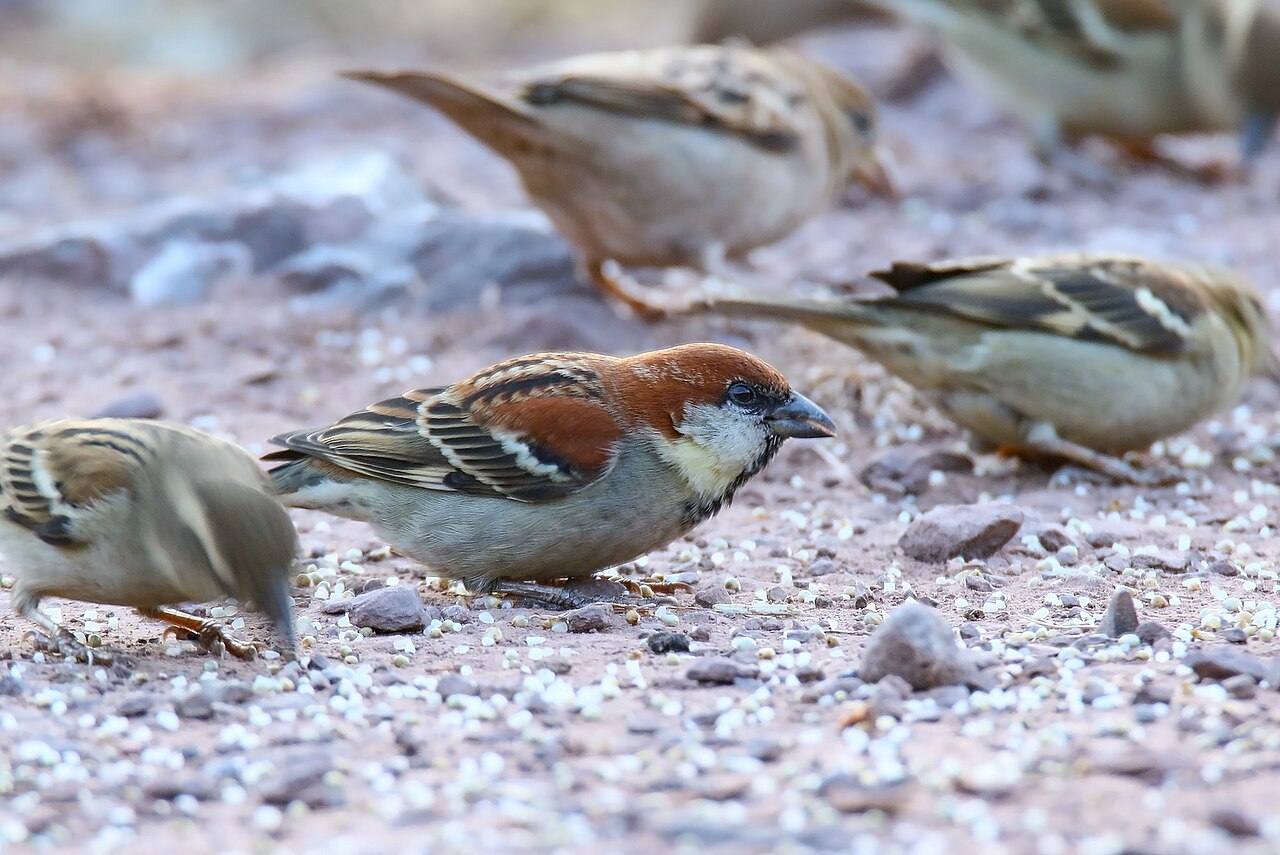
The russet sparrow, also called the cinnamon or cinnamon tree sparrow, is a passerine bird of the sparrow family Passeridae. A chunky little seed-eating bird with a thick bill, it has a body length of 14 to 15 cm (5.5–5.9 in). Its plumage is mainly warm rufous above and grey below. It exhibits sexual dimorphism, with the plumage of both sexes patterned similarly to that of the corresponding sex of house sparrow. Its vocalisations are sweet and musical chirps, which when strung together form a song.
Region
East Asia and the Himalayas
Typical Environment
Occurs from the Himalayan foothills across central and eastern China to Korea, Taiwan, and Japan, with isolated populations in parts of Southeast Asia’s uplands. It prefers open woodlands, scrubby hillsides, forest edges, orchards, farmland, and rural villages, and is less urbanized than the house sparrow. Frequently uses human structures for nesting but forages in nearby natural cover. In winter some populations descend to lower elevations and more open country.
Altitude Range
Sea level to 3000 m
Climate Zone
Temperate
Ease of Keeping
Beginner friendly: 2/5
Also called the cinnamon or cinnamon tree sparrow, this small passerine favors forest edges, orchards, and rural settlements across East Asia. Males are vividly rufous above with a gray belly and a neat black bib; females are duller and more buff-brown. It often nests in cavities and building eaves and forms small, loose colonies. Its bright, musical chirps link into a simple, pleasant song.


An illustration by Philipp Franz von Siebold from Fauna Japonica, in which the russet sparrow was described with the now synonymised name Passer russatus

Breeding male in Kullu, India
A wintering flock of russet sparrows in Murree, Pakistan

A male eating Yoshino cherry blossoms, in Aichi Prefecture, Japan

The c. 1830 woodblock "Hibiscus and Sparrow" by the Japanese artist Hokusai, which portrays the russet sparrow
Temperament
social and active
Flight Pattern
short rapid wingbeats with bounding, undulating flight
Social Behavior
Often forms small flocks outside the breeding season and mixes loosely with other seed-eating birds. Typically nests in cavities, crevices, or building eaves, sometimes in small colonies. Pairs are generally monogamous and both sexes contribute to nest building and chick rearing.
Migratory Pattern
Partial migrant
Song Description
Song is a series of clear, sweet chirps and short trills delivered from exposed perches. Calls include sharp chips and softer contact notes used to keep flocks together.
Plumage
Male with rich rufous crown, nape, and mantle, gray underparts, black bib, and pale wing bars; female duller brownish with buffy supercilium and plainer underparts. Both sexes have a chunky, sparrow-like build and thick bill.
Diet
Primarily eats seeds and grains from grasses, weeds, and crops, gleaned from the ground and low vegetation. In the breeding season it adds a higher proportion of insects such as beetles, caterpillars, and aphids, which are important for nestlings. It will visit stubble fields, weedy lots, and field margins, and occasionally takes buds or small fruits.
Preferred Environment
Feeds in open, lightly wooded or shrubby areas near human cultivation, including orchards, field edges, and village surroundings. Also forages along forest edges and clearings where seeds are abundant.


