
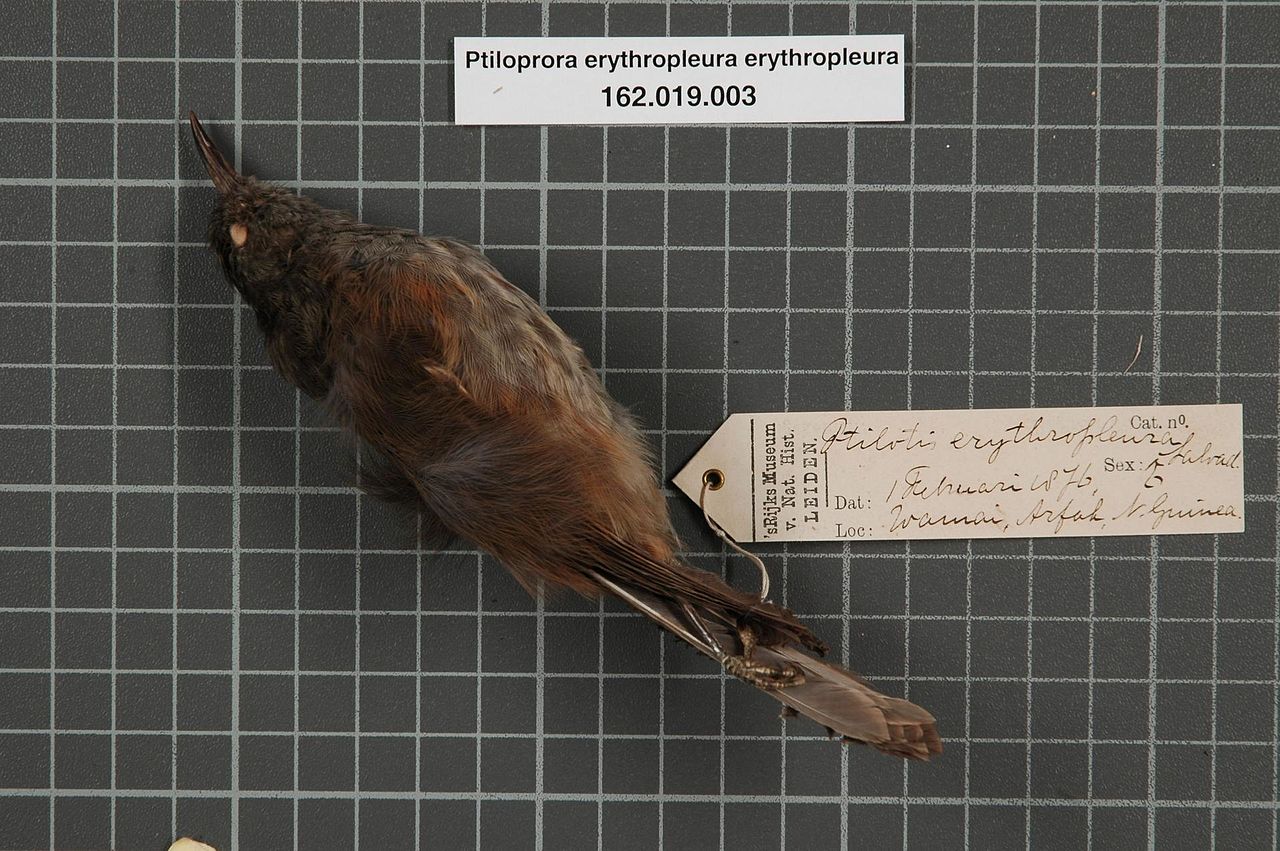
The rufous-sided honeyeater is a species of bird in the family Meliphagidae. It is endemic to West Papua, Indonesia. There are currently 2 recognized subspecies.
Region
Western New Guinea highlands (West Papua)
Typical Environment
Occurs in montane and subalpine forests, especially mossy cloud forest, forest edges, and secondary growth with abundant flowering shrubs. It forages from understory to mid-canopy, often along ridges and gaps where blossoms are concentrated. The species tolerates lightly disturbed habitats and forest edges near villages. It is typically localized to upland ranges within West Papua.
Altitude Range
1200–3000 m
Climate Zone
Highland
Ease of Keeping
Beginner friendly: 1/5
A small montane honeyeater, the rufous-sided honeyeater is named for its distinctive reddish flanks. It frequents mossy cloud forests where it probes flowers for nectar and gleans insects from foliage. It often joins mixed-species flocks and is more often heard than seen as it moves quickly through midstory tangles.

Temperament
active and somewhat skulking
Flight Pattern
short rapid wingbeats between perches
Social Behavior
Usually seen singly, in pairs, or small family groups, and commonly joins mixed-species flocks with other montane insectivores. Defends rich flowering shrubs when in bloom but otherwise forages widely. Nesting is presumed to be a small cup placed low to mid story, with both parents involved in care.
Migratory Pattern
Resident
Song Description
High, thin whistles and sharp chips delivered in short sequences. Calls are quick and repeated, often given while moving through dense foliage.
Plumage
Olive-brown upperparts with a greyer breast and pale buff wash below, set off by distinct rufous flanks. Subtle pale supercilium and darker eye-line; underparts lightly streaked or washed gray-buff. Feathers appear soft and slightly fluffy in cool, humid montane habitats.
Diet
Takes nectar from a variety of montane blossoms, probing tubular flowers and occasionally defending favored patches. Also consumes small arthropods gleaned from leaves, twigs, and mossy trunks, and may sally briefly to catch flying insects. Will supplement diet with small fruits and berries when available.
Preferred Environment
Feeds along forest edges, clearings, and midstory layers where flowering shrubs and epiphytes are abundant. Frequently visits roadside vegetation and gardens adjacent to montane forest.


