

The ruddy tody-flycatcher is a species of bird in the family Tyrannidae, the tyrant flycatchers. It is found in Brazil, Guyana, and Venezuela.
Region
Guiana Shield
Typical Environment
Occurs in northern South America, primarily in eastern Venezuela, Guyana, and adjacent northern Brazil. Favors the understory and edges of humid lowland forest, white-sand (campina/campinarana) woodlands, and scrubby second growth. Often found along forest margins, in vine tangles, and near small clearings or streams. It is patchy but can be locally common where suitable dense understory is present.
Altitude Range
0–1500 m
Climate Zone
Tropical
Ease of Keeping
Beginner friendly: 1/5
A tiny tyrant flycatcher, the ruddy tody-flycatcher is noted for its rich rufous coloration and very short, flattened bill used to glean small insects. It typically occupies tangles and edges of humid forests on the Guiana Shield. Like many tody-flycatchers, it builds a hanging pouch nest with a side entrance. Its high, thin calls can be insect-like and easy to overlook in dense understory.


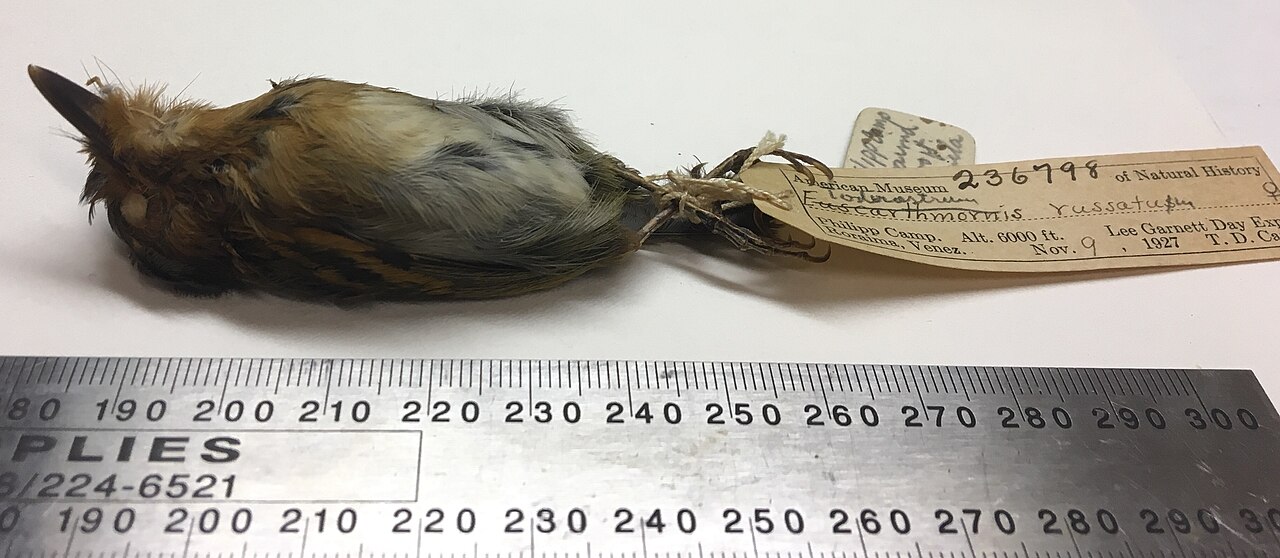
Museum specimen of ruddy tody-flycatcher in collection of the AMNH

Temperament
active and somewhat secretive
Flight Pattern
short rapid wingbeats between brief sallies
Social Behavior
Usually solitary or in pairs, sometimes accompanying mixed-species understory flocks. Pairs maintain small territories and communicate with thin, high-pitched notes. Nests are pouch-like structures suspended from low branches or tangles with a side entrance.
Migratory Pattern
Resident
Song Description
Gives thin, high, insect-like tsee notes and brief trills. The song is soft and easily masked by ambient forest sounds, often detected by consistent, repeated high notes.
Plumage
Compact and short-tailed with predominantly rich rufous to chestnut tones on face, breast, and belly; upperparts more olive-brown with dusky wings edged rufous. Bill short, broad-based, and slightly flattened. Overall appearance is warm-toned with minimal contrasting markings.
Diet
Feeds on small arthropods such as insects and spiders. Forages by gleaning from leaves and twigs and by making short hover-gleans to pick prey from foliage. Occasionally sallies from low perches to snatch tiny flying insects. Typically selects dense tangles where prey is abundant.
Preferred Environment
Forages in the lower to mid-understory, often 1–5 m above ground, in vine thickets, forest edges, and white-sand woodlands. Frequently uses semi-open edges and second growth adjacent to mature forest.


