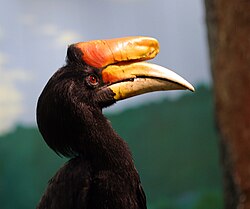
The rhinoceros hornbill is a large species of forest hornbill (Bucerotidae). In captivity it can live for up to 35 years. It is found in lowland and montane, tropical and subtropical climates and in mountain rain forests up to 1,400 metres in Borneo, Sumatra, Java, the Malay Peninsula, Singapore, and southern Thailand.
Region
Sundaland and southern Thailand
Typical Environment
Occurs in primary and mature secondary lowland to lower montane rainforests across the Malay Peninsula, southern Thailand, Sumatra, Borneo, and Java. Prefers extensive evergreen forests with large emergent trees for nesting. Often follows fruiting fig trees and other large-seeded fruit sources, occasionally using selectively logged forests if big trees remain. It will visit forest edges and riparian corridors but depends on intact interior forest for breeding. Typically ranges from the canopy to mid-story, rarely descending to the ground.
Altitude Range
Sea level to 1400 m
Climate Zone
Tropical
Ease of Keeping
Beginner friendly: 1/5
This iconic hornbill sports a prominent, upturned casque on its bill that glows orange-red from preen oil staining and is used in display and sound resonance. It is culturally significant across Borneo and is the state bird of Sarawak, Malaysia. Pairs are strongly monogamous; during nesting the female seals herself inside a tree cavity and is fed by the male through a narrow slit.


The skull of B. r. silvestris

A female eating a peanut





Temperament
social and active
Flight Pattern
strong flier with slow, heavy wingbeats and audible whooshing
Social Behavior
Usually seen in pairs or small family groups, aggregating at fruiting trees. Strongly monogamous pairs maintain territories and rely on large cavity-bearing trees for nesting. The female seals the nest entrance with a wall of mud and droppings, leaving a slit through which the male passes food until the chicks are ready.
Migratory Pattern
Resident
Song Description
Loud, resonant honks and nasal calls that carry over long distances, often amplified by the casque. Wingbeats produce a characteristic whooshing sound during flight.
Plumage
Predominantly glossy black with white thighs and a white tail marked by a broad black subterminal band; flight feathers show pale bases in flight.
Diet
Primarily eats fruits, especially figs (Ficus), which can comprise the bulk of its diet seasonally. Also takes other large drupes and berries, regurgitating seeds and thus acting as an important seed disperser. Opportunistically consumes animal prey such as large insects, small reptiles, and occasionally small birds or mammals, particularly when feeding chicks.
Preferred Environment
Forages mainly in the upper canopy of primary and mature secondary rainforest, especially at fruiting trees. Frequently visits large strangler figs and riparian fruiting trees and may cross open areas between forest patches.