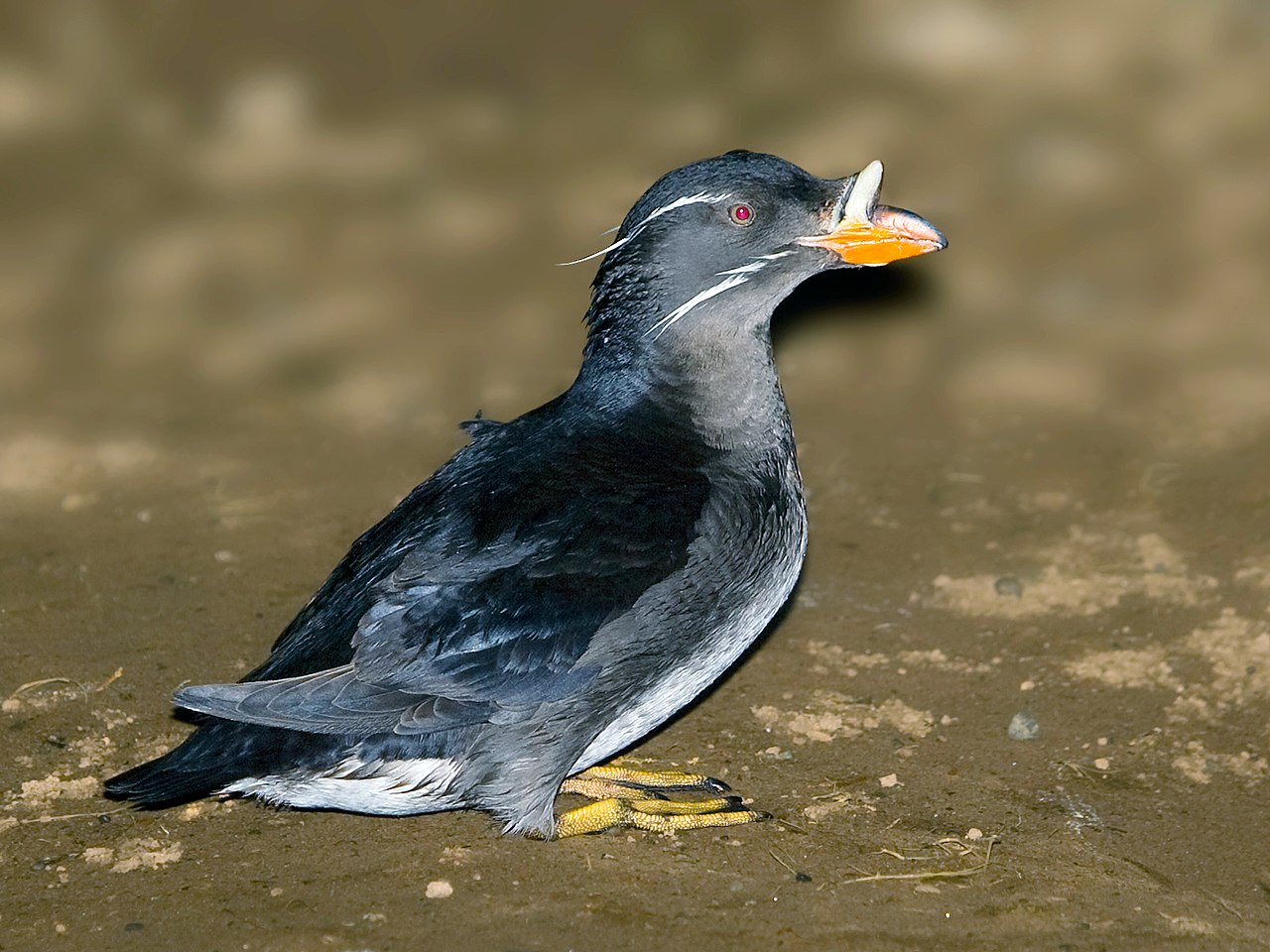
The rhinoceros auklet is a seabird and a close relative of the puffins. It is the only extant species of the genus Cerorhinca. Given its close relationship with the puffins, the common name rhinoceros puffin has been proposed for the species.
Region
North Pacific Ocean
Typical Environment
Breeds on offshore islands and coastal headlands around the North Pacific, from California to Alaska and across to Russia and Japan. Outside the breeding season it disperses widely over continental shelf waters. It favors productive upwelling zones, tidal fronts, and nearshore waters where schooling fish are abundant. Nesting occurs in burrows within forested or grassy slopes, often under shrubs or tree roots. Birds typically commute between marine foraging areas and colonies at night to avoid predators.
Altitude Range
Sea level to 300 m
Climate Zone
Temperate
Ease of Keeping
Beginner friendly: 1/5
A close relative of puffins, the rhinoceros auklet is the only living member of the genus Cerorhinca. Adults grow a small horn-like keratin sheath at the base of the bill during the breeding season, which is later shed. They are nocturnal at colonies, visiting and provisioning chicks under cover of darkness, and nest in burrows dug into soil on offshore islands.


Temperament
social at sea, secretive and nocturnal around colonies
Flight Pattern
strong flier with rapid wingbeats low over the water
Social Behavior
A colonial burrow nester, it forms dense breeding colonies on predator-free islands. Pairs are largely monogamous and share incubation and chick-rearing duties. Adults typically return to burrows after dark to reduce predation risk, and chicks are fed multiple fish carried crosswise in the bill.
Migratory Pattern
Partial migrant
Song Description
Generally quiet at sea, but around colonies emits low, gruff grunts, growls, and wheezy calls. Vocalizations are most frequent at night when arriving or interacting near burrow entrances.
Plumage
Sooty to dark gray-brown overall with slightly paler underparts; during breeding shows fine white facial plumes behind the eyes and at the base of the bill.
Diet
Feeds mainly on small schooling fish such as anchovies, herring, sand lance, and smelt. Also takes squid and other small cephalopods, and occasionally crustaceans. Captures prey by pursuit-diving, using wings to 'fly' underwater and often carrying multiple fish crosswise in the bill.
Preferred Environment
Forages over continental shelf waters, especially in areas of tidal mixing and upwelling. Often concentrates along current lines, near coastal headlands, and around islands adjacent to colonies.