

The reddish egret is a medium-sized heron that is a resident breeder in Central America, the Bahamas, the Caribbean, the Gulf Coast of the United States, and Mexico. The egret is known for its unusual foraging behavior compared to other herons as well as its association with mud flats, its habitat of choice.
Region
Caribbean and Gulf of Mexico
Typical Environment
Found along shallow coastal environments including tidal mudflats, salt pans, mangrove-fringed lagoons, and sheltered bays. It rarely ventures far inland and generally avoids freshwater habitats. Breeding colonies are often on isolated barrier islands or mangrove islets to reduce predation. Foraging typically occurs on expansive, open flats where water is ankle-deep. Nesting sites are chosen near reliable, shallow saline foraging areas.
Altitude Range
Sea level to 50 m
Climate Zone
Subtropical
Ease of Keeping
Beginner friendly: 1/5
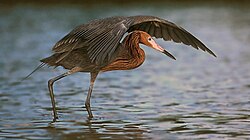
The reddish egret is famous for its energetic, dance-like hunting style, often running, leaping, and shading the water with its wings to startle fish. It occurs in two morphs: a dark morph with a shaggy rufous head and neck and a white morph that is entirely white. It is one of the most saltwater-dependent herons, favoring tidal flats and hypersaline lagoons. Conservation concerns include loss of coastal habitat and disturbance at breeding colonies.


Adult white morph


Temperament
solitary and territorial when feeding
Flight Pattern
strong flier with steady wingbeats and occasional glides
Social Behavior
Often forages alone but may feed in loose aggregations where prey is abundant. Nests colonially, sometimes alongside other herons and egrets, building stick nests in mangroves or low shrubs on isolated islands. Pairs are seasonally monogamous and both sexes help incubate and rear young. Roosting occurs communally on protected islands or in mangrove stands.
Migratory Pattern
Resident
Song Description
Vocalizations are harsh croaks and grating squawks, especially at colonies. During displays, birds give low, rasping calls rather than melodious songs.
Plumage
Dark morph shows slate-gray body with shaggy, rufous head and neck; white morph is entirely white. Feathers are loose and filamentous around the neck, forming a distinct ruff in display.
Diet
Primarily small fish such as killifish, silversides, and mullet; also takes small crustaceans like shrimp. It hunts by running, pivoting, and using its wings to create shade that attracts or confuses prey. Strikes are rapid and precise, often in very shallow water. Opportunistically captures any small aquatic prey available on tidal flats.
Preferred Environment
Feeds on exposed tidal flats, shallow salt pans, and the edges of mangrove lagoons. Prefers clear, shallow saline water with firm substrates that allow rapid pursuit. Often selects areas with active tidal flow that concentrates fish.


