

The red-winged lark is a species of lark in the family Alaudidae found in eastern Africa. It was formerly treated as conspecific with the Kidepo lark.
Region
East Africa
Typical Environment
Occurs patchily across eastern Ethiopia, Somalia, northern Kenya and adjacent parts of South Sudan and Uganda. It favors open, semi-arid grasslands, stony plains, and lightly bushed savanna with scattered acacias and termite mounds. Often found in overgrazed pastures and along track edges where bare ground is available. Typically keeps to low vegetation and open ground, flushing only when approached closely. Local movements may occur in response to rainfall and grass growth.
Altitude Range
0–2000 m
Climate Zone
Arid
Ease of Keeping
Beginner friendly: 1/5
This lark is named for the warm rufous panels in its wings, which show conspicuously in flight. It is a ground-dwelling bird of semi-arid grasslands and bushy plains in eastern Africa. The Kidepo lark was formerly treated as conspecific but is now regarded as a separate species by most authorities.


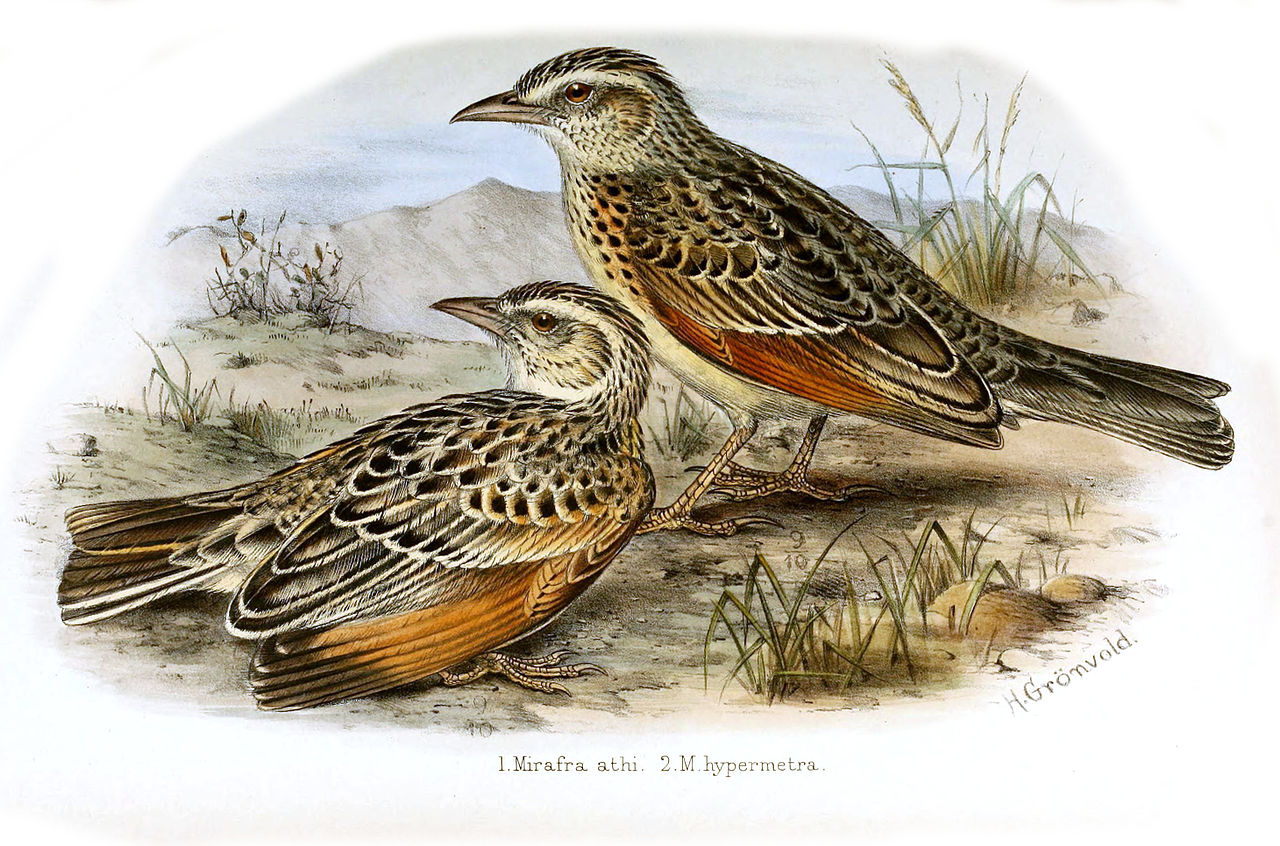
Rufous-naped (left) and Red-winged larks by Henrik Grønvold
Temperament
solitary and territorial
Flight Pattern
short rapid wingbeats with fluttering song-flights
Social Behavior
Usually encountered singly or in pairs, maintaining territories during the breeding season. Nests are shallow cup structures placed on the ground, often sheltered by a grass tuft or small shrub. Pairs perform display flights, and the male sings from low perches, termite mounds, or during fluttering ascents. Outside breeding, may form loose, small groups in suitable feeding areas.
Migratory Pattern
Resident
Song Description
A varied, melodious series of chirrs, trills and clear whistles delivered from a perch or during a fluttering song-flight. Calls include dry chips and soft contact notes given on the ground or in low vegetation.
Plumage
Sandy to rufous-brown upperparts with fine dark streaking; paler buff underparts with light streaking on the breast. The wings show rich rufous panels formed by coverts and primaries, especially obvious in flight. Tail is brown with paler or whitish outer feathers. A pale supercilium contrasts with a slightly darker ear covert patch.
Diet
Feeds mainly on insects such as ants, beetles, grasshoppers, and termites, supplemented with seeds and small grains. During the breeding season, it takes a higher proportion of invertebrates to feed chicks. Forages by walking and gleaning on bare patches, occasionally scratching lightly among short grasses. Often takes advantage of insects flushed by grazing livestock.
Preferred Environment
Open ground with sparse grasses and scattered shrubs, including stony plains, termitaria fields, and lightly grazed savannas. Frequently along track verges and patches of disturbed ground where prey is easier to locate.


