

The red-tailed black cockatoo also known as Banksian- or Banks' black cockatoo, is a large black cockatoo native to Australia. Adult males have a characteristic pair of bright red panels on the tail that gives the species its name. It is more common in the drier parts of the continent. Five subspecies are recognised, differing chiefly in beak size. Although the more northerly subspecies are widespread, the two southern subspecies, the forest red-tailed black cockatoo and the south-eastern red-tailed black cockatoo are under threat.
Region
Australia
Typical Environment
Occurs across northern Australia’s tropical savannas, inland woodlands, and along riparian corridors, with separate populations in the southwest and southeast. Prefers open eucalypt woodland, monsoon forest edges, and forest mosaics with mature hollow-bearing trees for nesting. In southwestern Western Australia it frequents jarrah–marri forests, while southeastern birds use stringybark and buloke woodlands. Often seen feeding in the canopy but will also forage in cleared farmland and along roadsides where food trees remain.
Altitude Range
Sea level to 1200 m
Climate Zone
Tropical
Ease of Keeping
Beginner friendly: 2/5
A striking Australian cockatoo, males show vivid red tail panels while females are barred and spotted with yellow. It relies on large tree hollows for nesting and may travel widely in search of seed crops from eucalypts, sheoaks, and banksias. Five subspecies are recognized; while the species overall is secure, some southern subspecies face local threats from habitat loss.


Female, Northern Territory

Male, Northern Territory

Red-tailed black cockatoo (Male), C. b. naso subspecies, Perth, Western Australia

Red-tailed black cockatoo (juvenile male), Darling Scarp, Roleystone, south-west Western Australia

In flight
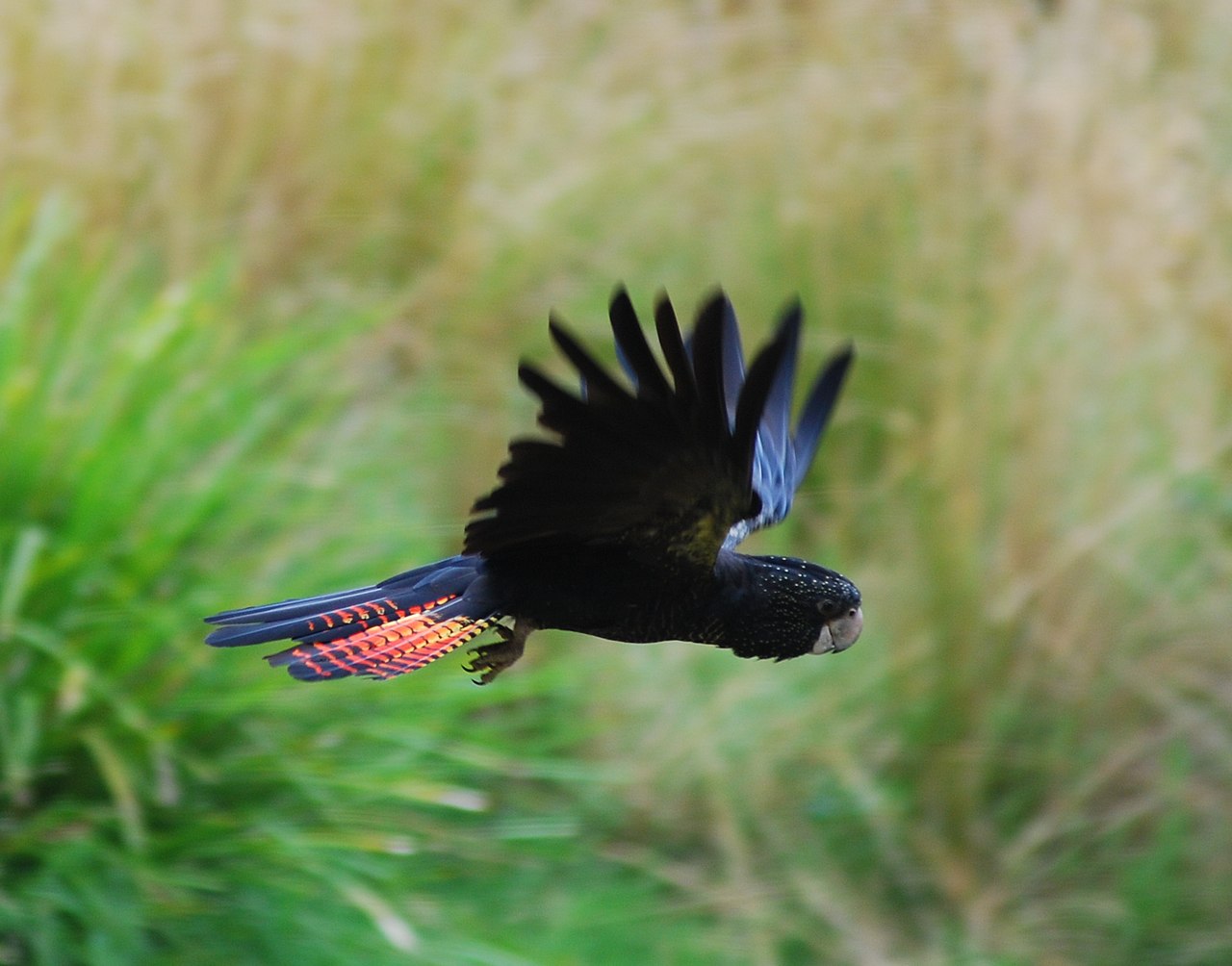
Red-tailed black cockatoo in flight, Healesville Sanctuary


A juvenile male red-tailed black cockatoo feasting on the seeds of a Casuarina tree on McMinn St, Darwin, Northern Territory, Australia

Adult tame female of subspecies samueli

Banksian Cockatoo by Thomas Watling, the first professional European artist to paint in New South Wales
Temperament
social and wary
Flight Pattern
strong flier with deep, deliberate wingbeats
Social Behavior
Often found in pairs or family parties that gather into larger flocks at feeding and roost sites. Forms long-term pair bonds and nests in large hollows high in mature eucalypts. Clutch is typically one, occasionally two, with prolonged parental care.
Migratory Pattern
Partial migrant
Song Description
Calls are loud, ringing and metallic, including drawn-out ‘kreee’ and harsh ‘karrk’ notes that carry over long distances. In flocks they exchange contact calls and softer chattering at roosts.
Plumage
Overall black with a shaggy crest; males glossy black with solid red tail panels, females and immatures black with fine yellow spotting on head and breast and orange-yellow barring in the tail.
Diet
Primarily consumes seeds from native trees such as eucalypts (including marri), sheoaks (Allocasuarina and Casuarina), banksias, and grevilleas. It skillfully manipulates cones and nuts with its bill and feet to extract seeds. Will also take fruits and flowers seasonally and may occasionally glean insect larvae, though plant material dominates.
Preferred Environment
Feeds mostly in the canopy of mature woodlands and forests where key food trees are abundant. Also forages in edges, along waterways, and in partially cleared farmland retaining remnant seed trees.


