

The red-knobbed coot or crested coot is a member of the rail and crake bird family, the Rallidae.
Region
Sub-Saharan Africa and Iberian Peninsula
Typical Environment
Occurs widely on inland freshwater lakes, reservoirs, large ponds, and marshes with ample emergent vegetation and open water. It avoids fast-flowing rivers but uses slow backwaters and sheltered bays. The species also occupies brackish lagoons and man-made impoundments. During droughts it disperses to more permanent waters, sometimes forming large congregations. Nesting usually takes place in dense emergent plants where floating platforms can be anchored.
Altitude Range
Sea level to 2500 m
Climate Zone
Subtropical
Ease of Keeping
Beginner friendly: 1/5
The red-knobbed coot, also called the crested coot, is very similar to the Eurasian coot but shows two bright red knobs atop its white frontal shield in breeding condition. It has lobed toes (not webbed) that help it swim and walk over floating vegetation. Pairs build floating nests anchored to reeds and can be notably aggressive in defending territories. It readily uses artificial water bodies such as farm dams and reservoirs.


Head of a bird in breeding condition, South Africa

non-breeding condition, Ethiopia
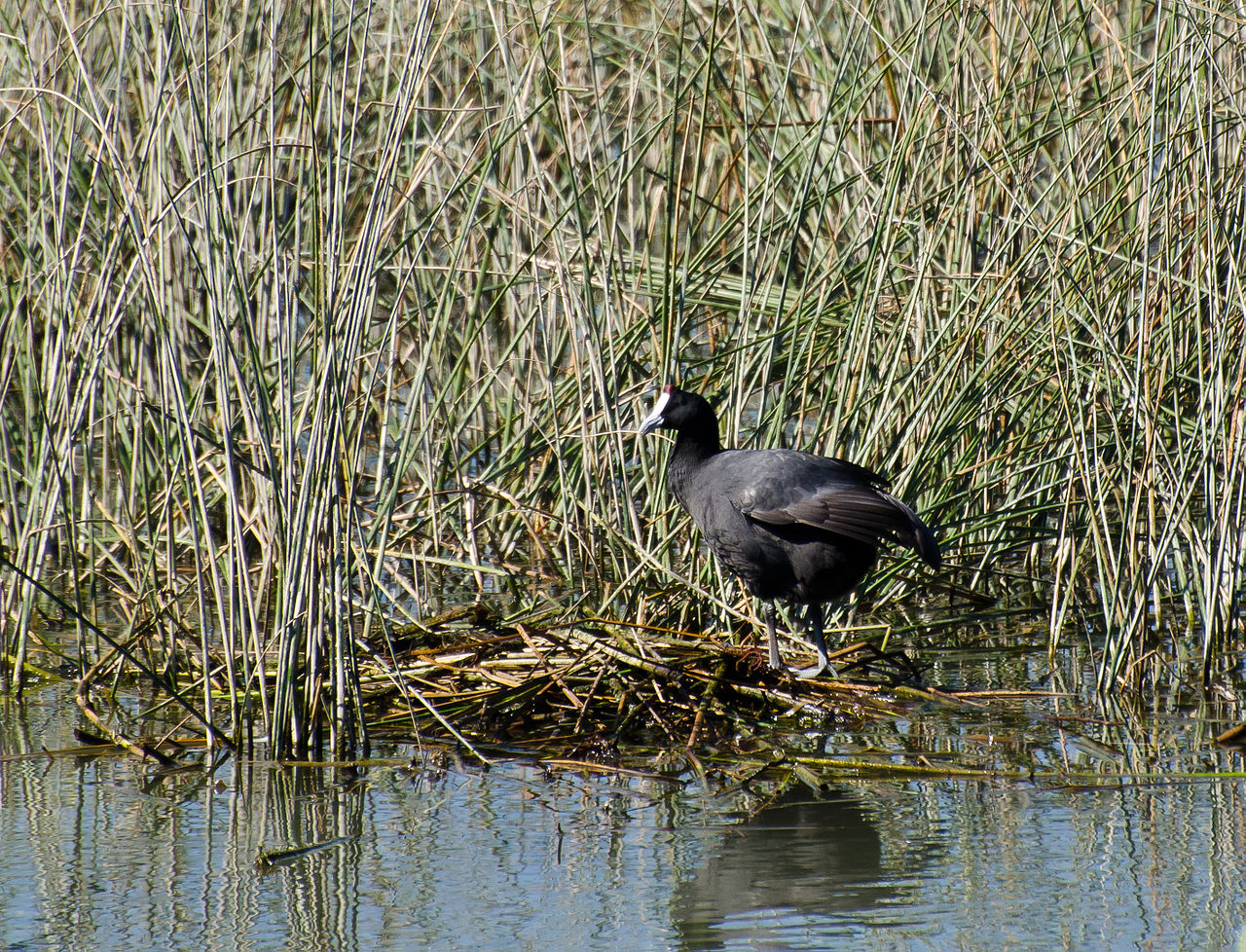
Nest on the island of Mallorca

Clutch from Morocco

Adult feeding a chick.
Temperament
territorial and aggressive during breeding; gregarious outside breeding
Flight Pattern
short rapid wingbeats after a running takeoff; flies low over water
Social Behavior
Monogamous pairs establish and defend nesting territories in dense emergent vegetation. Both sexes build the floating nest and share incubation and chick-rearing. Outside the breeding season, birds form large flocks or rafts on open water, often mixing with other waterfowl.
Migratory Pattern
Partial migrant
Song Description
Vocal, giving sharp, metallic kiks and kowks, along with grunts and chattering notes. Calls become especially frequent and loud during territorial disputes and courtship.
Plumage
Uniform sooty-black to dark slate-grey with a slight sheen, short tail, and white undertail coverts; white bill and frontal shield with two red knobs in breeding season.
Diet
Primarily consumes aquatic plants, algae, and seeds, often plucking stems and leaves from the water surface or just below. Also takes small invertebrates such as insects, mollusks, and crustaceans, especially when feeding chicks. Occasionally grazes on short grass near shorelines and will scavenge floating material.
Preferred Environment
Feeds mostly in shallow zones of lakes and dams, among emergent reeds and sedges and at open-water edges. Dives and up-ends to reach submerged vegetation and forages along shorelines or floating mats.


