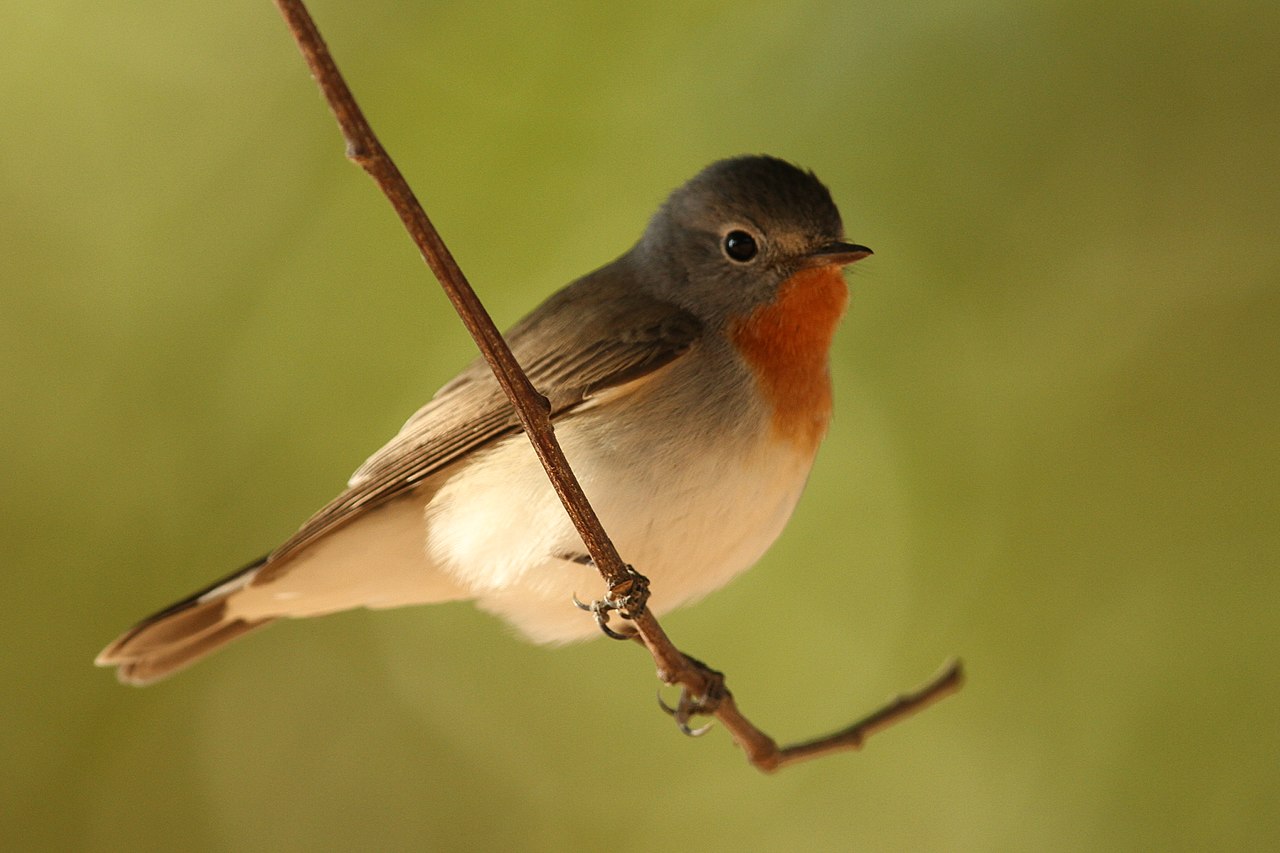
The red-breasted flycatcher is a small passerine bird in the Old World flycatcher family. It breeds in eastern Europe and across Central Asia and is strictly migratory, wintering in south Asia. The breeding male is mainly muted brown above and white below, with a grey head and an orange throat. Females and immatures are similarly colored but lack the orange throat patch. The red-breasted flycatcher is a regular passage migrant in western Europe, whereas the collared flycatcher, which has a different migration route, is scarce. It forms a superspecies with the closely related taiga flycatcher and Kashmir flycatcher and can be distinguished from the former by its different song, warmer-toned plumage and the more extensive orange throat patch.
Region
Eastern Europe to Central Asia; winters in South Asia
Typical Environment
Breeds in mature deciduous and mixed woodlands, often with beech, oak, birch, or spruce, and a well-developed understory. Prefers forest edges, clearings, riverine woods, and sometimes large parks and old gardens. During migration it uses a variety of wooded habitats, including hedgerows and shelterbelts. In winter it frequents moist and dry forests, groves, and wooded gardens across the Indian subcontinent and Sri Lanka.
Altitude Range
0–2000 m
Climate Zone
Temperate
Ease of Keeping
Beginner friendly: 1/5
This small flycatcher breeds from eastern Europe through Central Asia and winters in South Asia. Males show a vivid orange throat in breeding plumage, while females and immatures lack the orange and look plainer. It forms a superspecies complex with the taiga flycatcher and Kashmir flycatcher; voice, throat color extent, and subtle plumage tones help separate them. Red-breasted flycatchers often flick their tails and sally from low to mid-level perches to catch insects.


Ficedula parva - MHNT

Breeding male in Ukraine

Wintering male in Keoladeo National Park, Rajasthan, India
Temperament
secretive but active
Flight Pattern
short rapid wingbeats with frequent sallies
Social Behavior
Generally solitary or in pairs during breeding; territorial males sing from low to mid canopy. Nests in tree cavities or crevices, often using natural holes or old woodpecker nest sites. Clutch typically 5–7 eggs; both parents feed the young.
Migratory Pattern
Seasonal migrant
Song Description
A soft, sweet series of high, thin phrases and trills, delivered in short strophes. Calls include a sharp tick or tzek, often given when alarmed. Song is faster and more musical than taiga flycatcher, aiding identification.
Plumage
Upperparts muted brown to grey-brown with pale fringes; underparts whitish with buffy wash on flanks. Breeding males show a grey head and a bright orange throat and upper breast; females and immatures are plainer with a whitish throat. Tail is dark with contrasting pale outer tail feathers and a subtle pale wing panel.
Diet
Primarily small flying insects such as flies, midges, and mosquitoes, taken on the wing. Also gleaned caterpillars, beetles, and other arthropods from leaves and twigs. In autumn and winter, may supplement with small berries when insects are scarce.
Preferred Environment
Feeds from low to mid-level perches in light gaps, along forest edges, and in understory glades. Uses sallying flights to catch prey and returns to the same or nearby perch. In winter, forages in wooded gardens and groves near human habitation.