
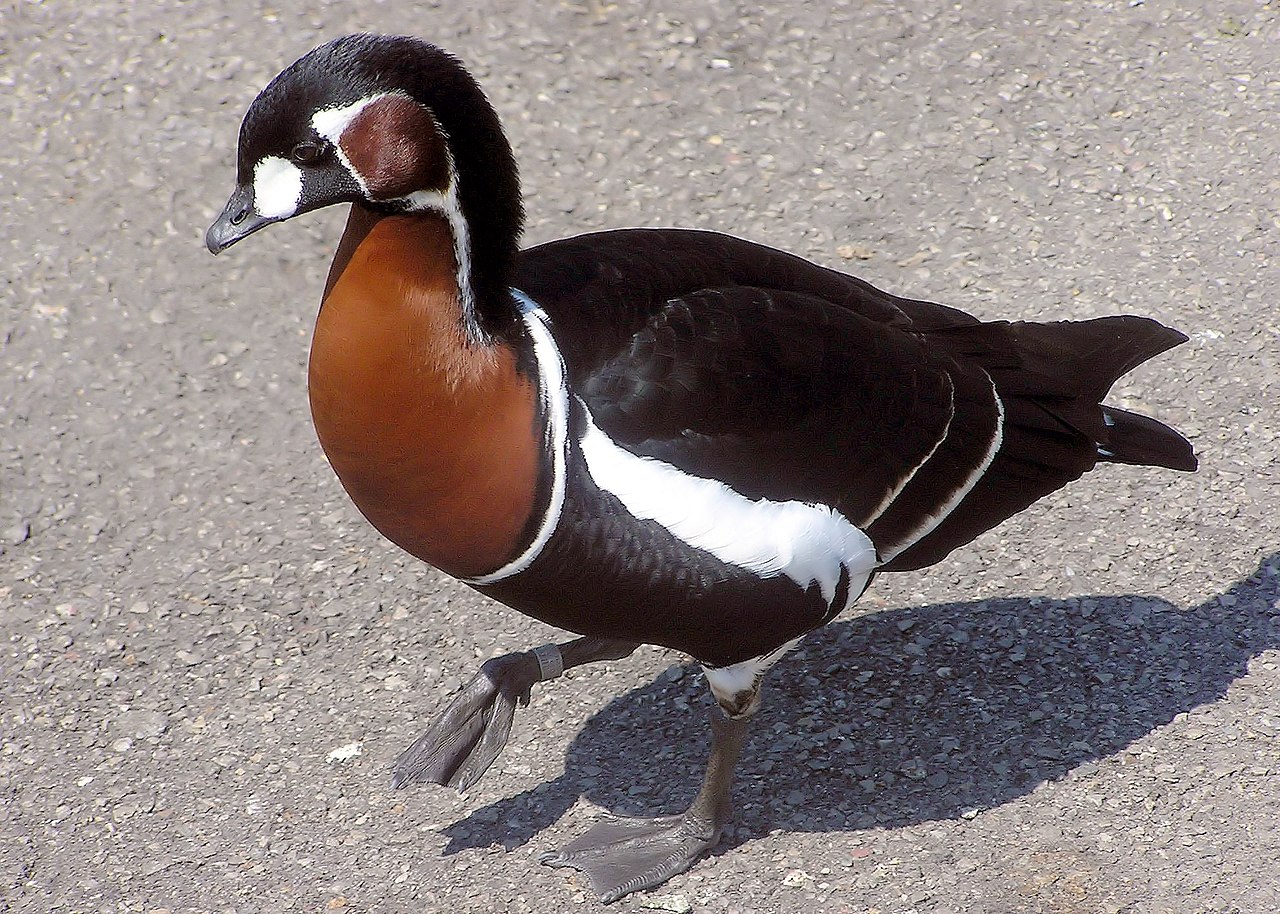
The red-breasted goose is a brightly marked species of goose in the genus Branta from Eurasia. It is currently classified as vulnerable by the IUCN.
Region
Western Siberia to the Black Sea
Typical Environment
Breeds on low Arctic tundra in western Siberia, especially on the Taymyr, Gydan, and Yamal peninsulas, favoring areas near rivers, lakes, and elevated nest sites. During migration it stages at steppe lakes and wetlands across northern Kazakhstan and southern Russia. In winter it concentrates on coastal lagoons, brackish lakes, and adjacent agricultural fields along the western Black Sea, primarily in Bulgaria, Romania, and Ukraine. Small numbers occur irregularly in Turkey and Greece.
Altitude Range
Sea level to 500 m
Climate Zone
Temperate
Ease of Keeping
Beginner friendly: 1/5
The red-breasted goose is one of the most strikingly patterned geese, with bold chestnut, black, and white plumage. It often nests near raptors such as snowy owls or peregrine falcons to gain protection from predators like Arctic foxes. Most of the global population winters along the western Black Sea, making a few key sites critical for its survival.


Red-breasted goose swimming


Front view

Eggs of red-breasted goose

Flag of Taymyrsky Dolgano-Nenetsky District, featuring a Red breasted goose in flight in the center.

Temperament
social and active
Flight Pattern
strong flier with rapid, direct wingbeats
Social Behavior
Forms tight flocks outside the breeding season, often mixing with other geese in winter fields. Monogamous pairs nest in small colonies, frequently situating nests near raptors to deter mammalian predators. Nests are ground scrapes lined with down and vegetation.
Migratory Pattern
Seasonal migrant
Song Description
Calls are high-pitched, yapping honks given in quick series, especially in flight. In flocks it adds softer cackles and conversational chatter.
Plumage
Boldly patterned with clean color blocks; glossy black upperparts with striking white bands and rich chestnut on the breast and face.
Diet
Feeds mainly on grasses, sedges, leaves, and seeds. In winter it heavily grazes on winter wheat, barley, and spilled grain, and also takes aquatic plants around lagoons. Opportunistic grazing on young shoots provides essential energy during migration and wintering.
Preferred Environment
On the breeding grounds it forages on moist tundra meadows and lake margins. During migration and winter it feeds in stubble fields, pasture, and near coastal wetlands, moving between safe roosts and nearby farmland.


