

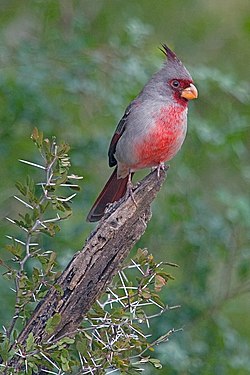
The pyrrhuloxia or desert cardinal is a medium-sized North American songbird found in the American southwest and northern Mexico. This distinctive species with a short, stout bill and red crest and wings, and closely resembles the northern cardinal and the vermilion cardinal, which are in the same genus.
Region
Southwestern United States and northern Mexico
Typical Environment
Occurs primarily in the Sonoran and Chihuahuan Deserts, extending into arid scrub and mesquite-thorn woodlands. Favors brushy washes, desert flats with scattered cacti and mesquite, and riparian thickets in otherwise dry landscapes. It also uses suburban edges and ranchlands where native thorny shrubs persist. Nests are typically placed in dense, spiny vegetation that offers protection.
Altitude Range
Sea level to 1800 m
Climate Zone
Arid
Ease of Keeping
Beginner friendly: 1/5
Also called the desert cardinal, the pyrrhuloxia thrives in hot, thorny desert scrub where few other cardinals occur. It sports a thick, parrot-like yellow bill adapted for cracking tough desert seeds. Males are gray with rich red highlights and a jaunty crest; females are subtler with limited red. Its whistled songs resemble those of the northern cardinal but are often drier and more metallic.




Temperament
solitary and territorial
Flight Pattern
short rapid wingbeats
Social Behavior
Pairs defend territories in the breeding season, often remaining together year-round. Nests are open cups tucked into thorny shrubs, cacti, or mesquite; the female incubates while the male often feeds her. Outside breeding, small loose flocks may form around food sources.
Migratory Pattern
Resident
Song Description
Song is a series of clear, whistled phrases similar to a northern cardinal but drier, with metallic overtones. Calls include sharp chips and tinkling notes used for contact in dense brush.
Plumage
Males are slate-gray with bright red crest, face, breast wash, wings, and tail; females are gray-brown with subdued reddish tints on crest, wings, and tail. Both sexes have a short, deep, parrot-like bill and a shaggy crest.
Diet
Eats a wide variety of desert seeds (mesquite, cactus, grasses) and seasonal fruits and berries. Insects such as beetles, grasshoppers, and caterpillars are taken more frequently during breeding to feed nestlings. Uses its powerful bill to crack tough pods and hulls and will glean arthropods from foliage and the ground.
Preferred Environment
Forages in thorny desert scrub, mesquite bosques, and along brushy arroyos and riparian edges. Often feeds low in shrubs or on the ground near cover, occasionally visiting bird feeders in desert towns.


