

The passenger pigeon or wild pigeon is an extinct species of pigeon that was endemic to North America. Its common name is derived from the French word passager, meaning "passing by", due to the migratory habits of the species. The scientific name also refers to its migratory characteristics. The morphologically similar mourning dove was long thought to be its closest relative, and the two were at times confused, but genetic analysis has shown that the genus Patagioenas is more closely related to it than the Zenaida doves.
Region
Eastern and Central North America (historical)
Typical Environment
Historically occupied vast tracts of deciduous and mixed forests from southern Canada through the eastern United States to the Gulf Coast. They bred in immense colonies in mast-rich woodlands, especially around the Great Lakes and Appalachian foothills. Wintering occurred mostly in the southeastern United States, with movements tracking acorn, beech, and chestnut crops. Migratory routes spanned the Mississippi Valley and along the Appalachian chain. Their roosts and nesting sites could cover many square kilometers, with branches breaking under the weight of thousands of birds.
Altitude Range
Sea level to 1200 m
Climate Zone
Temperate
Ease of Keeping
Beginner friendly: 1/5
Passenger pigeons once formed the largest bird flocks ever recorded, darkening the sky for hours as they passed. The species went extinct in 1914, when the last known individual, Martha, died in the Cincinnati Zoo. Overhunting and widespread loss of mast-rich old-growth forests led to a rapid population collapse. They played a major role in seed dispersal for oaks, beeches, and chestnuts across eastern North America.


Earliest published illustration of the species (a male), Mark Catesby, 1731

Mounted male passenger pigeon, Field Museum of Natural History

Band-tailed pigeon, a species in the related genus Patagioenas

The physically similar mourning dove is not closely related.

Skeleton of a male bird, 1914

Musical notes documenting male vocalizations, compiled by Wallace Craig, 1911
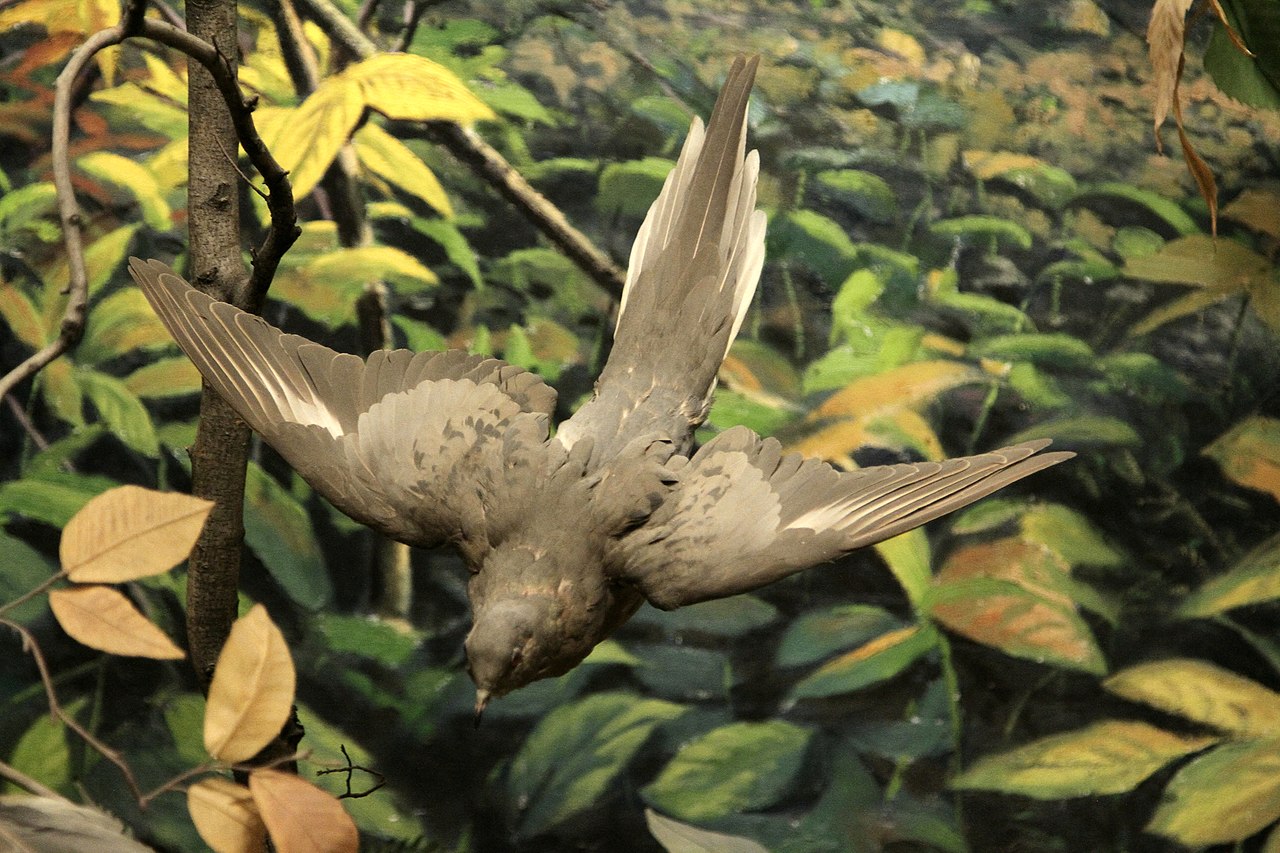
Specimen in flying pose, Academy of Natural Sciences of Drexel University

Live male in Whitman's aviary, 1896/98

Illustration of migrating flocks, Frank Bond, 1920

Juvenile (left), male (center), female (right), Louis Agassiz Fuertes, 1910

Alert parent bird posing defiantly towards the camera (1896, published 1913)

Taxidermied specimens mounted as if foraging for pin oak acorns, at the American Museum of Natural History.

Internal organs of Martha, the last individual: cr. denotes the crop, gz. the gizzard, 1915

Nesting captive bird, wary of the photographer

Nest and egg in Whitman's aviary

Preserved egg, Muséum de Toulouse

Live nestling or squab

Immature bird; the young were vulnerable to predators after leaving the nest

Billing pair by John James Audubon, from The Birds of America, 1827–1838. This image has been criticized for its scientific inaccuracy.

Painting of a male, K. Hayashi, c. 1900

Depiction of a shooting in northern Louisiana, Smith Bennett, 1875

1881 spread showing methods of trapping pigeons for shooting contests

Pigeon net in Canada, by James Pattison Cockburn, 1829

Trapper Albert Cooper with blind decoy pigeons for luring wild birds, c. 1870

Male and female by Louis Agassiz Fuertes, frontispiece of William Butts Mershon's 1907 The Passenger Pigeon

Life drawing by Charles R. Knight, 1903

"Buttons", one of the last confirmed wild passenger pigeons, Cincinnati Zoo

Whitman's aviary with passenger pigeons and other species, 1896/98

"The Folly of 1857 and the Lesson of 1912", frontispiece to William T. Hornaday's Our vanishing wild life (1913), showing Martha in life, the endling of the species.

Martha at the Smithsonian Museum, 2015

Pigeons being shot to save crops in Iowa, 1867

Taxidermied male and female, Laval University Library
Temperament
highly social and gregarious
Flight Pattern
very fast, powerful flight with rapid wingbeats
Social Behavior
Formed massive flocks and bred colonially, with nesting colonies numbering millions of birds. Typically laid a single egg per nest; both parents incubated and fed the chick with crop milk. Communal roosting and synchronized movements were common, likely as an anti-predator strategy.
Migratory Pattern
Seasonal migrant
Song Description
Vocalizations included soft cooing notes and harsher, clucking keck calls in flocks. Wing claps and rustling from large groups were often as conspicuous as their calls.
Plumage
Sleek, smooth plumage with a long, tapered tail; males show iridescent bronze-to-rose neck patches and bluish-gray upperparts with black spots on the wings. Underparts in males are warm rufous; females are duller brownish-gray with less iridescence.
Diet
Primarily consumed mast such as acorns, beechnuts, and chestnuts, supplemented by seeds and berries. They also took agricultural grains when available. Seasonally, they ate soft fruits and occasionally small invertebrates to meet protein needs. Foraging in enormous flocks allowed efficient exploitation of patchy food resources.
Preferred Environment
Fed on the forest floor beneath oaks and beeches, as well as at forest edges and adjacent fields. They often descended in dense waves to strip food resources, then moved en masse to new sites.


