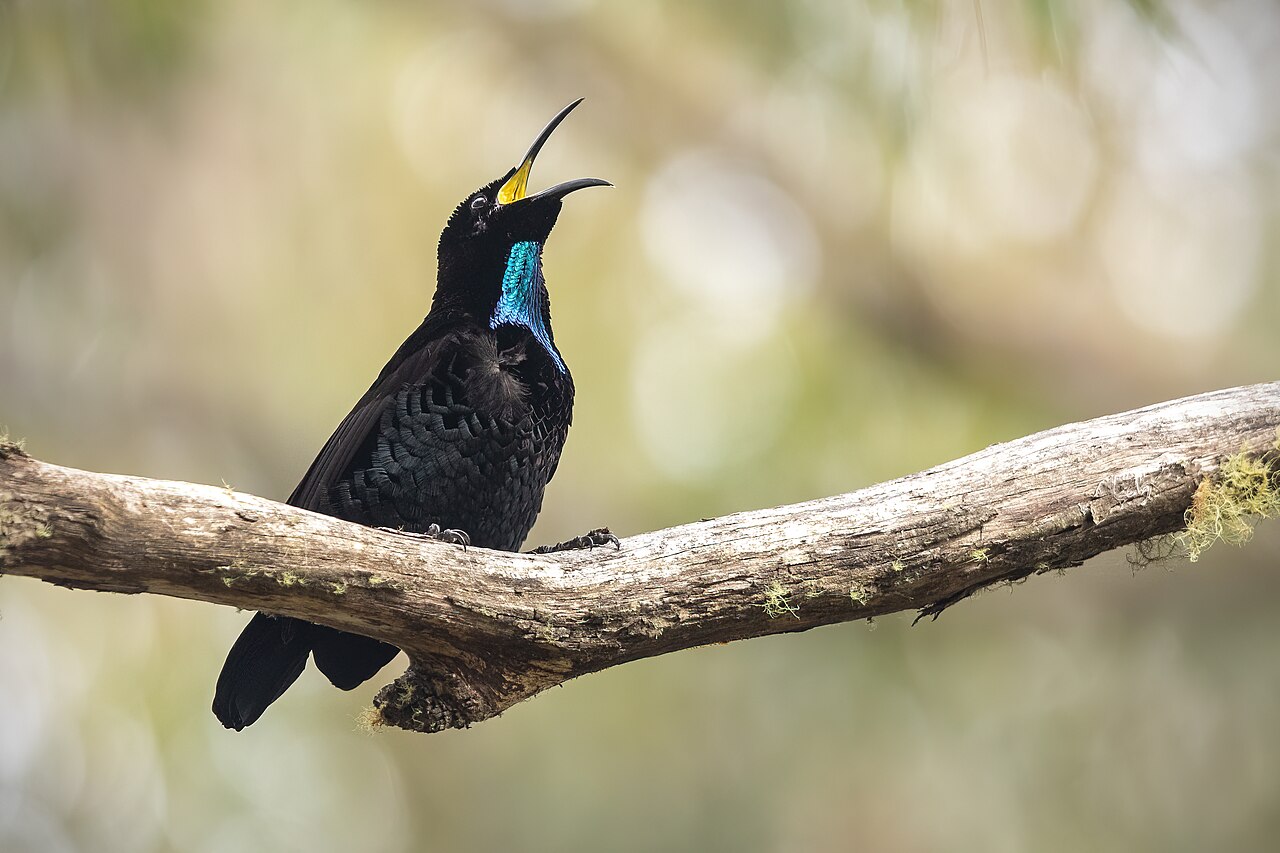
The paradise drongo or ribbon-tailed drongo is a species of bird in the family Dicruridae. It is endemic to New Ireland in the Bismarck Archipelago, Papua New Guinea. With a total length of 51 to 63 cm and body mass of 130 g (4.6 oz), this may be the largest species of drongo.
Region
Bismarck Archipelago
Typical Environment
Occurs only on New Ireland, where it inhabits primary and mature secondary rainforest from lowlands into foothills. It frequents interior forest but also edges, clearings, and riparian corridors where aerial insects are abundant. Birds typically forage in the mid- to upper canopy, using exposed perches to launch short sallies. It can persist in selectively logged forest provided sufficient canopy structure remains.
Altitude Range
Sea level to 1200 m
Climate Zone
Tropical
Ease of Keeping
Beginner friendly: 1/5
Also known as the ribbon-tailed drongo, this species is endemic to New Ireland in the Bismarck Archipelago of Papua New Guinea. With a total length of 51–63 cm driven by extremely long tail streamers, it is considered the largest drongo. It is a forest specialist that often hunts by sallying from perches in the mid- to upper canopy. The spectacular tail streamers are used in display and can be several times the body length.

Temperament
territorial and alert
Flight Pattern
agile with short rapid wingbeats and quick sallies
Social Behavior
Usually seen singly or in pairs, defending territories in suitable forest. Pairs build a small cup nest on a horizontal branch or fork high in the canopy. They may join mixed-species flocks while foraging but remain assertive around their core territory.
Migratory Pattern
Resident
Song Description
Vocalizations include sharp metallic chinks, whistles, and rasping notes delivered from prominent perches. The repertoire is varied and loud, carrying well through dense forest.
Plumage
Glossy black with a bluish-green metallic sheen; outer tail feathers extremely elongated and ribbon-like.
Diet
Primarily hunts flying insects such as beetles, moths, wasps, and flies by sallying from exposed perches. It also gleans arthropods from foliage and branches when opportunities arise. Occasional small prey may be taken from the ground or understory.
Preferred Environment
Most often forages in the mid- to upper canopy along forest edges, gaps, and sunlit clearings that concentrate aerial insects. It also works along stream corridors and above forest roads.