

The Papuan mountain pigeon is a species of bird in the pigeon family, Columbidae. It is found in the Bacan Islands, New Guinea, the D'Entrecasteaux Islands, and the Bismarck Archipelago, where it inhabits primary forest, montane forest, and lowlands. It is a medium-sized species of pigeon, being 33–36 cm (13–14 in) long and weighing 259 g (9.1 oz) on average. Adult males have slate-grey upperparts, chestnut-maroon throats and bellies, whitish breasts, and a pale grey terminal tail band. The lores and orbital region are bright red. Females are similar, but have grayish breasts and grey edges to the throat feathers.
Region
New Guinea and adjacent islands
Typical Environment
Occurs across New Guinea and nearby islands including the Bacan Islands, the D’Entrecasteaux Islands, and the Bismarck Archipelago. It uses primary and secondary forests from lowlands to montane zones, often roosting in tall emergent trees. Birds frequently move along elevational gradients to track fruiting events. It also visits forest edges and clearings but remains strongly tied to wooded habitats.
Altitude Range
Sea level to 3500 m
Climate Zone
Tropical
Ease of Keeping
Beginner friendly: 1/5
Often seen in fast-flying flocks commuting at dawn and dusk between feeding areas and high forest roosts. It favors fruiting trees, especially figs, and can descend from mountains to lowland forests when food is abundant. Its bright red lores and orbital skin are distinctive at close range. Like many forest pigeons, it is an important seed disperser.


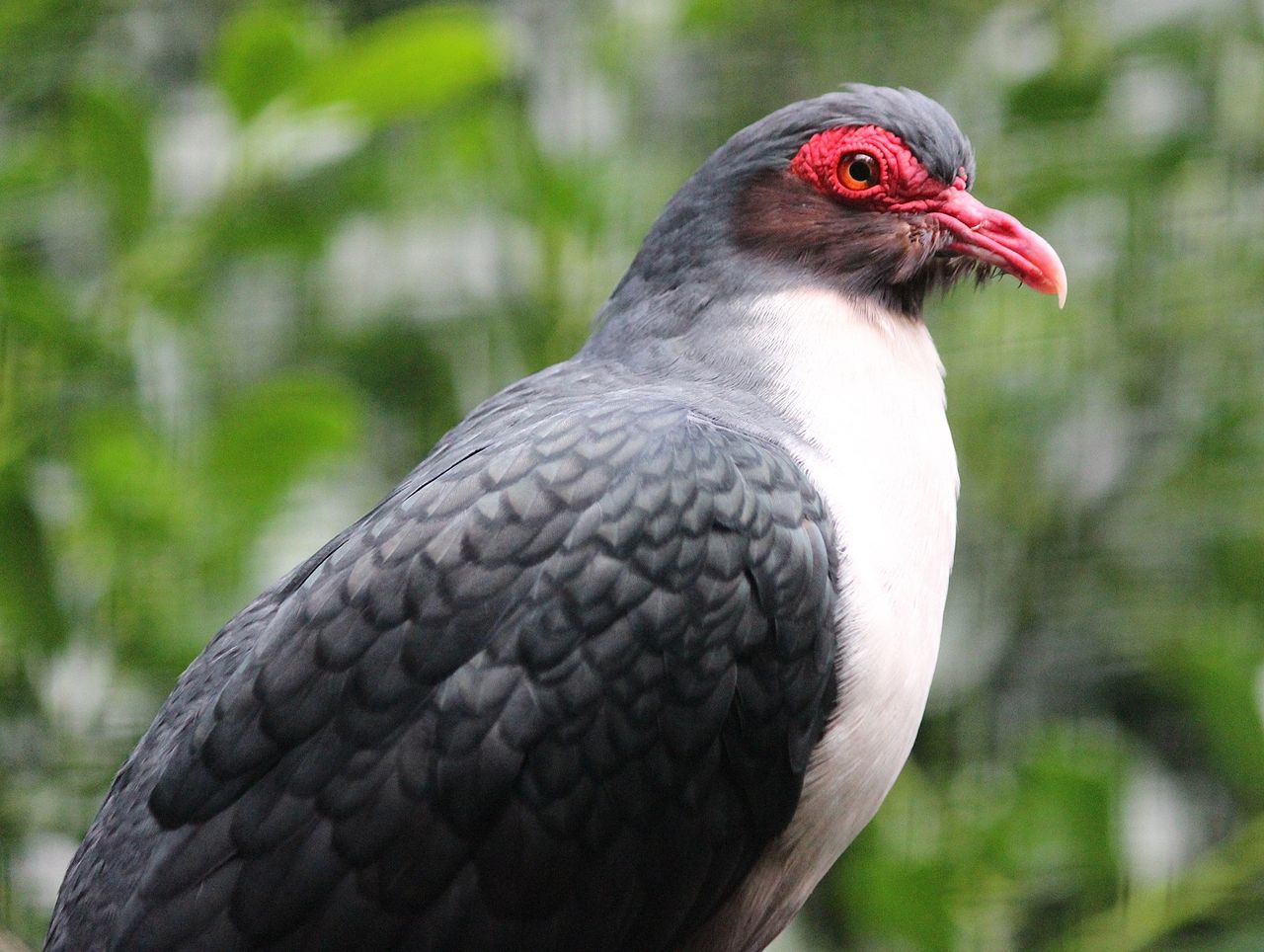
An individual at the Walsrode Bird Park

Papuan mountain pigeon feeding
Temperament
social and active
Flight Pattern
strong flier with fast, direct flight; often high overhead
Social Behavior
Commonly forms medium to large flocks, especially when commuting between roosts and feeding sites. Nests in trees within forest, with discreet behavior around nesting areas. Pairs likely maintain close bonds during the breeding period while joining larger groups to forage.
Migratory Pattern
Partial migrant
Song Description
Vocalizations are low, booming coos typical of large forest pigeons. Calls are most often heard at dawn and dusk near roosts or during display flights.
Plumage
Slate-grey upperparts with a whitish breast, chestnut-maroon throat and belly, and a pale grey terminal tail band; females show greyer breast tones and grey edging on throat feathers.
Diet
Primarily frugivorous, taking figs and other soft fruits from forest canopies. It also consumes a variety of berries and drupes and may swallow small seeds incidentally. By moving across elevations to follow fruiting peaks, it contributes significantly to seed dispersal.
Preferred Environment
Feeds mainly in the mid- to upper canopy of primary and montane forests. Also forages along forest edges and in secondary growth where fruiting trees are abundant.


