

The northern house wren is a very small passerine in the wren family Troglodytidae. It is found in southern Canada, the USA and Mexico. It occurs in most suburban areas in its range. It formerly included many subspecies resident in South America and in the Caribbean that are now considered as separate species. The name troglodytes means "hole dweller", and is a reference to the bird's tendency to disappear into crevices when hunting insects or to seek shelter.
Region
North America
Typical Environment
Breeds widely from southern Canada through most of the United States into parts of northern and central Mexico, and winters southward into the southern U.S. and Mexico. Favors forest edges, open woodlands, shrubby thickets, riparian corridors, and suburban yards and parks. Common around human habitation where nest sites and brushy cover are available. Uses natural cavities, old woodpecker holes, nest boxes, and crevices in buildings for nesting.
Altitude Range
Sea level to 3000 m
Climate Zone
Temperate
Ease of Keeping
Beginner friendly: 1/5
A tiny, energetic wren that thrives around people, readily nesting in birdhouses, fence posts, and crevices. Males often build several 'dummy' stick nests to attract a mate and defend territory. Its scientific genus name, Troglodytes, means 'hole-dweller,' reflecting its cavity-nesting habits. Despite its size, it sings a remarkably loud, bubbly song.




Audubon's illustration of nesting house wrens

House Wren peering out from a nesting box
Temperament
energetic and territorial
Flight Pattern
short rapid wingbeats with low, darting flights
Social Behavior
Primarily monogamous but males may build multiple nests within a territory. Strong cavity nester that readily uses nest boxes and natural holes. Aggressively defends nest sites and may remove material from competing nests. Both parents feed the young after hatching.
Migratory Pattern
Partial migrant
Song Description
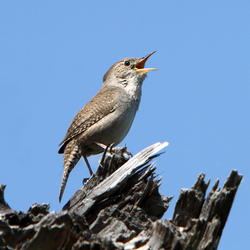
A loud, bubbly series of trills and gurgling phrases delivered in rapid succession. Scolding harsh churrs and chatters are common when alarmed near the nest.
Plumage
Plain brown above with fine barring on wings and tail; paler, lightly barred underparts; short, cocked tail typical of wrens.
Diet
Feeds mainly on insects and spiders, including beetles, caterpillars, ants, leafhoppers, and flies. Gleans prey from bark, leaves, and twigs, and probes into crevices and curled leaves. Occasionally takes small berries in cooler months when insects are scarce. Forages close to the ground up to mid-canopy in dense cover.
Preferred Environment
Brushy edges, hedgerows, gardens, and woodlots with abundant understory and tangles. Often forages around human structures, brush piles, and fallen logs that harbor insect prey.


