

The northern giant petrel, also known as Hall's giant petrel, is a large, predatory seabird of the southern oceans. Its range overlaps broadly with the range of the related southern giant petrel, albeit slightly further to the north.
Region
Subantarctic and Southern Ocean
Typical Environment
Breeds on subantarctic islands north of the Antarctic Convergence and ranges widely across the Southern Ocean. At sea it frequents cold, productive waters, frontal zones, and continental shelf edges. Near colonies it patrols coastlines and beaches where marine mammals and penguins occur. It regularly attends fishing vessels for offal and follows ships across vast distances. Nesting sites are on open slopes, coastal headlands, and tussock-covered terrain close to the sea.
Altitude Range
Sea level to 300 m
Climate Zone
Polar
Ease of Keeping
Beginner friendly: 1/5
Also called Hall's giant petrel, it is a powerful scavenger and predator, often dominating carcasses of penguins and seals. It is one of the few procellariiforms capable of taking sizeable live prey and regularly follows fishing vessels for discards. Northern and southern giant petrels look similar; the northern usually shows a reddish bill tip, helping separation from the green-tipped southern species.


Immature northern giant petrel in flight.

On Salisbury Plain, South Georgia, British Overseas Territories

A northern giant petrel picking a penguin carcass at Godthul, South Georgia
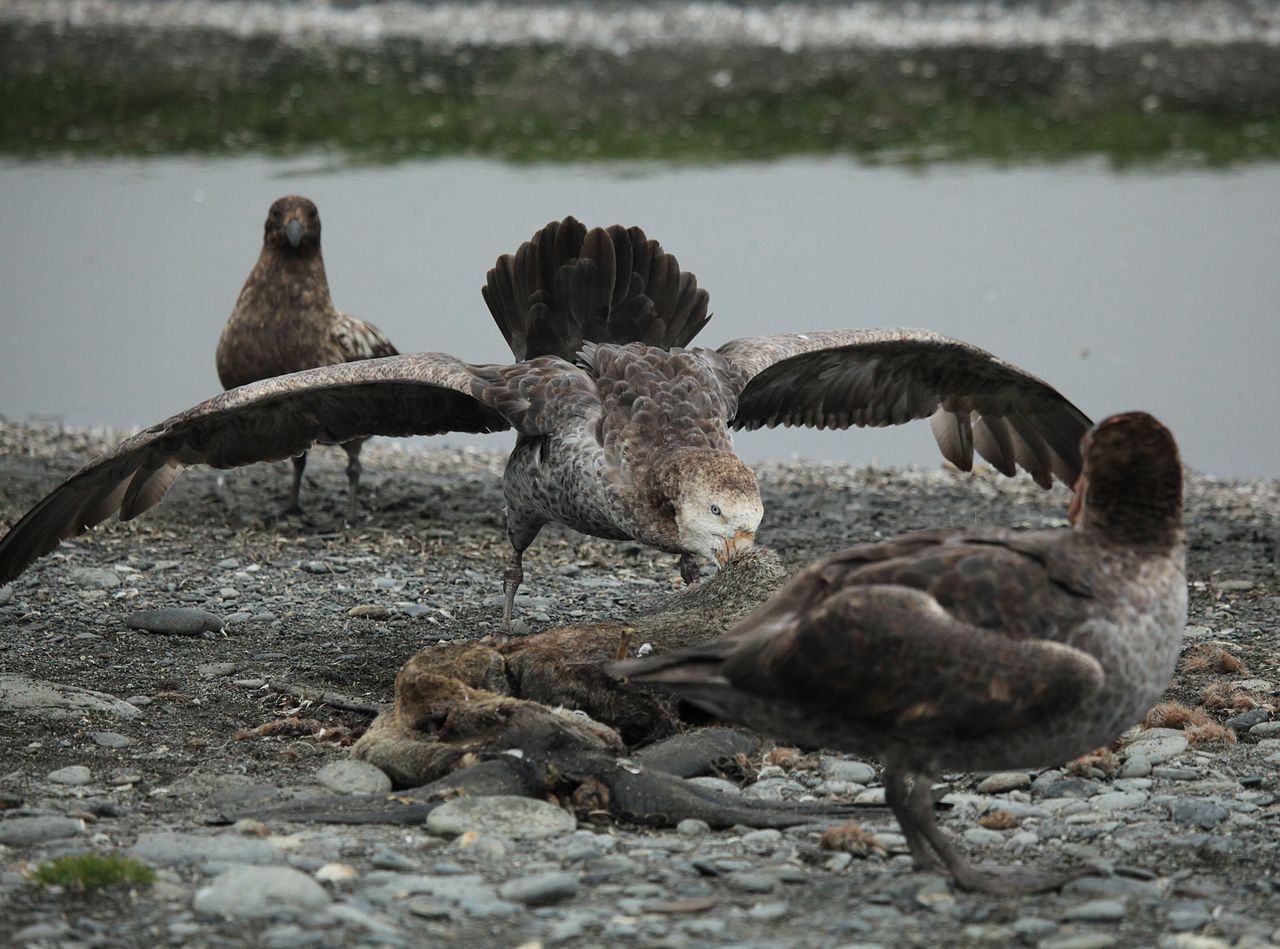
Two giant petrels eating a fur seal carcass at Salisbury Plain, South Georgia. In the rear is a brown skua.
Temperament
dominant and assertive scavenger
Flight Pattern
soaring glider using dynamic soaring and low, stiff-winged passes over waves
Social Behavior
Breeds in loose colonies or scattered pairs, typically laying a single egg. Pairs are long-lived and show strong site fidelity, sharing incubation and chick-rearing duties. Away from nests, birds congregate at carcasses and behind vessels, where competitive aggression is common.
Migratory Pattern
Partial migrant
Song Description
Vocalizations are harsh and guttural, including croaks, grunts, and cackling calls, often accompanied by bill-clicking. Most calling occurs at colonies and during competitive interactions at food sources.
Plumage
Coarsely mottled chocolate-brown to gray-brown body with paler head and neck in older birds; juveniles are darker overall. A rare pale morph shows mostly white plumage with scattered dark blotches. Feathers appear harsh and shaggy around the neck, enhancing the bulky look.
Diet
An opportunistic carnivore that scavenges carcasses of penguins and seals and also takes fish, squid, krill, and other seabirds. It frequently pirates food from other seabirds and exploits discards from fishing vessels. Capable of tearing tough hide and opening carcasses with its powerful bill.
Preferred Environment
Forages over cold, productive subantarctic waters, along upwelling fronts, and near colonies where marine mammals haul out. Often feeds at the water’s surface, at strandlines, and in the wake of ships.


