

The noisy scrubbird is a species of bird in the family Atrichornithidae. It is endemic to the coastal heaths of south-western Australia.
Region
Southwest Australia
Typical Environment
Occurs in dense coastal heaths, thickets, and sedge-dominated understorey near the south coast of Western Australia. It favors wet gullies, swampy margins, and densely vegetated slopes where leaf litter accumulates. Habitat structure—continuous low cover with complex ground layer—is more important than specific plant species. Populations are centered around Two Peoples Bay and Waychinicup, with translocations to nearby areas including Bald Island. Fire regimes strongly influence occupancy and persistence.
Altitude Range
Sea level to 400 m
Climate Zone
Temperate
Ease of Keeping
Beginner friendly: 1/5
Long thought extinct, the noisy scrubbird was rediscovered in 1961 at Two Peoples Bay, Western Australia. It is one of the loudest songbirds relative to size, with calls carrying over long distances through dense scrub. Extremely secretive and reluctant to fly, it depends on unburnt, dense undergrowth and is highly sensitive to frequent fire. Conservation efforts include habitat protection and translocations to nearby reserves and islands.

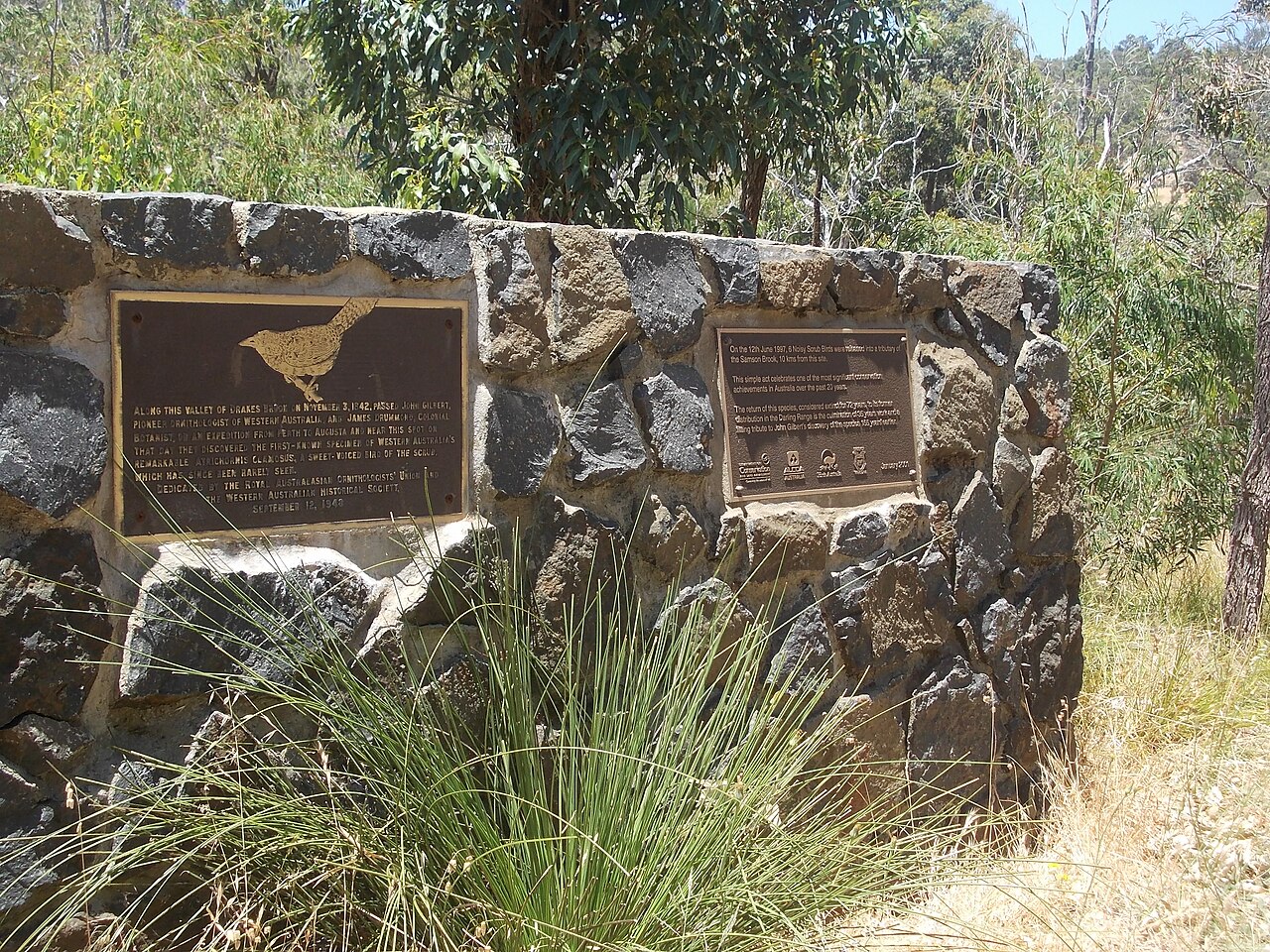
Memorial to "Atrichornis clamosus, a sweet voiced bird of the scrub" at Drakes Brook (Waroona).
Temperament
secretive and skulking
Flight Pattern
short rapid wingbeats, low and reluctant flier
Social Behavior
Typically solitary or in pairs within dense cover. Males hold small territories and sing from concealed perches to advertise and defend space. The nest is a domed structure placed low in dense vegetation, where the female undertakes most nesting duties.
Migratory Pattern
Resident
Song Description
Powerful, ringing phrases delivered in repeated sequences, often startlingly loud for its size. Song carries far through scrub and is used mainly at dawn and dusk, with sharp metallic notes and varied trills.
Plumage
Upperparts brown with fine barring and scalloping; underparts grey-brown with subtle streaking. Male shows darker face and throat with contrasting pale eyebrow; female is plainer and browner overall. Tail is long and often cocked; wings are short and rounded.
Diet
Feeds mainly on ground-dwelling insects, spiders, and other small arthropods. Probes and flicks through leaf litter, bark, and moss to locate prey. Also gleans from low shrubs and sedges but rarely ventures into open ground.
Preferred Environment
Forages within dense understorey, especially in wet thickets, sedgelands, and along creeklines. Uses cover to move quietly while searching in leaf litter and at the bases of shrubs.


