
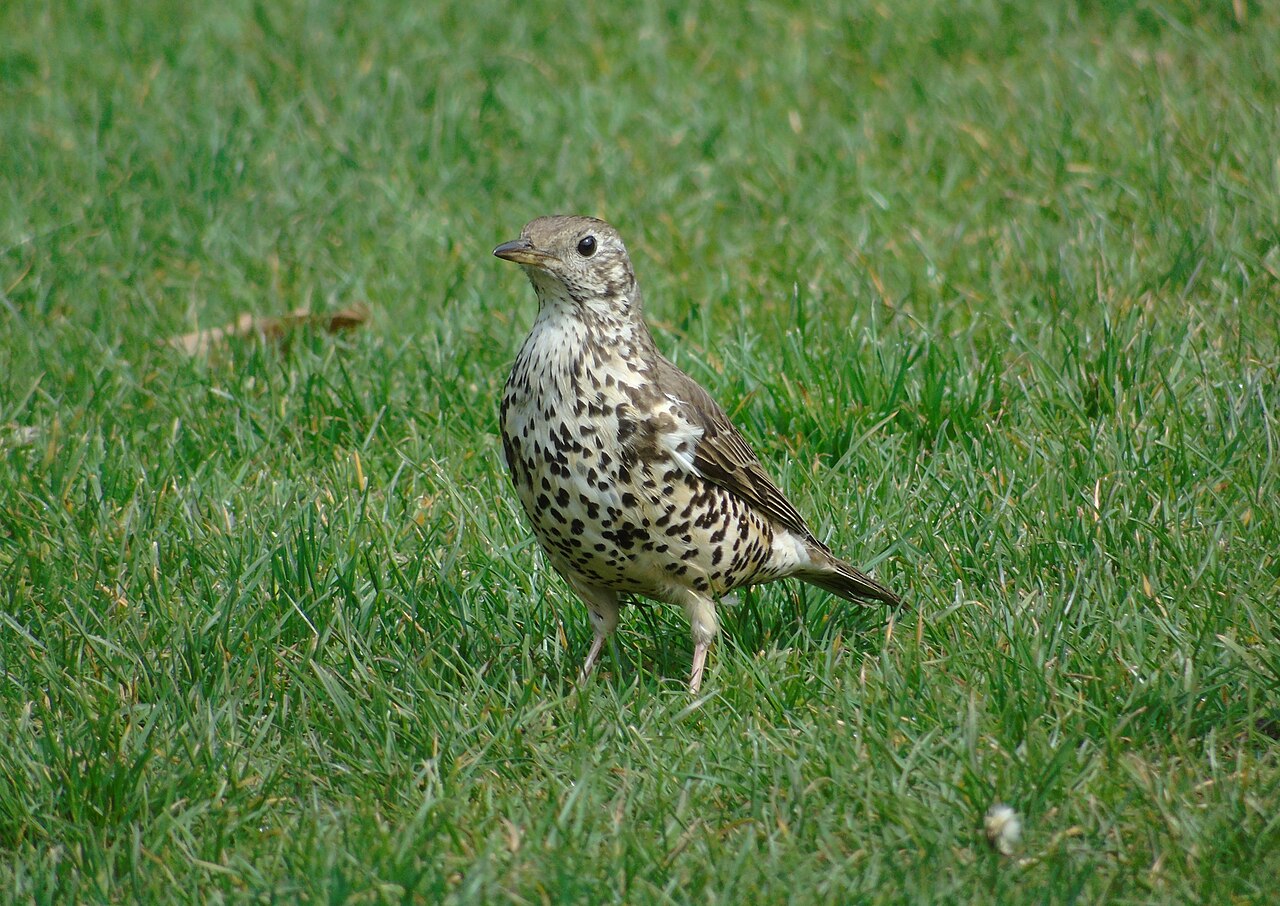
The mistle thrush is a bird common to much of Europe, temperate Asia and North Africa. It is a year-round resident in a large part of its range, but northern and eastern populations migrate south for the winter, often in small flocks. It is a large thrush with pale grey-brown upper parts, a greyish-white chin and throat, and black spots on its pale yellow and off-white under parts. The sexes are similar in plumage, and its three subspecies show only minimal differences. The male has a loud, far-carrying song which is delivered even in wet and windy weather, earning the bird the old name of stormcock. Historically, the name was also sometimes spelled "missel thrush".
Region
Palearctic
Typical Environment
Widespread across much of Europe, North Africa, and temperate Asia. Favors open woodlands, forest edges, parks, large gardens, hedgerows, and pasture with scattered trees. Avoids dense, closed-canopy forest but uses conifer plantations and mixed woodland mosaics. In winter it frequents orchards and berry-rich shrubs, often defending fruiting trees. Urban greenspaces with open lawns and tall trees are also used.
Altitude Range
Sea level to 2500 m
Climate Zone
Temperate
Ease of Keeping
Beginner friendly: 1/5
Also called the stormcock, males famously sing powerfully even in wind and rain from high song posts. It often defends berry-laden trees, especially mistletoe and holly, and is an important disperser of mistletoe seeds. Larger and paler than the song thrush, it stands upright and shows bold round spots on the underparts.


Mistle thrush defending berries in a rowan tree

In Baikonur, Kazakhstan

An adult (right) with two juveniles feeding on a lawn

Male (left) passing earthworms to female on nest

The mistle thrush derives its English and scientific names from mistletoe, a favourite food.

A castor bean tick swollen with the blood of its host

Mistle Thrush and Alpine Chough by Giovanni da Udine
Temperament
solitary and territorial
Flight Pattern
strong, direct flight with steady wingbeats and brief glides
Social Behavior
Breeds early in the season, nesting high in trees near the trunk or on sturdy forks; the nest is a bulky cup of grasses and mud. Pairs defend territories vigorously, especially around fruiting trees in late summer and winter. After breeding, small flocks may form, but adults often remain loosely associated with favored feeding areas.
Migratory Pattern
Partial migrant
Song Description
A loud, fluty, far-carrying song delivered from prominent perches, often continued in windy or rainy weather. Phrases are repeated and less varied than a song thrush, giving a ringing, declarative quality. Calls include a dry, rattling chatter in flight.
Plumage
Pale grey-brown upperparts with a greyish-white chin and throat, and boldly spotted off-white to pale yellowish underparts. The spots are round and well defined, extending onto the belly and flanks. Tail is relatively long with whitish edges; underwing appears pale. Overall a clean, pale, and heavily spotted thrush with an upright stance.
Diet
In spring and summer it takes invertebrates such as earthworms, beetles, caterpillars, and other insects gleaned from the ground and low vegetation. In autumn and winter, berries and fruits become dominant, especially mistletoe, holly, hawthorn, and rowan. It will also take seeds and other soft plant material opportunistically. By swallowing mistletoe berries and excreting the sticky seeds onto branches, it helps propagate the plant.
Preferred Environment
Feeds mainly on short grass, pasture, and open ground where it can run and pause while scanning for prey. In colder months it concentrates around fruiting trees and shrubs in wood edges, gardens, orchards, and hedgerows. Often forages singly or in small, loose groups outside the breeding season.


