

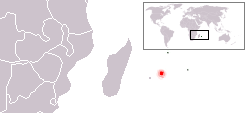
The Mauritius grey white-eye is a species of bird in the family Zosteropidae. It is one of two white-eye species endemic to the island of Mauritius, the other being the rare and localized Mauritius olive white-eye. It inhabits woodlands, forests, and gardens. The Réunion grey white-eye is very closely related. They were formerly considered conspecific and together called Mascarene white-eye.
Region
Mascarene Islands
Typical Environment
Endemic to the island of Mauritius, it occurs from coastal lowlands to upland forest. It occupies native evergreen forest, secondary woodland, thickets, and exotic plantations. The species is also common in rural areas, orchards, and suburban gardens, where it visits flowering shrubs and fruiting trees. It tolerates habitat fragmentation better than many island endemics and often persists along forest edges and in disturbed scrub.
Altitude Range
Sea level to 800 m
Climate Zone
Tropical
Ease of Keeping
Beginner friendly: 2/5
This small white-eye is abundant and adaptable across Mauritius, readily using native forest, scrub, and suburban gardens. It was formerly lumped with the Réunion grey white-eye but is now recognized as a separate species. Its conspicuous white eye-ring and busy, cooperative foraging make it easy to spot despite its size.



Temperament
social and active
Flight Pattern
short rapid wingbeats
Social Behavior
Often travels in pairs or small, chattering groups, especially outside the breeding season. Builds a small cup nest in shrubs or trees; both parents participate in nest building and chick rearing. Frequently joins mixed-species flocks in forest edge habitats.
Migratory Pattern
Resident
Song Description
A high, rapid twitter of thin, tinkling notes interspersed with soft trills. Contact calls are sharp, metallic ‘tsip’ or ‘tzeet’ sounds delivered frequently while foraging.
Plumage
Neat, compact bird with grey to grey-brown upperparts and paler whitish underparts, sometimes with a faint olive wash on the flanks. Throat is pale and clean, contrasting subtly with the breast. Feathers are smooth and close-fitting, giving a tidy appearance.
Diet
Takes small insects and other arthropods gleaned from leaves and twigs. Also consumes nectar from flowering plants and soft fruits such as guavas and other garden fruit. Will hawk briefly for tiny flying insects and probe blossoms for nectar, sometimes getting dusted with pollen.
Preferred Environment
Feeds in the mid-story and canopy of forests, along edges, and in scrubby gardens. Regularly visits ornamental and native flowering shrubs as well as fruiting trees in cultivated areas.


