

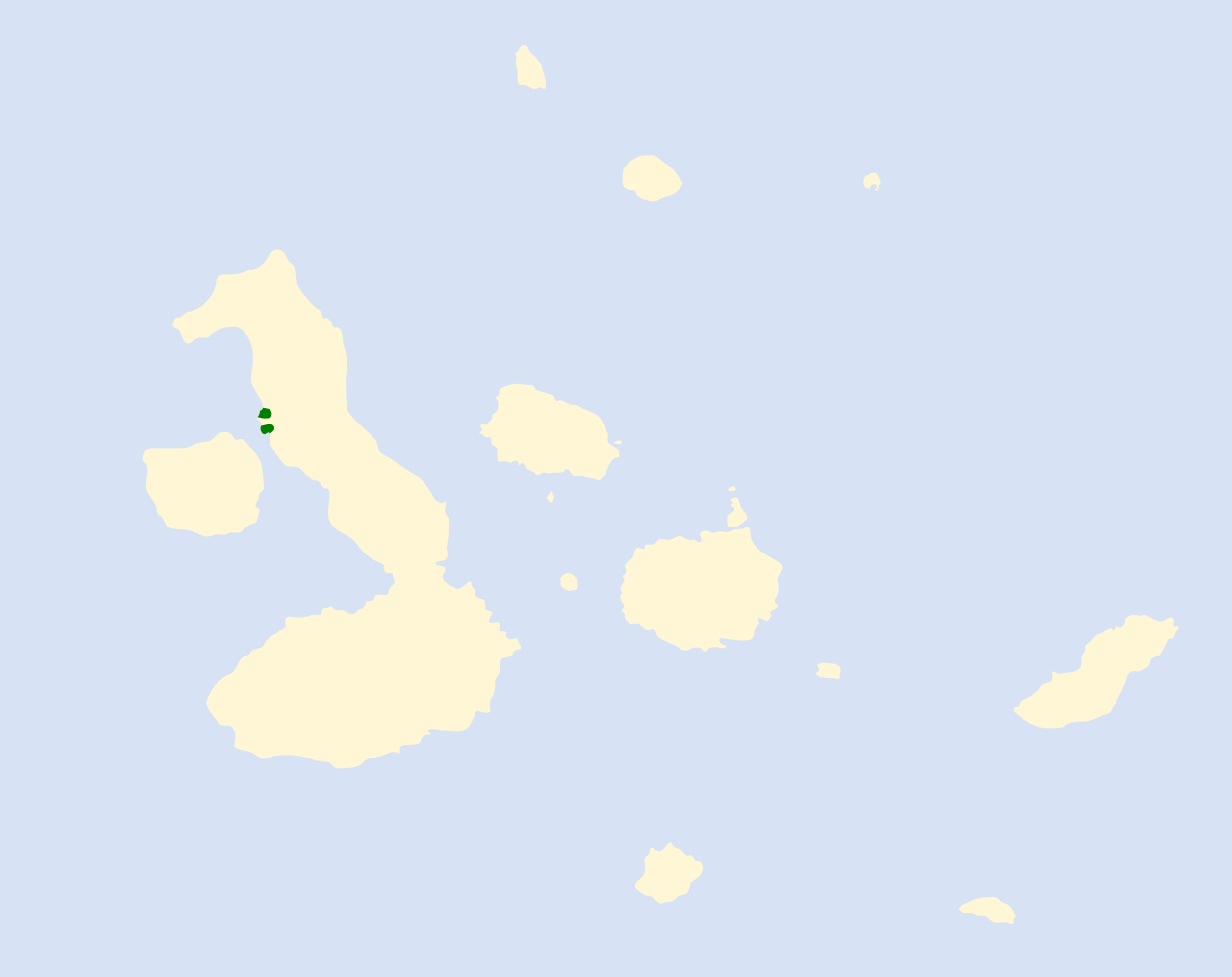
The mangrove finch is a species of bird in the Darwin's finch group of the tanager family Thraupidae. It is endemic to the Galápagos Islands. It was found on the islands of Fernandina and Isabela, but recent surveys have failed to record the species on Fernandina. It has been classified as critically endangered by BirdLife International, with an estimated population of 20–40 mature individuals in 2021, located in two large mangroves on Isabela. A study has shown that the two small populations remaining on Isabela Island have begun undergoing speciation and that one or both populations will eventually become extinct due to a lack of interbreeding.
Region
Galápagos Islands
Typical Environment
Now confined to two mangrove patches on the northwest coast of Isabela Island, primarily in black mangrove (Avicennia germinans). It occupies narrow coastal belts, edges of brackish lagoons, and mangrove thickets adjacent to arid scrub. The species forages on bark, leaves, and dead wood within mangroves, gleaning arthropods. Historically it also occurred on Fernandina, but recent surveys have not found it there.
Altitude Range
Sea level to 30 m
Climate Zone
Tropical
Ease of Keeping
Beginner friendly: 1/5
The mangrove finch is one of Darwin’s finches and is restricted to a few mangrove stands on Isabela Island in the Galápagos. It is among the rarest birds in the world, with an extremely small and fragmented population. Major threats include nest parasitism by the invasive Philornis downsi fly, habitat degradation, and small-population effects. Conservation programs use intensive nest management and head-starting to boost chick survival.

Temperament
solitary and territorial
Flight Pattern
short rapid wingbeats
Social Behavior
Typically seen alone or in pairs, maintaining small territories within mangroves. Pairs build enclosed nests in mangrove trees and show strong site fidelity. Breeding success is heavily impacted by parasitic fly larvae, prompting intensive conservation management.
Migratory Pattern
Resident
Song Description
Soft, simple finch-like trills and chips delivered from perches within mangroves. Calls are understated and can be difficult to detect over surf and wind noise.
Plumage
Dull olive-brown to grey-brown upperparts with subtly streaked underparts and a paler throat; overall plain appearance.
Diet
Primarily arthropods including beetles, caterpillars, moths, and spiders gleaned from bark, leaves, and dead wood. It probes crevices in mangrove bark and occasionally forages on the ground or shoreline detritus. Seeds or plant material may be taken opportunistically but are not a major component.
Preferred Environment
Feeds within black mangrove stands, especially on trunks, branches, and canopy foliage. Also forages along edges of brackish lagoons and in driftwood tangles within mangrove belts.


