
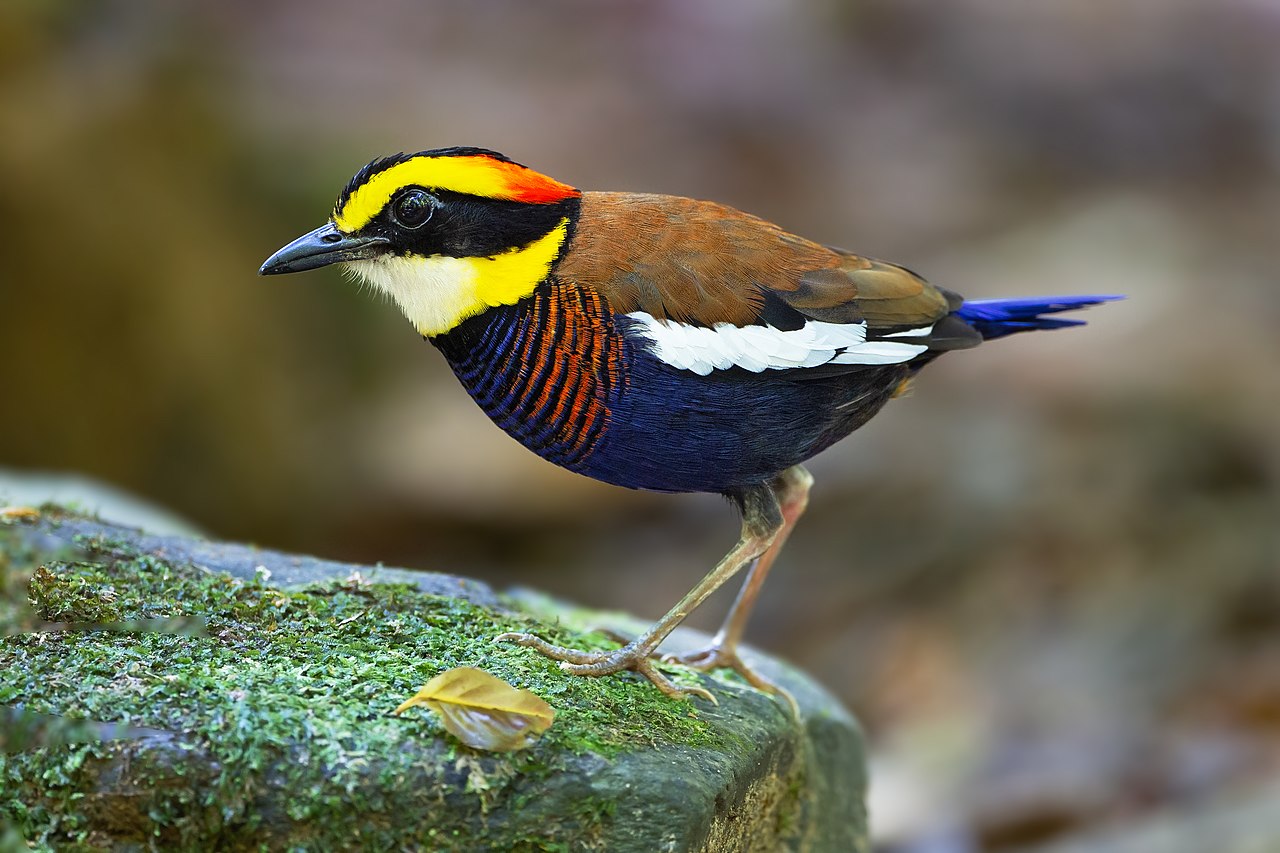
The Malayan banded pitta is a species of bird in the family Pittidae. Other common names include the blue-tailed pitta, the Irene's pitta, the banded pitta and the Van den Bosch's pitta. It is found in Thailand, the Malay Peninsula and Sumatra. It was formerly considered conspecific with the Bornean and Javan banded pittas, together they were referred to as the banded pitta, but now they are considered to be separate species.
Region
Sundaland (southern Thailand, Peninsular Malaysia, Sumatra)
Typical Environment
Inhabits lowland and hill evergreen forests, including mature primary forest and well-structured secondary growth. Prefers dense, shaded understory with plentiful leaf litter and often frequents stream gullies and bamboo thickets. Typically keeps close to the forest floor, moving quietly through cover. It can persist in selectively logged forest if understory remains intact, but avoids highly degraded habitats.
Altitude Range
Sea level to 1500 m
Climate Zone
Tropical
Ease of Keeping
Beginner friendly: 1/5
Once lumped with the Bornean and Javan banded pittas, it is now treated as a distinct species. It is notoriously shy, keeping to dense understory where it forages by flipping leaf litter for invertebrates. Its clear, fluty whistles often reveal its presence long before the bird is seen.

Temperament
shy and secretive
Flight Pattern
short rapid wingbeats, low through understory
Social Behavior
Usually solitary or in pairs, maintaining territories on the forest floor. Nests are domed or ball-shaped structures placed low in dense cover. Breeding typically coincides with wetter months; both parents participate in incubation and care of the young.
Migratory Pattern
Resident
Song Description
A clear, fluty series of whistles, often given as repeated two- or three-note phrases. Calls carry well in dense forest and are the primary cue used to locate the bird.
Plumage
Strikingly banded underparts with fine black barring over rich yellow to orange tones, contrasted with dark upperparts and a bright blue tail. Males show a bold yellow supercilium and black mask; females are duller with heavier barring. Upperparts are brown to olive with subtle barring and blue panels on the wings and tail.
Diet
Feeds mainly on ground-dwelling invertebrates such as beetles, ants, termites, caterpillars, and cockroaches. Also takes earthworms and small snails, occasionally small amphibians. Uses its bill to flip leaves and probe soft soil or moss for hidden prey.
Preferred Environment
Forages on the shaded forest floor, especially in dense understory and along damp stream edges. Often works slowly through patches of leaf litter, pausing to listen before striking.


