
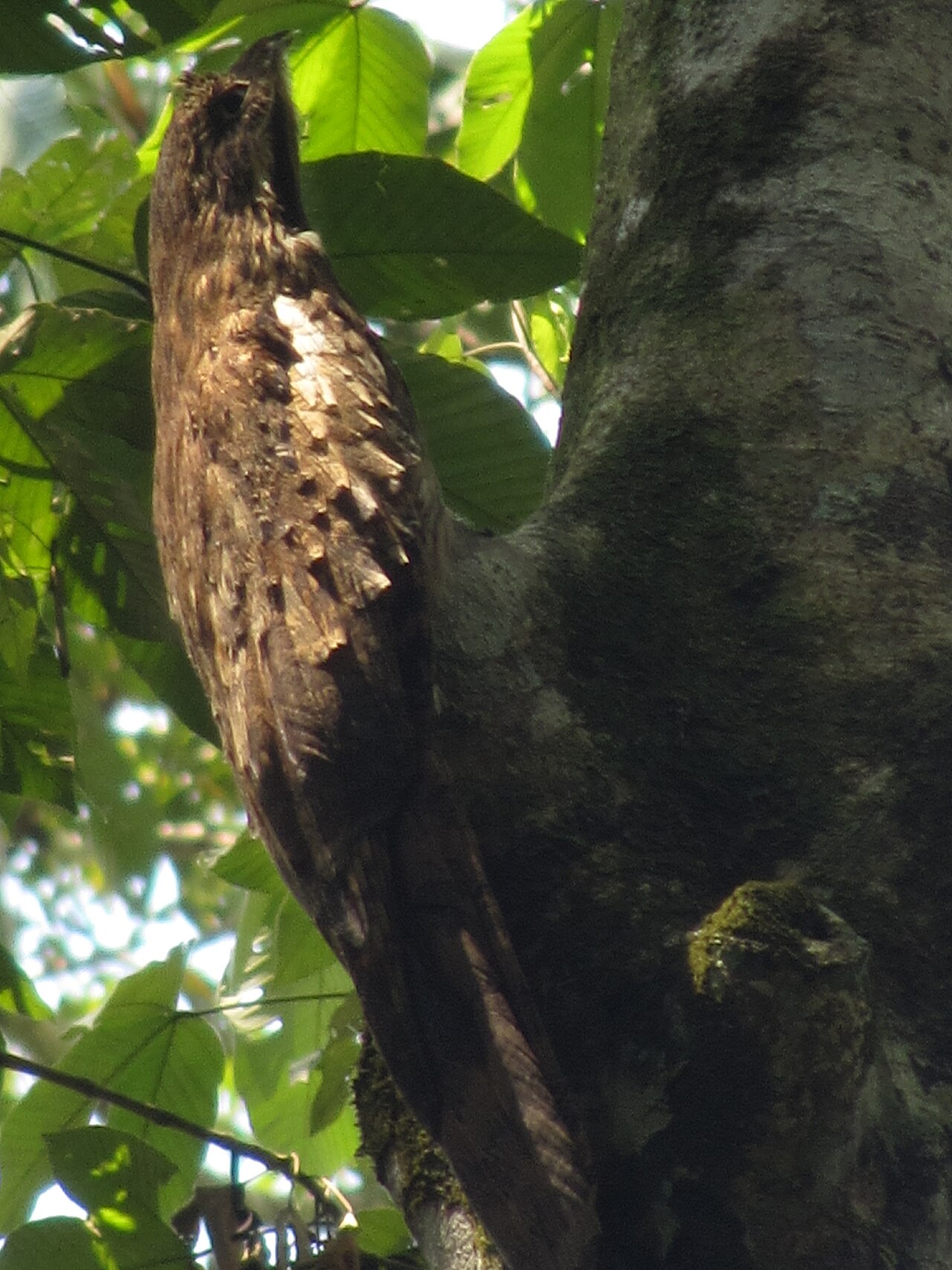
The long-tailed potoo is a species of bird in the family Nyctibiidae. It is found in every mainland South American country except Chile and Uruguay.
Region
Tropical South America
Typical Environment
Occurs widely across the Amazon Basin and the Guianas, extending into eastern Brazil’s Atlantic Forest and reaching parts of Bolivia, Peru, Colombia, Venezuela, and Argentina/Paraguay; absent from Chile and Uruguay. Prefers mature lowland evergreen forest, including terra firme and seasonally flooded várzea, as well as riverine forest and forest edges. Commonly roosts and hunts in the subcanopy and along light gaps, streams, and clearings within otherwise continuous forest. Avoids heavily open landscapes and heavily urbanized areas.
Altitude Range
Sea level to 1200 m
Climate Zone
Tropical
Ease of Keeping
Beginner friendly: 1/5
A master of camouflage, the long-tailed potoo spends daylight hours perched upright on a snag, mimicking a broken branch. At night it hawks large flying insects using a huge, wide gape framed by fine rictal bristles. It lays a single egg in a shallow depression on a bare branch rather than building a nest. Its eerie, mournful whistles are a hallmark of tropical South American forests.


Temperament
solitary and nocturnal
Flight Pattern
short rapid wingbeats with buoyant, silent glides
Social Behavior
Typically solitary or in pairs during the breeding season. Roosts motionless by day on exposed stubs, relying on camouflage. Breeds on a bare branch or stump, laying a single egg; both adults share incubation and chick care.
Migratory Pattern
Resident
Song Description
Gives soft, mournful, whistled phrases that carry far on still nights, often descending in pitch. Calls are repeated at intervals and may accelerate or taper off, creating an eerie, ventriloquial effect.
Plumage
Highly cryptic gray-brown mottling with blackish streaks and fine barring, giving a bark-like appearance.
Diet
Primarily hunts large flying insects such as moths, beetles, and orthopterans. Forages by sallying out from a perch to snatch prey in mid-air with its wide gape. May occasionally take other nocturnal arthropods when available. Swallows prey whole and returns to the same or nearby perch between sallies.
Preferred Environment
Forages along forest edges, river corridors, canopy gaps, and subcanopy perches within mature forest. Often selects exposed snags or horizontal branches with good aerial flyways for hawking insects.


