

The lizard buzzard, or lizard hawk, is a bird of prey in the family Accipitridae. It is the only species placed in the genus Kaupifalco. It is native to Sub-Saharan Africa. Despite its name, it may be more closely related to the Accipiter hawks than the Buteo buzzards.
Region
Sub-Saharan Africa
Typical Environment
Occurs widely in open woodland, savanna, forest edges, and lightly wooded farmland across much of Sub-Saharan Africa. It favors scattered trees, riparian woodland, and edges of clearings, and readily uses fence posts and power lines as hunting perches. It generally avoids dense, closed-canopy rainforest and extremely arid deserts. It is commonly seen near human-altered landscapes, including villages and roadside edges, where suitable perches and prey are plentiful.
Altitude Range
Sea level to 2500 m
Climate Zone
Tropical
Ease of Keeping
Beginner friendly: 1/5
The lizard buzzard is the sole member of its genus and is easily recognized by a bold black vertical throat stripe on a white throat. It is a sit-and-wait hunter that often perches on wires or low branches before pouncing on prey. Despite the name, it is thought to be more closely related to Accipiter hawks than to true Buteo buzzards. Its diet helps control populations of reptiles and large insects in savanna ecosystems.


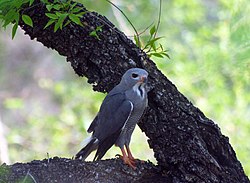
K. monogrammicus in The Gambia, December 2021


Temperament
solitary and territorial
Flight Pattern
short rapid wingbeats interspersed with glides
Social Behavior
Typically seen alone or in territorial pairs. Pairs build small stick nests high in trees and are monogamous within a breeding season. Clutches are usually 1–2 eggs, and both adults participate in incubation and provisioning of the young.
Migratory Pattern
Resident
Song Description
Gives sharp, high-pitched whistles and piping notes, often from an exposed perch. Calls may be repeated in short series, especially during territorial displays or breeding.
Plumage
Slate-grey upperparts with paler grey head; clean white throat and underparts with a bold black central throat stripe and fine grey barring on the chest and flanks. Tail is dark with broad pale bands and a contrasting white tip. Wings are rounded with dark flight feathers and paler coverts.
Diet
Primarily preys on lizards and other small reptiles, but also takes large insects, small birds, and rodents. Hunts from a low to mid-level perch, scanning the ground or trunks before dropping to seize prey. May pursue prey over short distances and sometimes snatches insects in flight. It swallows smaller prey whole and dismembers larger items with its hooked bill.
Preferred Environment
Edges of savanna woodland, open fields with scattered trees, and roadside or fence-line perches. Frequently uses power lines and dead snags to gain a vantage point over open ground.


