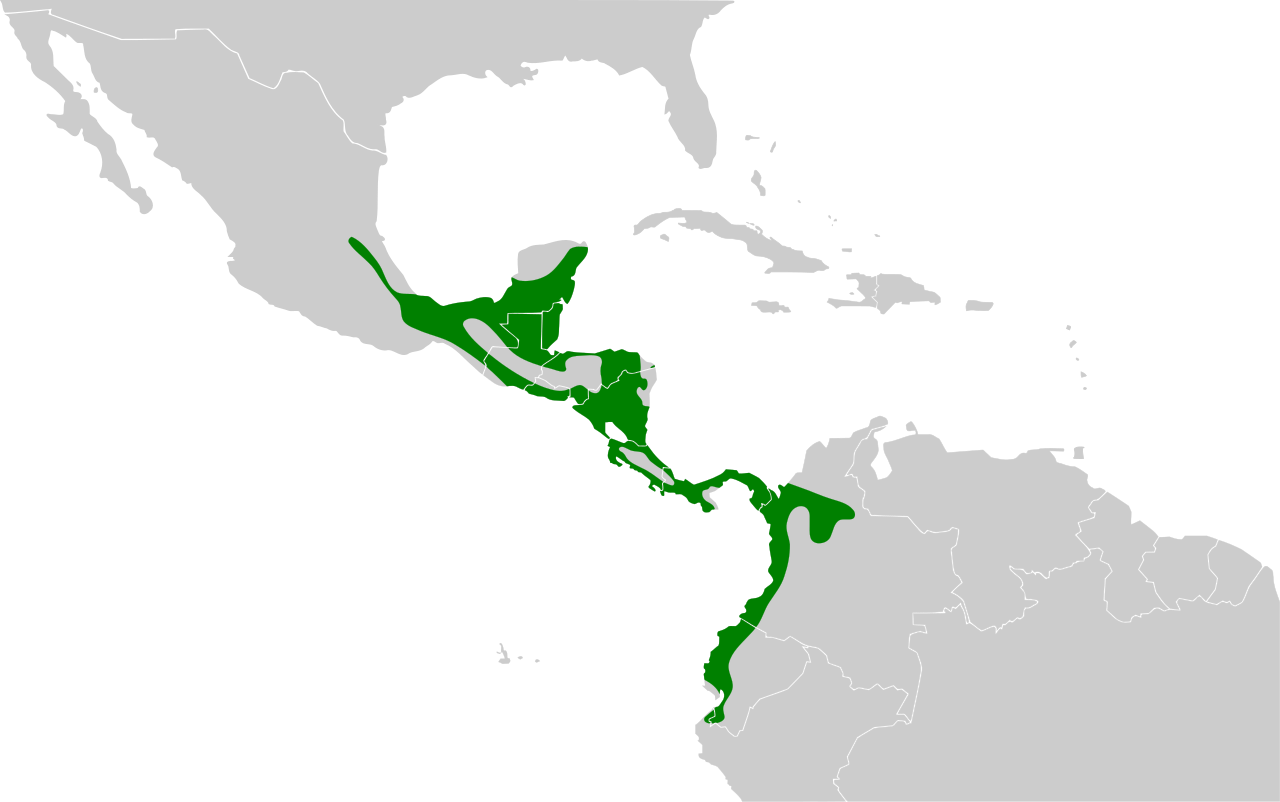
The lesser greenlet is a small passerine bird in the vireo family. It breeds from northeastern Mexico south to western Ecuador.
Region
Central America and Chocó region
Typical Environment
Occurs from northeastern Mexico through Belize, Guatemala, Honduras, Nicaragua, Costa Rica, and Panama, reaching the Pacific slope of Colombia and northwestern Ecuador. Favors humid and semi-humid lowland and foothill forests, forest edges, and second growth. Most frequently seen in the midstory to canopy where it gleans insects from leaves and twigs. Readily joins mixed-species foraging flocks, especially with tanagers and other vireonids.
Altitude Range
Sea level to 1500 m
Climate Zone
Tropical
Ease of Keeping
Beginner friendly: 1/5
The lesser greenlet is a small vireo that forages methodically through foliage, often joining mixed-species flocks. It is common in the canopy and edges of humid forests from northeastern Mexico to western Ecuador. Its neat hanging cup nest is suspended from a forked twig and is built by both sexes. Despite its plain appearance, its sharp scolding notes often reveal its presence before it is seen.

Temperament
active and somewhat secretive
Flight Pattern
short rapid wingbeats between perches
Social Behavior
Usually seen singly or in pairs, but commonly participates in mixed-species flocks while foraging. Pairs are monogamous during the breeding season and defend small territories. The nest is a delicate, hanging cup suspended from a forked twig; both sexes share nesting duties.
Migratory Pattern
Resident
Song Description
Gives a brisk series of scolding, chattering notes characteristic of vireos, interspersed with thin, high chips. The song is simple and repetitive, often delivered from concealed perches in the midstory.
Plumage
Plain olive-green upperparts with a grayish-tinged head, whitish throat and belly, and a yellowish wash on the flanks. Underparts are clean and smooth, lacking bold streaks. Wings and tail are dusky with olive edging.
Diet
Primarily consumes small arthropods such as caterpillars, beetles, and spiders gleaned from foliage. It occasionally takes small berries or soft fruits, especially when insect prey is less abundant. Foraging is deliberate, picking prey from leaf surfaces and twigs.
Preferred Environment
Feeds in the midstory to canopy of humid forest, edges, and tall secondary growth. Often forages along vine tangles and outer foliage where prey is abundant. Frequently joins mixed-species flocks to exploit disturbed insect prey.