

The laggar falcon, also known as the lugger falcon or jugger, is a mid-sized bird of prey which occurs in the Indian subcontinent from extreme southeastern Iran, southeastern Afghanistan, Pakistan, through India, Nepal, Bhutan, Bangladesh and northwestern Myanmar.
Region
Indian Subcontinent
Typical Environment
Occurs from southeastern Iran and Afghanistan through Pakistan, India, Nepal, Bhutan, Bangladesh, and into northwestern Myanmar. Prefers semi-arid plains, scrublands, open woodland edges, and farmlands with scattered trees. Frequently hunts along field margins, dry riverbeds, and around human settlements. It uses cliffs, rocky outcrops, tall trees, and utility structures for perching and nesting. Local movements follow prey availability and seasonal conditions.
Altitude Range
Sea level to 1500 m
Climate Zone
Arid
Ease of Keeping
Beginner friendly: 2/5
Also called the lugger falcon or jugger, this medium-sized falcon favors open, arid landscapes and agricultural mosaics across the Indian subcontinent. Its population has declined in parts of its range due to pesticide use, electrocution on power lines, habitat degradation, and trapping. It is sometimes confused with the lanner falcon; the laggar is generally darker with a weaker moustachial stripe. It often uses cliffs, pylons, or old nests of other raptors and corvids for breeding.


Laggar falcon juvenile in flight. Juvenile laggars are brown birds overall, very similar to juvenile saker falcons Falco cherrug. Markings on underparts vary from dark chocolaty brown to sparse brown blotches.

Juvenile laggar falcon
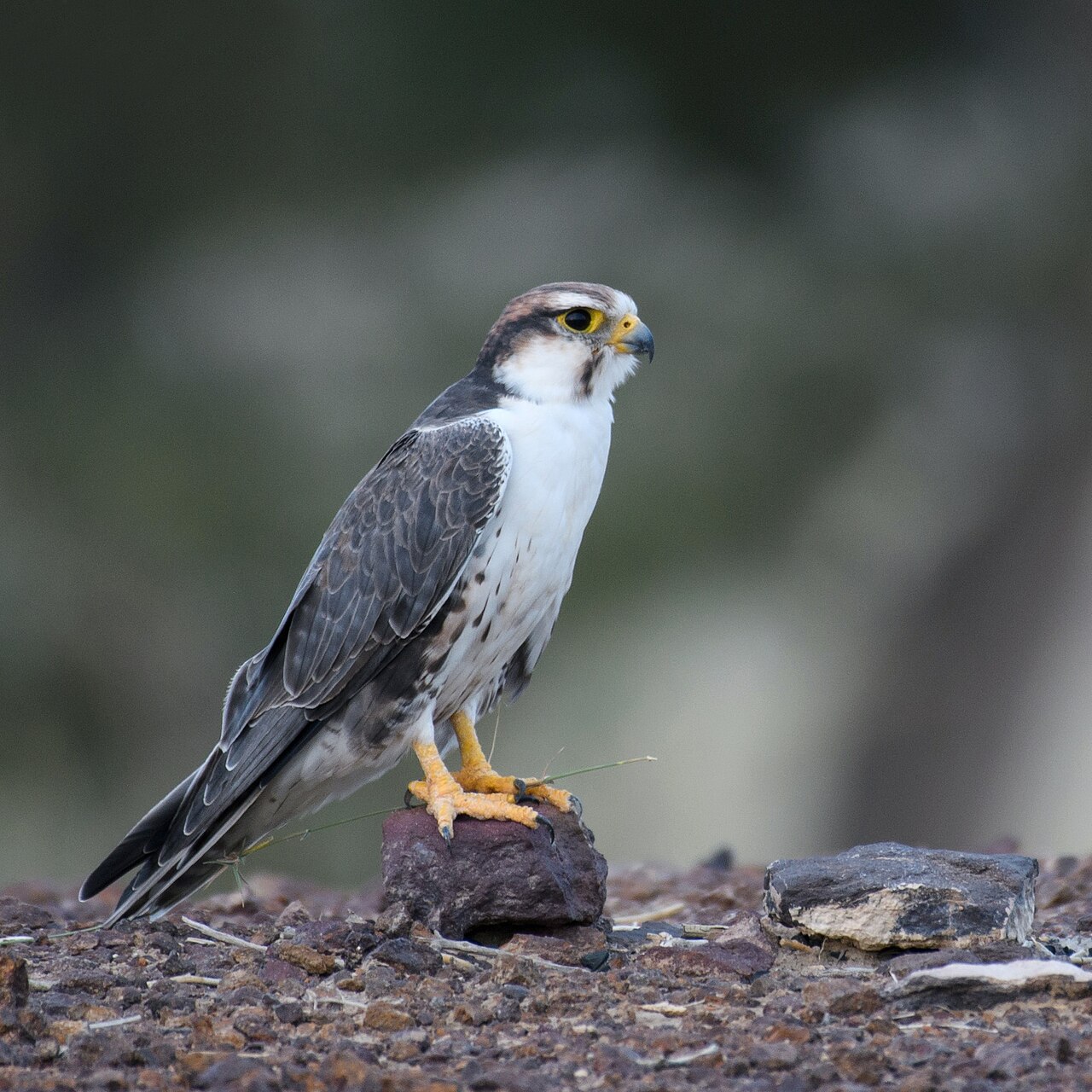
Classic plumage of an adult laggar falcon, with very plain whitish underparts, thin dark contrasting moustachial stripe, slight reddish head and bluish-gray upperparts. Bare parts darker yellow.

Laggar falcon pair. The darker-headed one on the left is an adult male and the paler-headed one is an adult female. Such variations are not unusual.
Temperament
solitary and territorial
Flight Pattern
strong flier with rapid wingbeats interspersed with short glides
Social Behavior
Typically seen alone or in pairs, especially during the breeding season. Monogamous pairs nest on cliffs, pylons, or in old stick nests of other birds, laying 3–4 eggs. Adults defend nesting territories vigorously and often reuse sites. Juveniles disperse widely after fledging.
Migratory Pattern
Resident
Song Description
Generally quiet away from the nest, but becomes vocal near breeding sites. Calls include harsh kek-kek-kek notes and sharp chattering alarms. Vocalizations are most frequent during pair bonding and territorial disputes.
Plumage
Sooty to dark brown upperparts with paler fringes and buffy, streaked underparts. Head often darker with a pale throat and weak moustachial stripe; juveniles appear more uniformly dark. Flight feathers are darker, contrasting with paler underwing coverts. Tail brown with faint barring.
Diet
Takes small to medium-sized birds, rodents, lizards, and large insects. Hunts from exposed perches or by low, fast contour flight over open ground. Capable of quick aerial pursuits and stoops when targeting birds. Will also forage around agricultural fields where prey concentrations are high.
Preferred Environment
Open, semi-arid habitats with scattered trees or poles for perching. Frequently uses field edges, scrub, and rocky areas, as well as human-made structures such as pylons and towers. Often hunts along ecotones where prey is more visible.


