
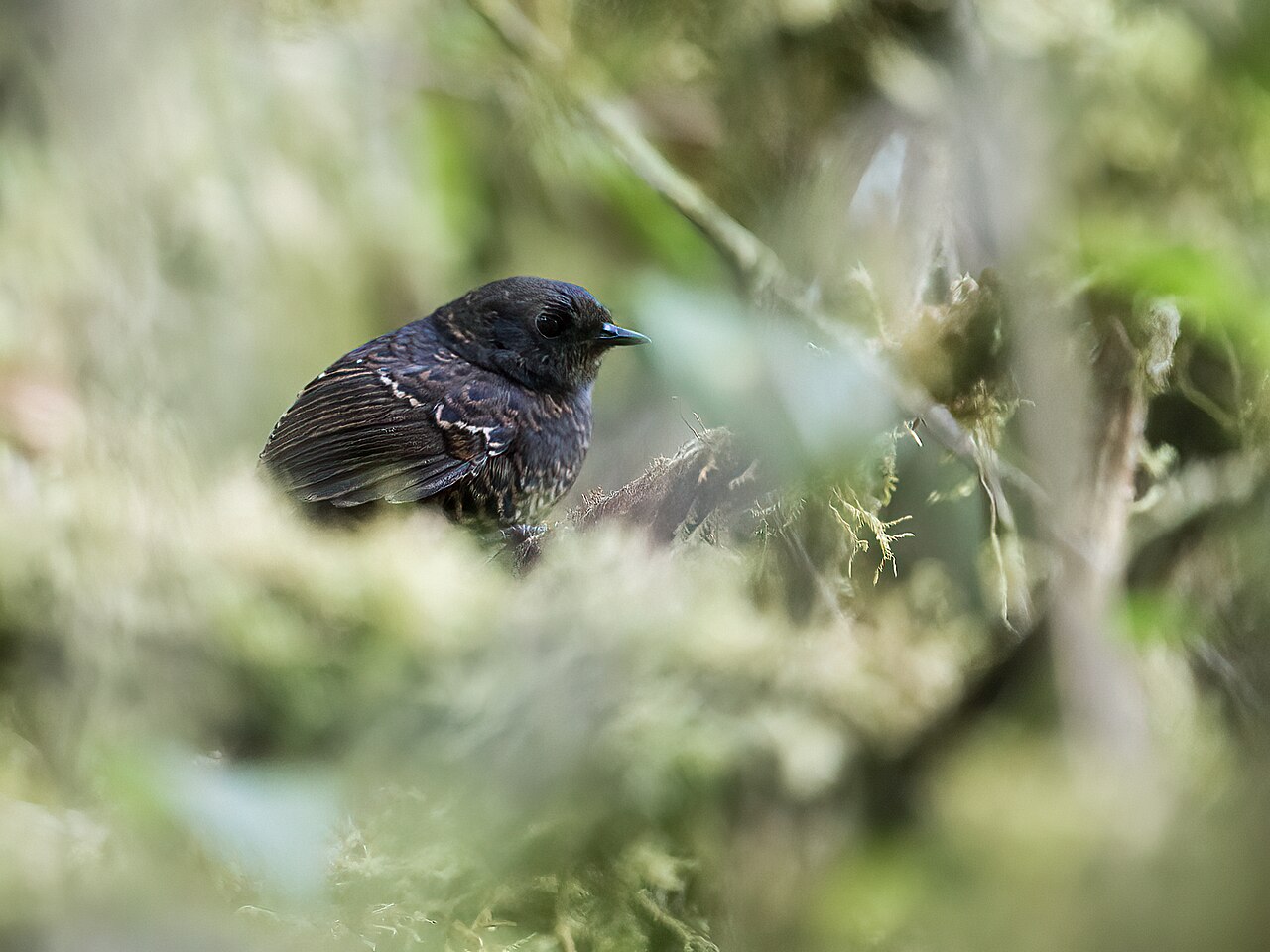
The Junin tapaculo is a Scytalopus tapaculo from Peru. It was discovered in 2008 and described as new species in 2013. It differs from other Scytalopus species by its song which consisting of a rapidly repeated series of ascending phrases. The species' epithet commemorates Caroline Marie Getty, a granddaughter of J. Paul Getty and nature conservationist, who works for the National Fish and Wildlife Foundation (NFWF).
Region
Andes Mountains
Typical Environment
Occurs in upper montane cloud forest and elfin forest with dense understory, especially in thickets of Chusquea bamboo and mossy tangles. It favors steep slopes, ravines, and forest edges where leaf litter accumulates. The species is a close-to-the-ground skulker, moving through dense cover and rarely venturing into open areas. Within its small range in central Peru, it is patchily distributed but can be locally common where habitat is intact.
Altitude Range
3000–3800 m
Climate Zone
Highland
Ease of Keeping
Beginner friendly: 1/5
The Junin tapaculo is a secretive ground-dwelling bird of the central Peruvian Andes, described as new to science in 2013 after discovery in 2008. Its diagnostic song is a rapidly repeated series of ascending phrases that distinguishes it from similar Scytalopus. The species epithet honors conservationist Caroline Marie Getty.


Temperament
solitary and territorial
Flight Pattern
short rapid wingbeats; usually hops and runs through cover
Social Behavior
Typically encountered alone or in pairs, maintaining small territories in dense understory. Nests are placed close to or on the ground in hidden cavities or dense vegetation. Courtship and territory defense rely heavily on vocalizations, with males singing from concealed perches.
Migratory Pattern
Resident
Song Description
A fast, repetitive series of clear notes that rises in pitch, delivered in long sequences. Calls include sharp chips and trills used for contact and alarm, often heard more than the bird is seen.
Plumage
Mostly slaty to dark gray above and below with contrasting warm brown rump and tail; flanks show fine rufous-brown barring. Plumage is matte and uniform, lacking wingbars or bold patches, with a slightly paler throat in some individuals.
Diet
Primarily small arthropods including insects and spiders gleaned from leaf litter and low vegetation. It probes and picks in tangles, moss, and bamboo stems, often methodically working along the ground. Occasional small larvae and other invertebrates are also taken.
Preferred Environment
Feeds in dense bamboo and mossy understory of cloud forest and along shaded ravines. It favors areas with deep leaf litter and abundant cover that provide both prey and protection.


