

The kagu or cagou is a crested, long-legged, and bluish-grey bird endemic to the dense mountain forests of New Caledonia. It is the only surviving member of the genus Rhynochetos and the family Rhynochetidae, although a second species has been described from the fossil record.
Region
Southwest Pacific (New Caledonia)
Typical Environment
Occurs on the main island of Grande Terre, primarily in moist evergreen and montane forests with dense understory. It also uses gallery forest along streams and, locally, maquis shrublands on ultramafic soils. The species is largely terrestrial, foraging on the forest floor and favoring areas with deep leaf litter and logs. It avoids highly fragmented or heavily disturbed habitats, persisting best inside protected areas with predator control.
Altitude Range
Sea level to 1400 m
Climate Zone
Tropical
Ease of Keeping
Beginner friendly: 1/5
The kagu is a near-flightless, crested bird found only on New Caledonia and represents its own unique family, Rhynochetidae. It has powder-down feathers that help maintain its soft, bluish-grey plumage. Pairs perform loud dawn duets and show striking black-and-white wing bars during displays. It is a cultural emblem of New Caledonia and a focus of intensive predator-control conservation.


Wood engraving of a pair, by F. J. Gauchard
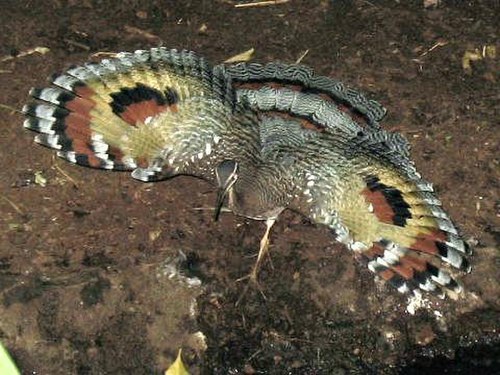
The sunbittern, a possible closest relative from Central and South America

The kagu possesses 'nasal corns', structures covering its nostrils, which are a feature not shared by any other bird. This bird is a juvenile, lacking the brightly coloured bill of the adult.

Rhynochetos jubatus egg, Muséum de Toulouse

The current population of wild kagus is about 250–1000 birds, and the species is the focus of a decades-long conservation effort.
Temperament
shy and territorial
Flight Pattern
reluctant flier; short fluttering glides and wing-assisted leaps
Social Behavior
Typically forms long-term monogamous pairs that defend territories year-round. Nests on the ground, usually laying a single egg; both adults share incubation and chick care. Territorial pairs perform coordinated displays and duets at dawn.
Migratory Pattern
Resident
Song Description
A loud, far-carrying, yapping series often given as a duet by pairs at first light. Calls can sound barking or wailing, used to advertise territory and maintain pair bonds.
Plumage
Soft, powdery bluish-grey plumage with subtle pale barring; long, shaggy crest on the head. Bold black-and-white barring on the wings becomes conspicuous when spread in display.
Diet
Primarily takes invertebrates such as earthworms, snails, insects, and spiders, often captured by probing and gleaning in leaf litter. It may also take small vertebrates like lizards when available. Foraging is methodical and quiet, with pauses to listen and watch for movement. Activity often increases after rain when soil invertebrates are abundant.
Preferred Environment
Feeds on the forest floor in dense, humid understory, especially along streams and in shaded leaf litter. Frequently works around fallen logs, root tangles, and soft soils where prey is easiest to extract.


