

The Indian white-eye, formerly the Oriental white-eye, is a small species of passerine bird in the white-eye family. It is a resident breeder in open woodland on the Indian subcontinent. They forage in small groups, feeding on nectar and small insects. They are easily identified by the distinctive white eye-ring and overall yellowish upperparts. The range previously extended eastwards to Southeast Asia, Indonesia and Malaysia. Their name was recently changed due to previous members of Zosterops palpebrosus in Southeast Asia being renamed to a new species, making the Indian White-eye a more geographically accurate term for this species.
Region
South Asia
Typical Environment
Occurs widely across the Indian subcontinent in open woodlands, scrub, orchards, plantations, and urban gardens. It favors edges, secondary growth, and areas with abundant flowering shrubs and trees, often avoiding dense interior forest and arid open deserts. Common in villages and city parks where nectar and small insects are plentiful. Frequently forms small flocks and moves nimbly through foliage from canopy to midstory.
Altitude Range
0–2600 m
Climate Zone
Tropical
Ease of Keeping
Beginner friendly: 2/5
The Indian white-eye (formerly known as the Oriental white-eye) is a tiny, highly social songbird recognized by its crisp white eye-ring. Recent taxonomic splits restricted this species to the Indian subcontinent, prompting the more accurate common name. It frequently visits flowering trees and shrubs for nectar and helps pollinate many garden and forest plants, though it may also pierce flower bases to access nectar. Pairs build neat cup nests and often join mixed-species foraging flocks.

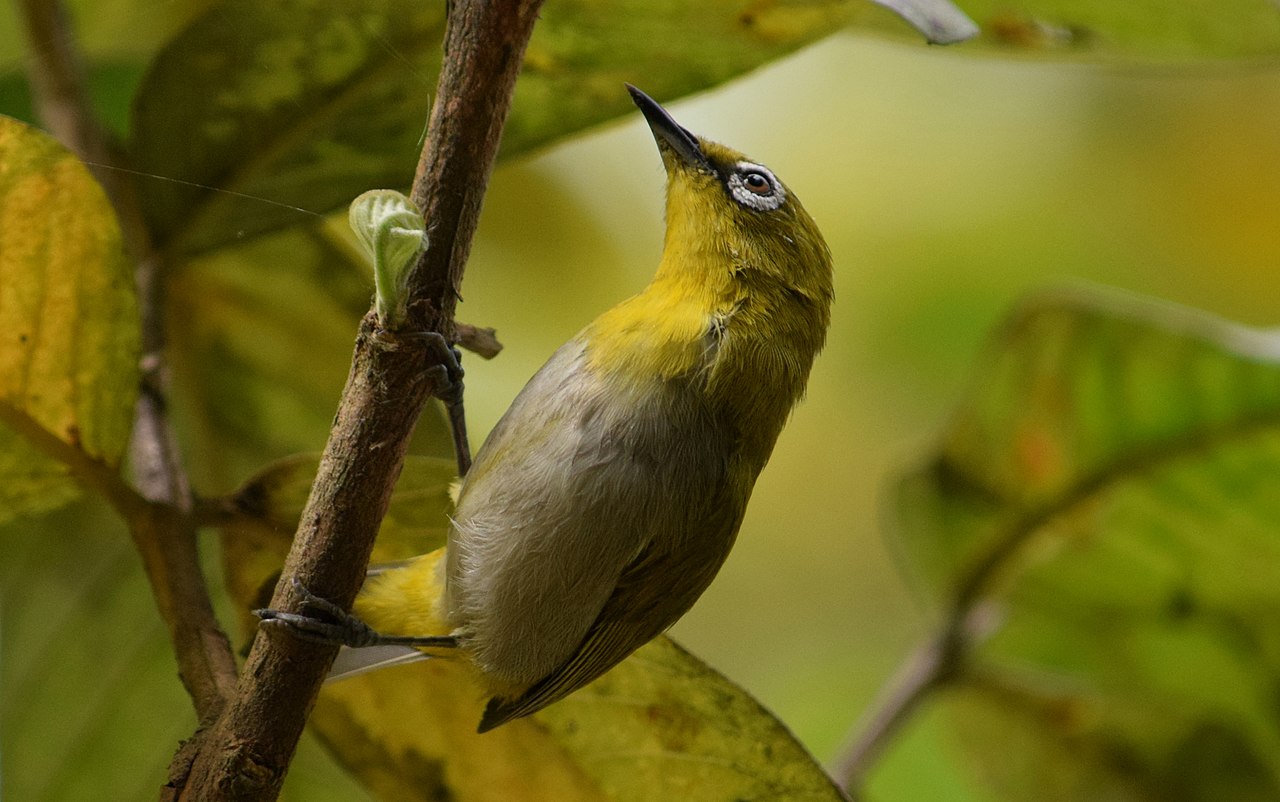
Indian white-eye in Kolkata outskirts

Indian white-eye nest in Bangalore, India


Temperament
social and active
Flight Pattern
short rapid wingbeats
Social Behavior
Usually travels in small, chattering groups and readily joins mixed-species flocks. Pairs are monogamous during the breeding season and build small cup nests suspended in shrubs or trees. Both sexes participate in nest construction and care of the young.
Migratory Pattern
Resident
Song Description
Song is a lively series of high-pitched warbles and trills, delivered in quick, tinkling phrases. Contact calls are thin, sibilant tsee or tzip notes repeated as birds move through foliage.
Plumage
Olive-green upperparts with a bright yellow forehead and throat, whitish belly with yellow vent, and a neat, complete white eye-ring. Plumage is smooth and uniform with slight grayish tones on the underparts.
Diet
Takes nectar from a variety of flowers, also consuming soft fruits and berries. Gleans small insects, caterpillars, and spiders from leaves and twigs, occasionally sallying short distances to snatch prey. Its nectar feeding can aid pollination, though it may sometimes pierce flowers to access nectar directly.
Preferred Environment
Feeds in flowering trees and shrubs along forest edges, gardens, orchards, and plantations. Often forages in the outer foliage and canopy layers, moving quickly in small groups.


