
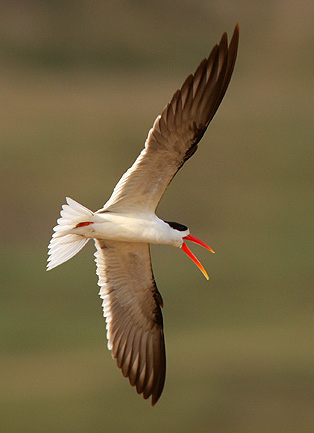
The Indian skimmer or Indian scissors-bill is one of the three species that belong to the skimmer genus Rynchops in the family Laridae. They are somewhat tern-like but like other skimmers, have a short upper mandible and the longer lower mandible that is ploughed along the surface of water as the bird flies over the water to pick aquatic prey. It is found in southern Asia, where it is patchily distributed and declining in numbers. They are mainly found in rivers or estuaries. They are very brightly marked in black, white and orange, making them difficult to miss.
Region
South Asia
Typical Environment
Patchily distributed along large lowland rivers with broad sandbars in northern and peninsular India, and locally in Pakistan, Bangladesh, and Myanmar. Breeding occurs on exposed mid-channel sandbanks of major rivers such as the Chambal, Ganges, Mahanadi, and Godavari. Outside the breeding season it frequents estuaries, coastal lagoons, and tidal creeks, especially on the east and west coasts of India. It prefers wide, slow-flowing channels with minimal wave action and undisturbed nesting sites. Human disturbance and altered flow regimes strongly influence site occupancy.
Altitude Range
Sea level to 300 m
Climate Zone
Tropical
Ease of Keeping
Beginner friendly: 1/5
The Indian skimmer hunts by flying low over calm water with its elongated lower mandible slicing the surface to snatch small fish—one of the most specialized feeding methods among birds. It nests on exposed river sandbars in loose colonies, often alongside terns and pratincoles. Rapid river regulation, sand mining, and human disturbance have driven significant declines, making it a flagship species for free-flowing river conservation.


The bill is thin and knife-like to reduce resistance to water

An Indian skimmer seen skimming for food in the River Chambal near Dholpur, Rajasthan.

A 1713 illustration in John Rays Synopsis methodica avium & piscium with a description of the "Madrass Sea Crow" by Edward Buckley

Egg colouration
Temperament
social and active
Flight Pattern
buoyant low flight with steady, shallow wingbeats; often skims just above the water surface
Social Behavior
Breeds colonially on bare sandbars, often in association with river terns. Nests are simple scrapes with 2–3 eggs, and both parents incubate and feed the young. Outside breeding, birds roost communally on sandbanks and move locally to track suitable water levels.
Migratory Pattern
Partial migrant
Song Description
Vocalizations are sharp, nasal yaps and kek-kek calls, especially during flight and colony activity. Alarm calls are harsher and more repeated when disturbed at nests.
Plumage
Sharp contrast of black upperparts and cap with clean white forehead, collar, and underparts; wings show a striking white trailing edge in flight.
Diet
Primarily small fish captured by skimming the lower mandible through the surface film, snapping shut when contact is made. Also takes aquatic insects and small crustaceans opportunistically. Prefers clear, smooth water where contact detection is most efficient.
Preferred Environment
Feeds along the edges of broad river channels, backwaters, and calm estuarine creeks. Often works parallel to sandbars where prey concentrates in shallow slicks and eddies.


