

The Hawaiian rail, Hawaiian spotted rail, or Hawaiian crake is an extinct species of diminutive rail that lived on Big Island of Hawaiʻi.
Region
Hawaiian Islands
Typical Environment
Formerly restricted to the Big Island of Hawaiʻi, it occupied dense grasslands, sedge beds, and shrubby edges of wetlands and seasonal marshes. It foraged along the margins of wet meadows and in thick ground cover, where it could remain concealed. The species likely used natural openings in ohia–metrosideros-dominated habitats and lowland grasslands influenced by early agriculture. As with many island rails, it showed a preference for areas with dense understory that provided both food and protection from predators.
Altitude Range
Sea level to 1800 m
Climate Zone
Tropical
Ease of Keeping
Beginner friendly: 1/5
Also called the Hawaiian spotted rail or Hawaiian crake, this diminutive rail was endemic to the Island of Hawaiʻi and is now extinct. It was a secretive ground-dweller that likely suffered rapid declines from habitat alteration and introduced predators following human settlement. Historical accounts suggest it could fly short distances but preferred to run through dense cover. Little is known from life; most details come from a handful of specimens and early observers.


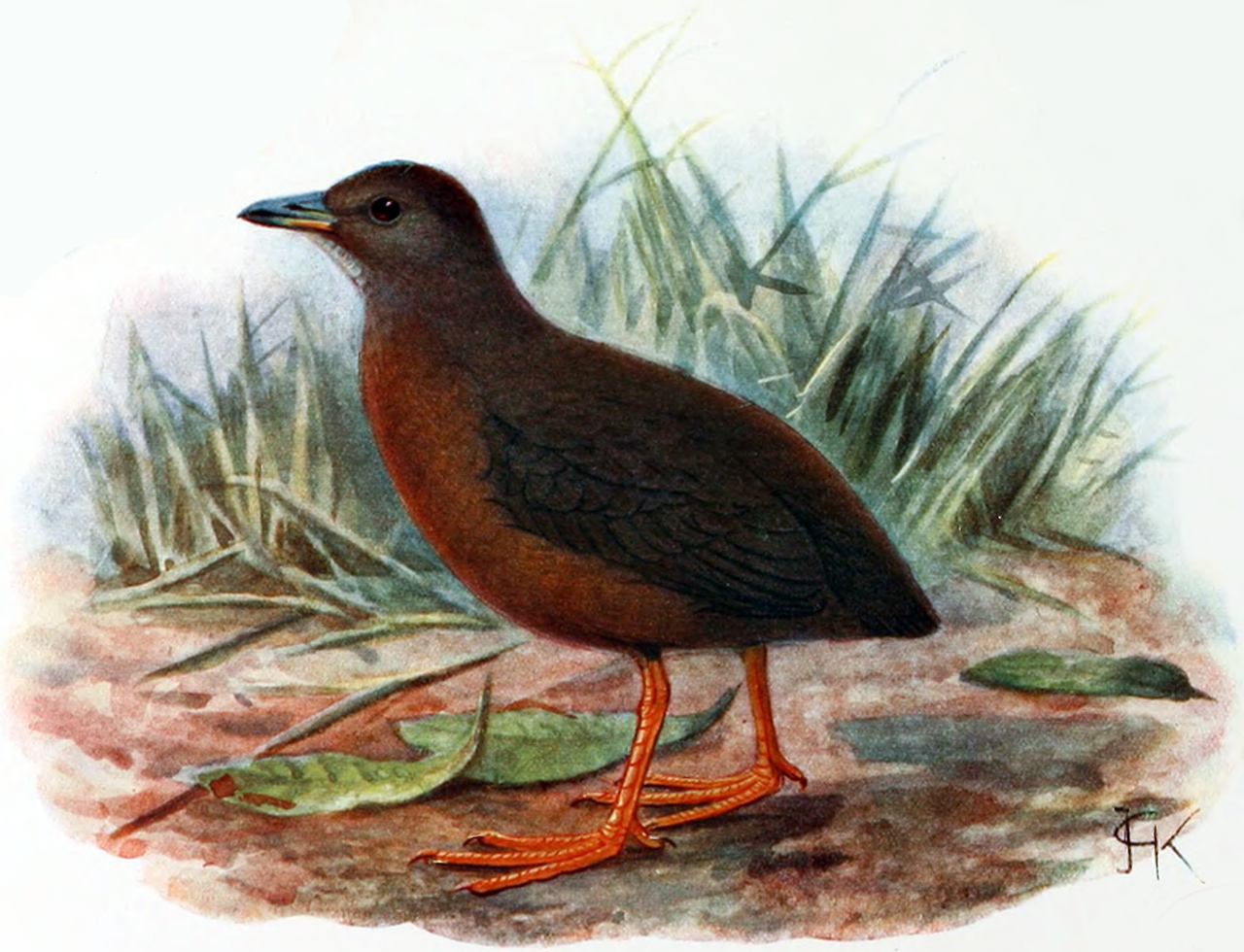
Dark individual

Specimen painted by William Ellis while accompanying Captain James Cook on his third voyage (1776–78)
Temperament
secretive and skulking
Flight Pattern
short rapid wingbeats; reluctant flier
Social Behavior
Typically encountered singly or in pairs, especially during the breeding season. Likely monogamous, nesting on the ground in dense vegetation with a small clutch typical of rails. Chicks were precocial and followed adults through cover shortly after hatching.
Migratory Pattern
Resident
Song Description
Vocalizations were described as soft, repetitive peeps and thin squeaks, with occasional harsher scolds when alarmed. Calls carried poorly, suited to close-range communication within dense vegetation.
Plumage
Compact rail with finely spotted and barred plumage; upperparts mottled with white spotting on brown, and flanks barred. Underparts buff to brownish with pale spotting and streaking. Short tail often held slightly cocked; feathers dense and soft for moving through cover.
Diet
An opportunistic omnivore feeding on insects, spiders, small snails, and other invertebrates taken from leaf litter and wet margins. It also consumed seeds and fallen berries when available. Foraging behavior involved probing and gleaning while moving quietly through thick grass and sedges.
Preferred Environment
Fed along the edges of wetlands, damp meadows, and dense grasslands where cover was abundant. It also exploited lightly disturbed areas and natural openings with ample leaf litter and invertebrate activity.


