

The hairy woodpecker is a medium-sized woodpecker that is found over a large area of North America. It is approximately 250 mm (9.8 in) in length with a 380 mm (15 in) wingspan. With an estimated population in 2020 of almost nine million individuals, the hairy woodpecker is listed by the IUCN as a species of least concern. Some nomenclature authorities, such as the eBird/Clements checklist, place this species in the genus Dryobates.
Region
North America
Typical Environment
Occurs across most of the United States and Canada, extending into parts of Mexico and Central America in montane forests. It inhabits mature deciduous, mixed, and coniferous forests, woodland edges, and riparian corridors. The species readily uses burned forests and areas with abundant dead snags for foraging and nesting. It also adapts to parks, large suburban woodlots, and orchards where suitable trees persist.
Altitude Range
Sea level to 3000 m
Climate Zone
Temperate
Ease of Keeping
Beginner friendly: 1/5
The hairy woodpecker is a widespread North American woodpecker that closely resembles the smaller downy woodpecker but has a much longer, sturdier bill. It drums loudly on resonant trunks to communicate and excavates nest cavities in dead or decaying wood. By feeding heavily on wood-boring beetle larvae and other insects, it helps control forest pests.


Costa Rican hairy woodpecker (L. v. extimus)

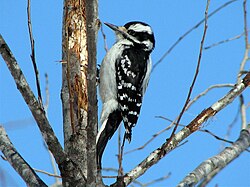
Female of the Great Basin race, orius, which has less white on the wings than eastern races and has cream-colored underparts

Male



Temperament
solitary and territorial
Flight Pattern
undulating flight with short rapid wingbeats
Social Behavior
Usually seen alone or in pairs, maintaining year-round territories. Pairs excavate nest cavities in dead or decaying trees and both sexes incubate and feed the young. Outside the breeding season, it may join mixed-species foraging flocks in woodlands.
Migratory Pattern
Resident
Song Description
Produces sharp, metallic peek calls and a descending rattle. The primary display is a rapid, resonant drumroll on hollow wood, often repeated from exposed perches.
Plumage
Boldly black-and-white with a clean white underside, a solid white patch down the back, and checkered black-and-white wings.
Diet
Feeds mainly on wood-boring beetle larvae, bark beetles, ants, and other insects obtained by probing, flaking bark, and excavating. It also takes spiders and occasionally consumes seeds, nuts, fruits, and suet at feeders. In some areas it visits sap wells made by sapsuckers to glean insects and sip sap.
Preferred Environment
Forages on trunks and large branches of mature trees and snags, as well as on fallen logs. Frequently uses recently dead or burned trees where insect larvae are abundant, and will visit backyard feeders with suet in wooded neighborhoods.


