

The gyrfalcon, also abbreviated as gyr, is a bird of prey in the genus Falco and the largest species of the family Falconidae. A high-latitude species, the gyrfalcon breeds on the Arctic coasts and tundra, the islands of northern North America and Siberia, where it is mainly a resident species. Some gyrfalcons disperse more widely after the breeding season or in winter, and individual vagrancy can take birds for long distances. Its plumage varies with location, with birds being coloured from all-white to dark brown. These colour variations are called morphs. Like other falcons, it shows sexual dimorphism, with the female much larger than the male.
Region
Arctic and Subarctic circumpolar
Typical Environment
Breeds across Arctic coasts and tundra from Greenland and Iceland through northern Canada and Alaska to Siberia. Prefers sea cliffs, inland escarpments, and rocky outcrops for nesting, often near open tundra rich in ptarmigan. In winter, many remain in the High Arctic while others disperse south into boreal zones, coastal fjords, and offshore islands. May also forage over sea ice edges and along river valleys. Occasional vagrants appear far south of the breeding range in winter.
Altitude Range
Sea level to 2000 m
Climate Zone
Polar
Ease of Keeping
Beginner friendly: 1/5
The gyrfalcon is the largest falcon in the world and a prized species in traditional falconry, especially the striking white morph from Greenland and Iceland. It shows wide plumage variation from pure white to dark chocolate-brown. Unlike peregrines, gyrfalcons often pursue prey in powerful, sustained chases close to the ground rather than steep stoops. They primarily hunt ptarmigan and other Arctic birds across vast tundra landscapes.


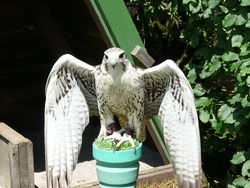


Hybrid white gyrfalcon × saker

Adult F. r. islandus at Dimmuborgir near Lake Mývatn (Iceland)

Gyrfalcon in flight (Hastings, MN)


A tamed gyrfalcon striking a wild grey heron (1920), Louis Agassiz Fuertes
Temperament
solitary and territorial
Flight Pattern
powerful flier with long, direct flights and short rapid wingbeats
Social Behavior
Typically forms long-term monogamous pairs that defend large territories. Nests on cliffs or occasionally on human structures or old raptor nests, often reusing traditional eyries. Clutches usually contain 2–4 eggs, and both adults provision the young. Breeding timing tracks prey availability, especially ptarmigan cycles.
Migratory Pattern
Partial migrant
Song Description
Vocalizations are harsh, rapid kak-kak-kak alarm calls near the nest and chattering scolds when agitated. Generally quiet away from breeding sites with softer contact notes between mates.
Plumage
Highly variable morphs from all-white through silver-gray to dark brown; typically heavily barred or speckled on the back and flanks with paler underparts. Stocky, broad-chested falcon with long, pointed wings and a relatively long tail.
Diet
Specializes on medium-sized birds, especially ptarmigan and grouse, but also takes waterfowl, seabirds, and shorebirds. Will opportunistically capture small mammals such as lemmings and hares. Hunts by high-speed pursuit at low altitude, ambush from terrain features, or surprise attacks along ridgelines. Often caches surplus prey in cold conditions.
Preferred Environment
Hunts over open tundra, coastal cliffs, and along fjords where prey is abundant and visibility is high. Uses rocky outcrops, cliffs, or human structures as vantage points. In winter may forage along sea-ice leads and coastal polynyas.


